REVIEW · MADRID
Madrid: Traditional Tour wh Private guide in yellow Tuk Tuk
Book on GetYourGuide →Operated by Yellow TU TUK TUK · Bookable on GetYourGuide
Madrid in one hour is a tall order. This tour nails the main sights with tuk-tuk convenience and clear human-scale storytelling. I especially like how the route hits the Royal Palace area and then slides into literary Madrid in Las Letras, so you get old power and everyday culture side by side. The one catch: it’s a tight circuit with lots of photo stops, so you won’t get long, inside museum time.
You also start right where most people want to orient themselves: Plaza Isabel II, then roll out to Opera and the royal complex. If you book with a private group (up to four), you get a guide who can pace the stops to your questions, and you’ll have an audio guide in English, Spanish, and French as backup.
In This Review
- Key highlights you’ll actually feel
- Why a yellow tuk tuk tour works so well in Madrid
- Opera Square to the Royal Palace: the power-center in fast motion
- Almudena Cathedral: architecture that makes the tour feel bigger than a checklist
- Las Letras with Quevedo and Cervantes: where Madrid becomes personal
- Parliament, Cibeles, and Neptune: symbols that map the city’s identity
- Los Jerónimos, the Prado, and Retiro Park: the classic trio on a tight schedule
- Alcalá Gate, Salamanca, Plaza Colón, and Metrópolis: Madrid’s broad avenues feel different
- Price and value for a one-hour private loop
- How to get more out of the guide (even if you speak only one language)
- Who this tour suits best
- Should you book this Madrid tuk tuk tour?
- FAQ
- How long is the Madrid yellow tuk tuk tour?
- What’s the price and group size?
- Where do I meet the guide?
- What transportation is used?
- Is this a private tour?
- What languages are available for the live guide?
- Is there an audio guide?
- Are museum tickets included?
- Is food or drinks included?
- Is the tour wheelchair accessible?
Key highlights you’ll actually feel

- Yellow tuk tuk electric ride: easy sightseeing without walking yourself into a blisters situation
- Royal Palace + Almudena Cathedral: the classic Madrid combo, framed with architecture context
- Las Letras stop with Quevedo and Cervantes context: literature culture explained on the street
- City-symbols loop: Cibeles, Neptune, and the big avenues give you a sense of Madrid’s layout
- Prado + Retiro without museum-ticket pressure: see key landmarks even if you skip interiors
Why a yellow tuk tuk tour works so well in Madrid
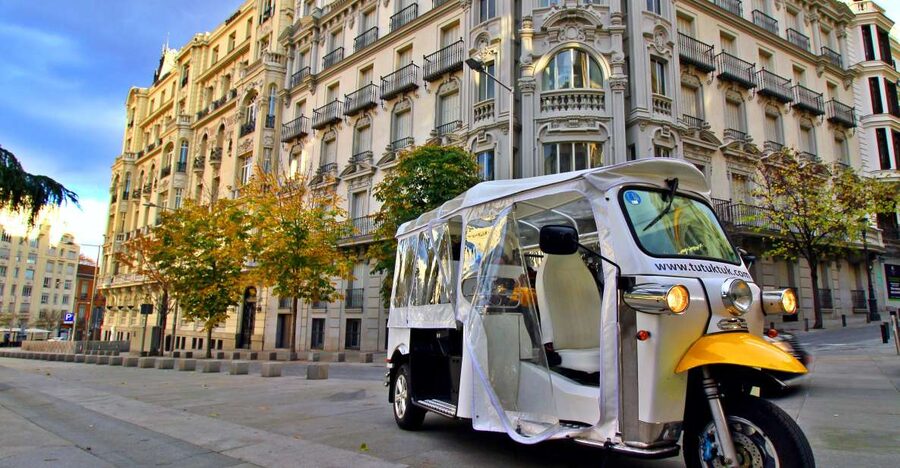
Madrid is huge, and the best stuff is spread out. This is why I like tuk tuk style for a short visit: you get moving time without turning the day into a long slog. The vehicle setup is built for quick changes in scenery, and the whole vibe feels practical—hop, look, learn, and roll on.
You’ll be in a private group up to four, which is important. In one hour, that means your guide can answer follow-up questions instead of treating you like a camera in a crowd. I also like that it’s wheelchair accessible, so the tour is designed to be doable for more people than the usual jammed walking loop.
The meeting point is easy to find: right in front of Starbucks Café across from Plaza Isabel II, with yellow or white tuk tuks. That matters because Madrid’s center can be confusing when you’re arriving with jet lag and a map app that’s lying to you.
You can also read our reviews of more tours and experiences in Madrid.



Opera Square to the Royal Palace: the power-center in fast motion
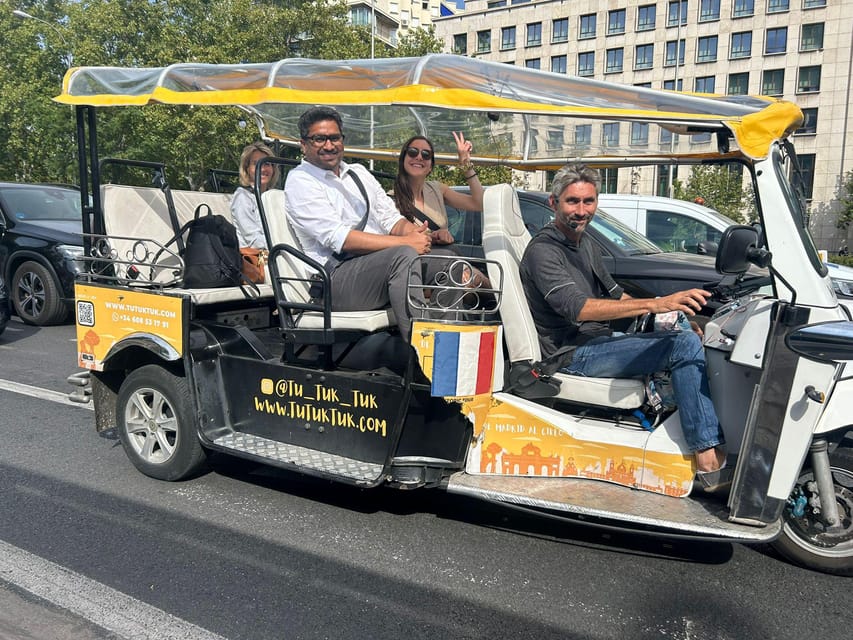
Your sightseeing begins at Plaza Isabel II, then you head toward Opera Square for an early photo stop. Even before you reach the palace, this stretch helps you understand Madrid’s rhythm: wide avenues, major institutions, and those straight lines that make the city feel planned.
At the Royal Palace of Madrid area, you’ll get a photo stop plus a guided look. Even if you don’t go inside, the palace exterior gives you immediate scale. You’re looking at Madrid’s “this is the center of authority” moment, and it’s the kind of stop that’s worth doing early—because later in the day you’ll be too deep in the tour to appreciate how commanding the setting is.
One more smart angle here: your guide can point out what you’re seeing in plain terms. A review mentioned how David delivered history clearly, and that matches what you want at this stop—less guessing, more understanding why this place matters in the story of Spain.
Almudena Cathedral: architecture that makes the tour feel bigger than a checklist

Next up is Almudena Cathedral, with photo stop, guided tour, and a bit of walking. This stop is great because it changes the energy from palace grandeur to religious architecture and urban presence. The cathedral area helps you connect the palace complex with the city’s civic feel.
What I like about this part is how the guide can explain the building as more than a pretty facade. When someone points out architectural choices and context, you start noticing details you’d normally skip. The result is that you don’t just collect photos—you get a better mental picture of Madrid’s layout and style.
Also, if you’re the type who worries about walking time, keep in mind this is still a short, structured walk. It’s not a hike; it’s a controlled chance to see the cathedral in a way that feels closer than a one-second street snapshot.
Las Letras with Quevedo and Cervantes: where Madrid becomes personal
Then the tour shifts into the neighborhood vibe with Barrio de Las Letras, with a photo stop and guided walkthrough. This is where the city starts to feel more human and less ceremonial. The area is tied to the Literary Quarter of Madrid, with major mentions like Cervantes and Quevedo, so you’re not just passing buildings—you’re getting story context.
This is also where I think the tour does something subtle but valuable. It gives you a contrast to the royal sites. You go from power and architecture to literature and daily street life, which makes Madrid feel like a living place instead of a museum corridor.
You’ll also stop around Mercado de San Miguel, which adds a food-market heartbeat to the route. You won’t be ordering a full meal on a one-hour circuit, but the market stop helps you see how Madrid’s center works in real time—people, commerce, and local routines.
Parliament, Cibeles, and Neptune: symbols that map the city’s identity
After Las Letras, you head into the middle stretch where Madrid’s “big symbol” points come together. You’ll pass the Parliament area and keep rolling to the Plaza de Cibeles region for photo stop and guided context. This is one of those moments where your guide’s job is mainly to help you read the city like a chart: landmarks tell you where you are in Madrid’s story.
The tour includes the Fountain of Neptune too. Even with limited time, these stops matter because they anchor the look of central Madrid. You start to recognize the city from its icons, not just from its buildings.
One note on pace: because it’s an hour-long loop, you’ll see these as key photo-and-context moments rather than linger-for-a-long-session stops. If you’re the type who loves studying fountains and statues for 30 minutes, you’ll feel the time pressure here. But if you’re aiming to get your bearings fast, this is exactly the right style.





Los Jerónimos, the Prado, and Retiro Park: the classic trio on a tight schedule
Next comes a sequence that most first-timers love: San Jerónimo el Real (Los Jerónimos), Museo del Prado, and Retiro Park. You’ll get photo stops, guided explanations, and in some places short walking segments.
Here’s the smart part: this tour lets you connect the dots between Madrid’s religious architecture, major art, and green-space culture without requiring you to buy museum tickets. The Prado stop is included, but tickets for museums aren’t. That means you’ll likely focus on exterior views and orientation rather than a full gallery plan.
At the Prado and Retiro stops, your guide can still make it worth it. If you can learn what to notice—collection themes, why the location matters, how Retiro functions as a social space—you’ll leave with a much better sense of what you might want to do on a future day with more time.
Retiro Park is often the “ah yes, I get it now” moment. Even in a short visit, it shifts Madrid from stone-and-power to breathing room. That contrast is part of why the city feels livable, not just impressive.
Alcalá Gate, Salamanca, Plaza Colón, and Metrópolis: Madrid’s broad avenues feel different
After Retiro, you move to the open-avenue side of Madrid: Alcalá Gate and Puerta de Alcalá make the transition feel real, like you’re moving between eras and neighborhoods. You’ll have a photo stop and guided context, plus some walking time.
Then you roll into the Barrio de Salamanca area for a stop that includes shopping as an option. Salamanca is a different vibe than the older center. Even if you don’t shop, the stop helps you see how Madrid changes as you move away from the royal and literary zones.
You’ll also pass Plaza de Colón, then see the emblematic Metrópolis building. This is a useful segment because it teaches you how Madrid balances classic monuments with modern-looking city identity. When your guide ties these places to what’s happening historically and culturally, you start noticing patterns in the streets: where the city concentrates prestige, where it keeps momentum, where it draws the eye.
Finally, you reach Plaza de Santa Ana for photo stop, guided context, and walking. It’s a fitting ending point because it feels like a place where Madrid people would rather linger than rush through. Even on a fast tour, this stop gives you a gentle landing.
Price and value for a one-hour private loop
This costs $105 per group for up to four, for about one hour. That pricing can look simple, but here’s the real value math: you’re paying for a live guide plus transportation in a private setup, not just a route.
What you get that’s hard to replicate on your own in limited time:
- Local guidance on key buildings (Royal Palace and Almudena Cathedral are worth understanding, not just photographing)
- A route that strings together central Madrid so you learn how the neighborhoods connect
- A format designed for short stays (you’re not stuck trying to plan museum timing)
- Audio guide support in English, Spanish, and French
What you should plan for on the downside:
- Museum tickets aren’t included, so if you want full Prado time, you’ll need a separate plan.
- Drinks and food aren’t included, so you may want to pair this with a meal stop outside the tour window.
If you’re a solo traveler, the private group cost can still be a good deal if you’re traveling with two or three people. If you’re a couple, this is often a way to buy time and clarity without a complicated itinerary.
How to get more out of the guide (even if you speak only one language)
The live guide is available in Spanish, English, and French, and the audio guide covers those same languages too. That means you can focus on the sights while still catching details—especially helpful if you’re juggling the language of street signs and explanations at the same time.
One thing I really like about tours like this is the chance to ask for meaning, not just facts. At places like the Royal Palace and Almudena Cathedral, ask what details you should notice to read the architecture. In Las Letras, ask how writers like Cervantes and Quevedo fit into the neighborhood’s identity. And around the fountain and plaza landmarks, ask what the symbolism is meant to communicate.
If you get a guide like David, based on a past guest experience, you’ll probably appreciate the clear, friendly storytelling style—history explained in a way that makes the streets feel readable.
Who this tour suits best
This is a great fit if:
- You have limited time in Madrid and want the main sights in a single morning/afternoon slot
- You’d rather get orientation fast than build a complex self-guided route
- You want a private setting where you can ask questions
- You’re okay with photo stops and short walking segments instead of long museum stays
It may not be ideal if:
- You want deep interior time at major museums like the Prado
- You prefer slow, unhurried neighborhood wandering without a schedule
- You want a heavy focus on food and shopping as the main event (you’ll have stops, but it’s not built as a full market or retail tour)
Should you book this Madrid tuk tuk tour?
If your goal is to get your bearings fast and understand what you’re seeing—especially around the royal sites, Almudena Cathedral, and Las Letras—this is a smart choice. The one-hour format forces efficiency, and the private guide format keeps it personal.
I’d book it when you’re planning to come back later for longer museum or neighborhood time. You’ll use this tour like your Madrid roadmap: you’ll know what to return to, what to skip, and what you’d like to explore without guessing.
FAQ
How long is the Madrid yellow tuk tuk tour?
It runs for 1 hour.
What’s the price and group size?
It’s $105 per group for up to 4 people.
Where do I meet the guide?
Meet at Plaza Isabel II, in front of Starbucks Café (across from it). Tuktuks are yellow or white.
What transportation is used?
You travel by tuk tuk (the tour is described as electric vehicles in the highlights).
Is this a private tour?
Yes, it’s a private group.
What languages are available for the live guide?
Spanish, English, and French.
Is there an audio guide?
Yes. Audio guide languages include English, Spanish, and French.
Are museum tickets included?
No. Tickets for different museums are not included.
Is food or drinks included?
No. Drinks and food are not included.
Is the tour wheelchair accessible?
Yes, it is wheelchair accessible.