REVIEW · BARCELONA
Barcelona Expert Tour with Local Guide in Eco Tuk Tuk Private
Book on Viator →Operated by Eco Tuk Tuk - Spain · Bookable on Viator
Barcelona looks best from a moving view. This private eco tuk-tuk tour strings together the city’s must-sees fast, with an expert guide and quick photo stops so you can get your bearings without spending your whole day in lines.
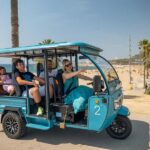
What I like most is the no-queue approach and the fact that it’s truly for your group in a 100% electric vehicle. You get that rare combo of comfort and momentum: sit back, roll through key neighborhoods, then decide what’s worth a longer walk after.
One thing to consider: short options are more about driving + photo moments than lingering inside sites. On top of that, the ride’s cover and the angle of certain viewpoints can limit views from up high, so it’s not the best choice if your top priority is a perfect panorama for every stop.
In This Review
- Key Things to Know Before You Go
- How the Eco Tuk Tuk Tour Gets You Across Barcelona Fast
- Starting at Carrer de Casp 13: Meet Point and What the Ride Feels Like
- The Gaudí Core: Sagrada Familia, Casa Milà (La Pedrera), and Casa Batlló
- Sagrada Familia: the ongoing masterpiece
- Casa Milà (La Pedrera): the last major civil work
- Casa Batlló: the Batlló family home in full modernism mode
- Eixample and Modernist Stops Beyond Gaudí
- Hospital de la Santa Cruz y San Pablo: modernism with purpose
- Plaza Monumental: bullring history without the clichés
- Passeig de Gràcia’s setup
- Plaza de Catalunya and Plaza de España: Barcelona’s Public Stage
- Plaça de Catalunya: where the city funnels
- Plaça d’Espanya: built for the 1929 Exhibition era
- Montjuïc in the Longer Options: Views, the Mountain, and What You’ll Get
- Port and Beach Time: Old Port, Barceloneta, and the Olympic Marina
- Old Port: tradition older than the modern city
- Barceloneta beach: classic and time-stamped
- Olympic Port and the marina vibe
- Ciutadella Park and Arc de Triomf: A Clean Ending Point for Walking
- Ciutadella Park: a former fortress turned park
- Arc de Triomf: the Universal Exhibition gateway
- Price and Value: When $28.67 Per Person Works
- Should You Book This Barcelona Eco Tuk Tuk Tour?
- FAQ
- How long is the Barcelona Eco Tuk Tuk tour, and what’s different about each option?
- Is the tuk-tuk electric?
- Do we need to wait in line at the main sights?
- Where is the meeting point?
- Will the tour run in rain or hot weather?
- Are there age or weight restrictions for kids?
- What if I cancel last minute or miss the start due to delays?
Key Things to Know Before You Go
- Private, for your group: Only your party rides, and the tuk-tuk count adjusts to your group size (up to 4 passengers per tuk-tuk).
- 100% electric + weather gear: You’ll have blankets/protective layers for rain and wind, and the ride is designed to keep you comfortable.
- Photo stops are fixed: You can’t swap stops for longer holds, so plan on stepping out on your own after for anything that grabs you.
- Gaudí in a tight sequence: Sagrada Familia and two major Gaudí homes (Casa Milà and Casa Batlló) plus nearby modernist architecture.
- Montjuïc timing depends on duration: The 60-minute tour won’t stop, while longer tours add Montjuïc and, on the longest options, more port/area time.
- Guides seem to set the tone: Many guides are praised for humor, clarity, and adapting pace for different travelers (including older guests).
How the Eco Tuk Tuk Tour Gets You Across Barcelona Fast
This is the kind of Barcelona experience that works on day one. You don’t just “see stuff.” You get a guided sweep that connects neighborhoods that otherwise feel like separate worlds—Eixample’s architecture, the old-city pulse, the waterfront mood, and the big exhibition-era squares.
The electric tuk-tuk matters more than it sounds. It keeps the ride smoother and quieter than you’d expect, and it makes the route feel easier on your body—especially if you’re juggling stairs, heat, or just jet lag. I also like the promise of starting without queues or waiting, because Barcelona’s biggest draws can be slow once you start lining up.
You’re also not locked into a rigid “stand and listen” style. The vehicle lets you keep moving, then pause at pre-selected photographing points that are chosen for angles you can actually use. If your goal is to make a smart “what to do next” list, this is a strong setup.
The trade-off is that you’re paying for an overview. Even with a private vehicle, the tour can’t magically turn into hours inside every landmark. If you want deep museum-time at each stop, you’ll still need your own follow-up walks.
You can also read our reviews of more tours and experiences in Barcelona.
Starting at Carrer de Casp 13: Meet Point and What the Ride Feels Like
Your meet point is Carrer de Casp 13 (Eixample), right by the Interparking Novedades lift access. You should wait at street level in front of the entrance elevator to that car park, opposite the ME Barcelona hotel. Your driver-guide comes to that point to pick you up, and you can reach the team by phone or WhatsApp (+34 696 997 889).
This detail matters because in Barcelona, you don’t want to waste your first minutes hunting for a van or staring at side streets. If you arrive a few minutes early, you’ll feel the day start calmer.
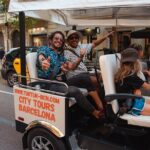
Once you’re on board, expect a vehicle built for real comfort. The tour notes that the vehicles are suitable for older people, and drivers help with getting on if needed. You’ll also get blankets and protective layers for rain and wind, since the ride runs in both heat and rain (with cancellation only under extreme conditions).
Group size runs up to 4 passengers per tuk-tuk, and if you have a larger party, you’ll use the legal maximum setup for more than one tuk-tuk. That keeps the experience from turning into a cramped bus feeling, and it helps explain why the price is per person.
The Gaudí Core: Sagrada Familia, Casa Milà (La Pedrera), and Casa Batlló
If you’re doing Barcelona in a hurry, this is where the tour earns its keep. The route hits Gaudí’s biggest mainstream hits in a logical order, giving you visual context so you understand why he’s such a big deal here.
Sagrada Familia: the ongoing masterpiece
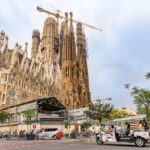
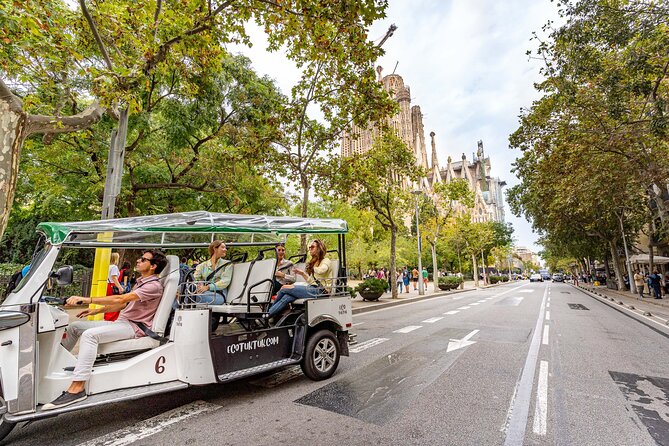
You’ll visit the Expiatory Temple of the Sagrada Familia, often simply called the Sagrada Familia. Construction began in 1882 and it’s still under construction, which makes every view feel slightly different depending on where you stand and what angle the team shows you. You get the “Gaudí masterpiece” context without needing to start your day with an hours-long planning puzzle.
Practical tip: even if you don’t go inside during the tuk-tuk ride, this stop helps you decide what you want to see more closely afterward—façade details, the interior feel, and how the construction layers shape the space.
Casa Milà (La Pedrera): the last major civil work
Next up is Casa Milà, nicknamed La Pedrera for its quarry-like exterior. It was built between 1906 and 1910, and it became a UNESCO World Heritage Site in 1994. The tour frames it as Gaudí’s last civil work before he dedicated himself exclusively to the Sagrada Familia.
This is one of those stops where pictures can’t fully explain it. Even so, the tuk-tuk pass-by helps you see the building as more than a postcard façade—think curves, stone-like texture, and the sense that the building behaves like sculpture.

Casa Batlló: the Batlló family home in full modernism mode
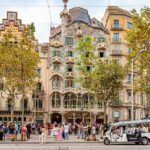
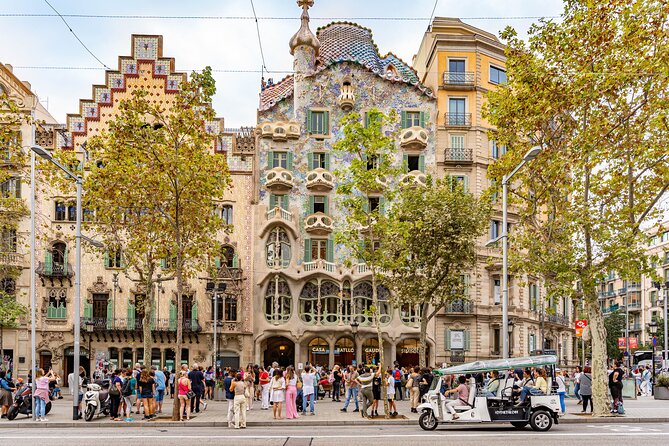
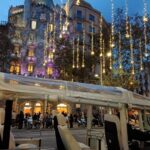
You’ll also pass the famous Casa Batlló, designed in the early 20th century in the height of modernism as the Batlló family residence. The façade is the star, and the tour gives you that first “wow” moment as you walk or roll along Passeig de Gràcia.
What I like here is how the tuk-tuk route connects the dots. You see Sagrada Familia as the spiritual/ongoing project, then you see how Gaudí’s home designs pushed playful structure in the urban grid.
Eixample and Modernist Stops Beyond Gaudí

Barcelona isn’t only one architect, and this tour makes sure you don’t leave with tunnel vision. Along the way, you’ll see major city markers that help explain why Eixample looks the way it does and how modernism shaped the city’s public and private spaces.
Hospital de la Santa Cruz y San Pablo: modernism with purpose
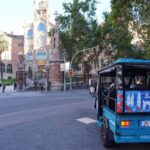
You’ll stop at the Hospital de la Santa Cruz y San Pablo, part of a complex designed by Lluís Domènech i Montaner. This is Catalan modernism with a job to do, not just decorative flair. It also serves as a reminder that architecture here was built to function as well as impress.
If you’re the type who likes seeing how Barcelona cared for public institutions, this stop gives you that texture.
Plaza Monumental: bullring history without the clichés
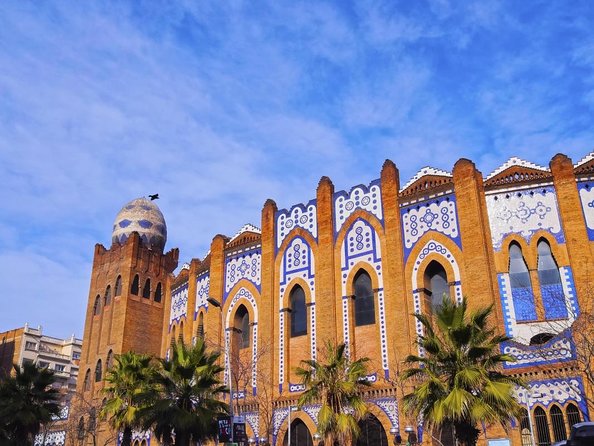
The route also includes Plaza Monumental de Barcelona, the city bullring. It opened in 1914 under the name Plaza de El Sport, then was enlarged and renamed Plaza Monumental in 1916. It’s a quick hit of local history tied to how Barcelona has long had public spectacle in the city fabric.
If you’re not into bullrings, treat it like a historical waypoint. You’re not buying a ticket here; you’re learning the city’s layers.
Passeig de Gràcia’s setup
Casa Batlló and the surrounding buildings sit in the area that’s easiest to “get.” The tuk-tuk flow through the grid helps you understand where broad boulevards fit into smaller neighborhood streets. After the ride, you’ll be better at picking walk routes that feel logical instead of random.
Plaza de Catalunya and Plaza de España: Barcelona’s Public Stage
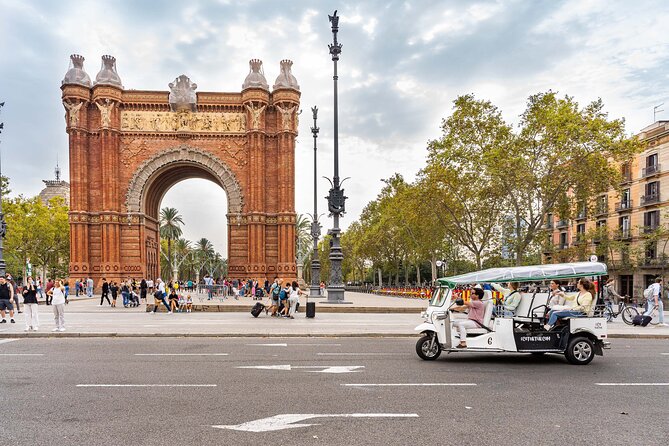
Two big squares do two different jobs in Barcelona, and this tour uses them like a map lesson.
Plaça de Catalunya: where the city funnels
Plaça de Catalunya is a link between Ciutat Vella and the Ensanche district. It’s also a convergence point for public transport and some of the city’s most important streets. Even if you’ve never been before, this stop helps you understand Barcelona as a city of flows—people and lines moving through a central hub.
Plaça d’Espanya: built for the 1929 Exhibition era
Then there’s Plaza de España, described as one of the most emblematic spaces in Barcelona. It was built for the International Exhibition of 1929, drawn up by Josep Puig i Cadafalch and Guillem Busquets, completed by Antoni Darder.
This matters because it shifts your mental timeline. You go from medieval-era layering and modernism into the big exhibition, planning-era Barcelona—the kind of city that was designed to impress visitors from far away.
If you like a city where architecture reflects different eras, these stops help you frame Barcelona as a timeline you can walk.
Montjuïc in the Longer Options: Views, the Mountain, and What You’ll Get
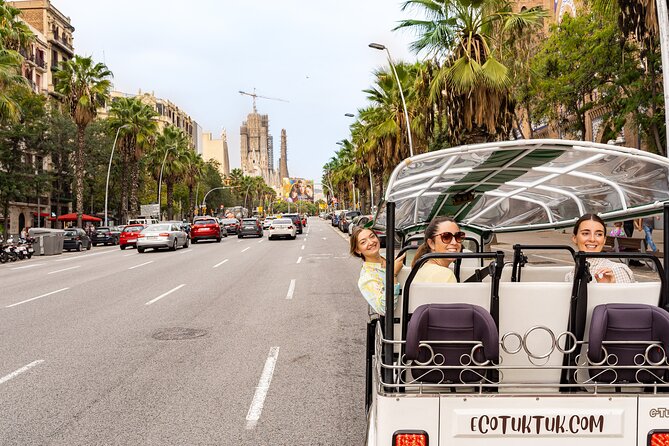
Montjuïc is the city’s mountain moment. The stop description calls it Montjuïc/Montjuich, 177 meters above sea level, and part of the Sants-Montjuïc district. It also notes that the Montjuïc stop runs about 10 minutes with admission ticket free.
Here’s the key practical point: the tour’s length controls whether you stop here. On a 120-minute tour, you will stop at Montjuïc. The 60-minute option doesn’t stop (it’s driving-focused). On the longest tours, you’ll add additional areas later.
What you’ll like about Montjuïc, even if time is short, is how it changes the “feel” of Barcelona. The ride shifts from street-level architecture to an outlook setting—the sort of vantage you can use to plan your next visit, especially if you want a longer walk or a separate view-focused afternoon.
Port and Beach Time: Old Port, Barceloneta, and the Olympic Marina
Barcelona’s waterfront is where the city breathes differently. This tour gives you a taste, especially on longer durations.
Old Port: tradition older than the modern city
You’ll see the Old Port, described as the oldest part of the Port of Barcelona, with more than two thousand years of tradition. It’s separated from the sea by a breakwater and has long been a popular leisure spot. Even a brief pass gives you the sense that this is Barcelona’s older working and cultural edge.
Barceloneta beach: classic and time-stamped
Next is Barceloneta beach, described as the oldest and most famous beach in the city. It was remodeled just before the 1992 Olympic Games. This is the kind of detail that makes a beach feel like part of a city story, not just sand.
Olympic Port and the marina vibe
On the longest tours, you also visit the Olympic Port, a marina in front of the Olympic Village. It sits between Barceloneta and Nova Icària, and it’s managed by the municipal company Barcelona de Serveis Municipals for the City Council.
If your Barcelona plan includes photos at the waterline, this section is where you’ll want to be thinking about timing. Morning or late afternoon tends to be friendlier for light and walking afterward, and the tuk-tuk helps you line up where you might want to stroll next.
Ciutadella Park and Arc de Triomf: A Clean Ending Point for Walking
A good tour leaves you with a smart “turn this into a walk” zone. This one does.
Ciutadella Park: a former fortress turned park
You’ll pass Citadel Park (Parc de la Ciutadella), located in Ciutat Vella. It used to be the former grounds of the Citadel fortress, and the layout was influenced by the Luxembourg Garden in Paris. If you like parks that feel designed rather than accidental, this makes sense.
Arc de Triomf: the Universal Exhibition gateway
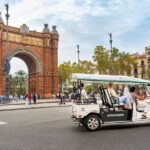
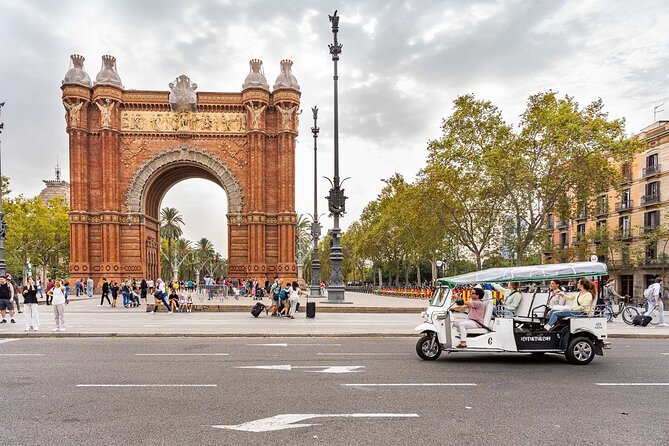
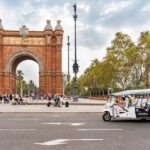
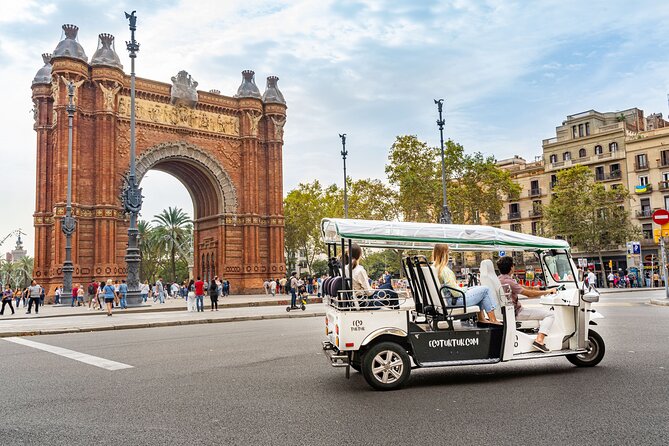
You’ll also see the Arc de Triomf, at the confluence of major avenues, designed by José Vilaseca as the main entrance to the Barcelona Universal Exhibition of 1888.
This ending blend—park plus exhibition monument—works well if you want a final stroll after the tour. It’s also a natural point to orient yourself for more city exploring without feeling like you’ve escaped into the suburbs.
Price and Value: When $28.67 Per Person Works
At $28.67 per person, you’re paying for two things: guide time plus transportation that gets you from stop to stop without friction. You’re not paying for unlimited stops or guaranteed inside admissions at every landmark, so the value depends on what you want out of the day.
This tour tends to make the most sense if you:
- have limited time and want a guided highlights route
- want a first-pass orientation so your next hours are spent better
- like architecture and big city landmarks, especially Gaudí and modernism
- want comfort and safety with a driver who can adjust pace (the ride is noted as suitable for older people)
It can disappoint you if your priorities are:
- deep inside visits at multiple sites during the same outing
- perfect picture angles from every viewpoint (one negative comment pointed out view limitations due to the vehicle’s cover and how sights sit relative to height)
My practical advice: treat this as your “Barcelona map with voice.” Then pick one or two places that earned your attention and plan your own longer walk or ticketed visit.
Should You Book This Barcelona Eco Tuk Tuk Tour?
Book it if you want a smart first-day plan: a private electric tuk-tuk ride, a focused route through Barcelona’s signature architecture, and enough stops to help you decide what’s worth more time later.
Skip it (or pick a longer duration) if you’re the type who gets frustrated when a tour doesn’t linger. The fixed stops and the note that the 60-minute option doesn’t stop mean you’ll be mostly riding and snapping photos, not hanging around inside buildings.
If you want the best chance of a great experience, choose the length that matches your pace. And if you’re sensitive to photo angles, remember that some viewpoints may be affected by the ride setup.
FAQ
How long is the Barcelona Eco Tuk Tuk tour, and what’s different about each option?
The tour runs about 1 to 4 hours. A key difference is that the 60-minute tour does not stop, while the 120-minute tour includes a stop at Montjuïc. On the 180- and 240-minute tours, you also stop at additional areas, including the Olympic Port and Pedralbes.
Is the tuk-tuk electric?
Yes. The tour uses a 100% electric and sustainable vehicle.
Do we need to wait in line at the main sights?
The tour includes the promise that it starts without queues or waiting.
Where is the meeting point?
Meet at Carrer de Casp 13, Eixample (08010). You should wait at street level in front of the entrance elevator to the Interparking Novedades car park, opposite the ME Barcelona hotel.
Will the tour run in rain or hot weather?
Yes. The tours take place in rain or heat. Blankets and protective layers are provided, and cancellation only happens under extreme conditions.
Are there age or weight restrictions for kids?
Yes. The minimum age is 2 years (babies are not allowed), and there is a minimum weight requirement of 9 kg.
What if I cancel last minute or miss the start due to delays?
If you cancel up to 24 hours in advance, you get a full refund. If your delay is longer than 15 minutes, the activity may be cancelled and there is no refund of the amount paid, and the route can be reduced according to lost time if the delay is shorter.