REVIEW · BARCELONA
Barcelona Expert Plus Tour with Local Guide in Eco Tuk Tuk Private
Book on Viator →Operated by Eco Tuk Tuk - Spain · Bookable on Viator
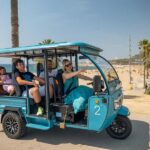
Barcelona, minus the walking grind. I love the 100% electric ride that keeps things smooth and low-fuss, and I love that this is private for your group, so you can move on when you want and ask questions without crowd noise. The result is a quick, high-value way to get your bearings fast across Barcelona’s big sights.
Here’s the one thing to think about: the route has set stops and photo moments, so if you want extra lingering time for pictures at every landmark, this tour may feel a bit structured. Also, like most compact vehicles, leg room and the seat position can be a mixed bag.
In This Review
- Key highlights to know before you go
- Why an Eco Tuk Tuk Tour Works So Well for Barcelona
- Price and What You Actually Get for $28.45
- Getting to Carrer de Casp 13 Without Losing Your Mind
- Picking the Right Tour Length: 120 vs 180 vs 240 Minutes
- Plaza Monumental and Hospital de la Santa Cruz y Sant Pau: Barcelona Beyond the Postcard
- Sagrada Familia and Gaudí’s Famous Street: Sights You’ll Want to Revisit
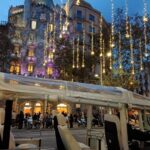
- Plaça Catalunya and Passeig de Gràcia: The City’s Spine
- Camp Nou and Pedralbes: Stadium Energy Meets Garden Quiet
- Montjuïc, Plaza de España, and the Port Path: Views That Change With the Light
- Barceloneta, Olympic Port, Ciutadella Park, and Arc de Triomf: The Best Ending Stretch
- Comfort, Climate, and the One Practical Limitation
- Who This Tour Is Best For (and Who Might Want Something Different)
- Should You Book This Barcelona Expert Plus Tour?
- FAQ
- How long is the Barcelona Expert Plus Tour?
- Is this a private tour?
- What’s included in the tour price?
- Do you stop in Montjuïc?
- Are there hotel pickup or drop-off options?
- Can I customize the route or add extra photo stops?
Key highlights to know before you go
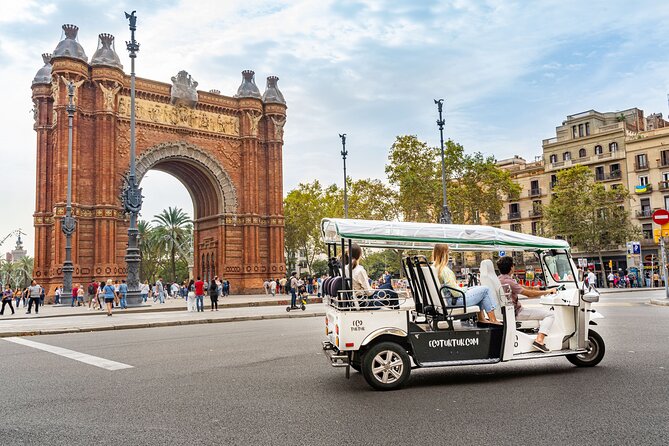
- Eco-friendly electric transport that’s built for comfort and frequent short stops, not long marches
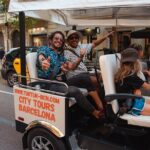
- Private vehicle for your group (up to four passengers per tuk-tuk), with guides who can tailor questions
- Expert local guiding with clear context at major landmarks like Sagrada Familia and Gaudí buildings
- Rain-ready comfort: blankets and protective layers for wind and cold weather
- Flexible tour length (choose 2, 3, or 4 hours) with different stop patterns like Montjuïc and the Olympic area
Why an Eco Tuk Tuk Tour Works So Well for Barcelona
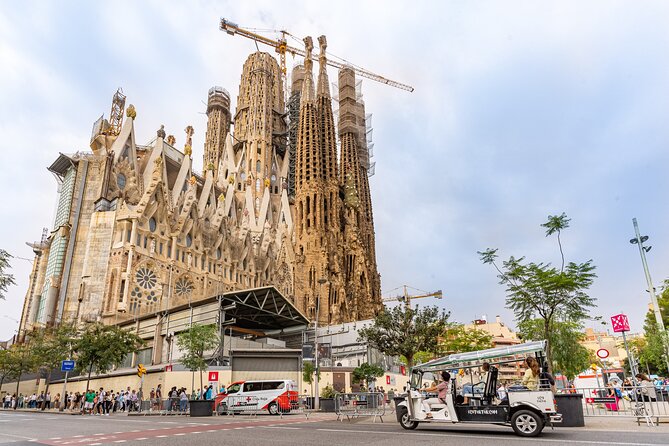
Barcelona is big in a way that feels sneaky. On paper it’s a city you can “walk around.” In real life, you’ll end up doing the tourist shuffle—short blocks that turn into long days. This tour is built to reduce that grind. You trade some foot travel for short rides between highlights, which is a smart move when you’re short on time or you just want the city’s highlights without earning blisters.
The electric tuk-tuk also changes the mood. It’s quieter than you expect, and because you’re moving in quick hops, you get more “there it is” moments. That matters with Gaudí landmarks, stadium-scale views, and waterfront scenes where angles and timing help.
You’ll also see Barcelona as a connected whole: architecture districts, park-green space, port life, and big city plazas. Instead of doing one neighborhood deeply, you’re getting a broad orientation that helps you plan the rest of your trip.
You can also read our reviews of more tours and experiences in Barcelona.
Price and What You Actually Get for $28.45
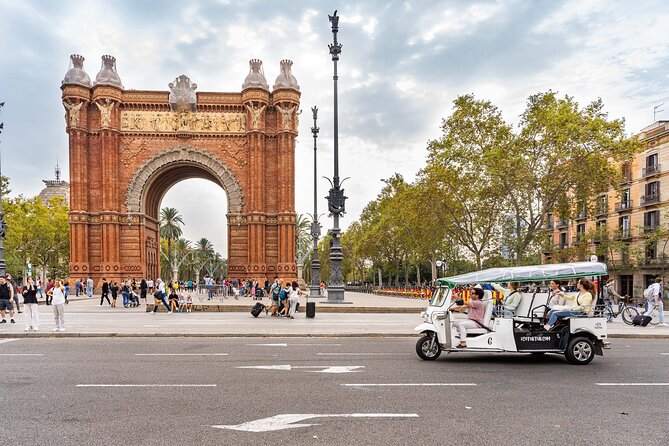
At $28.45 per person, the value is mainly in logistics: you’re buying guided time plus a private electric ride that gets you between multiple top sights. You’re not just “watching from a bus window.” You’re getting context from a local guide and you’re able to move at a pace that’s practical.
Two details make this price make sense. First, you’re not paying for a train ride, multiple taxis, or lots of walking taxis-with-feelings. Second, the tour is designed for efficiency: pre-set stops and photo moments mean you’re not wasting time trying to coordinate where to go next.
If you’re traveling as a small group, it often becomes even better value. The tuk-tuks are reserved privately, and the cost is set based on how many tuk-tuks are needed (with the legal maximum of four passengers per tuk-tuk). That setup keeps the experience feeling personal instead of crowded.
Getting to Carrer de Casp 13 Without Losing Your Mind
Meeting point accuracy can make or break early-day plans. This one starts at Carrer de Casp, 13, in the Eixample area, near the Interparking Novedades car park. The key detail: you wait at street level in front of the entrance elevator for that car park, opposite the entrance of the ME Barcelona hotel. Your driver-guide comes to that point to pick you up.
It’s also near public transportation, so if you’re already in the city center, you shouldn’t need a long commute. If you want to be extra smooth, give yourself a little buffer. There’s a strict rule if you’re delayed too long: if the delay is longer than 15 minutes, the activity is cancelled and there’s no refund.
Picking the Right Tour Length: 120 vs 180 vs 240 Minutes
This experience is designed around duration, and that matters for what you’ll actually see.
- The shorter option is set up so you cover a lot without making stops for photo time (and the 60-minute version doesn’t stop).
- On the 120-minute option, you stop in Montjuïc.
- On the 180- and 240-minute options, you add additional stops that typically include the Olympic Port and Pedralbes area.
So here’s the practical advice: if you’re the type who wants the Sagrada Familia and Gaudí street scene plus a look at the water, pick the longer options. If you’re trying to fit everything around another big booking (like a timed entry somewhere), the 120-minute version is a good “orientation plus” choice.
Plaza Monumental and Hospital de la Santa Cruz y Sant Pau: Barcelona Beyond the Postcard
The tour begins with two landmarks that help set the tone: city life, Catalan identity, and architecture that isn’t only about Gaudí.
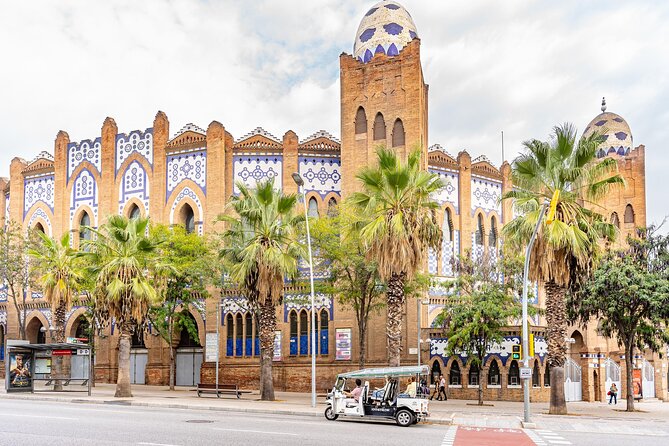
First up is Plaza Monumental de Barcelona, the bullring inaugurated in 1914 (with a name change in 1916). Even if bullfighting isn’t your thing, the building signals how Barcelona holds on to older traditions while modern neighborhoods grow around them.
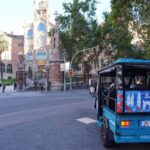
Next is Hospital de la Santa Cruz y San Pablo, part of a complex designed by Lluís Domènech i Montaner, a major figure in Catalan modernism. This stop works well because it breaks the usual “only famous-modern-architect-everywhere” pattern. You’ll see how Barcelona’s identity also lives in institutional architecture—places built for care, order, and civic pride.
The main drawback here? You’re seeing these from the outside and in passing. If you want deep interior time, you’ll still need separate plans. But for getting the feel of the city’s architectural eras, it’s a strong opening.
Sagrada Familia and Gaudí’s Famous Street: Sights You’ll Want to Revisit
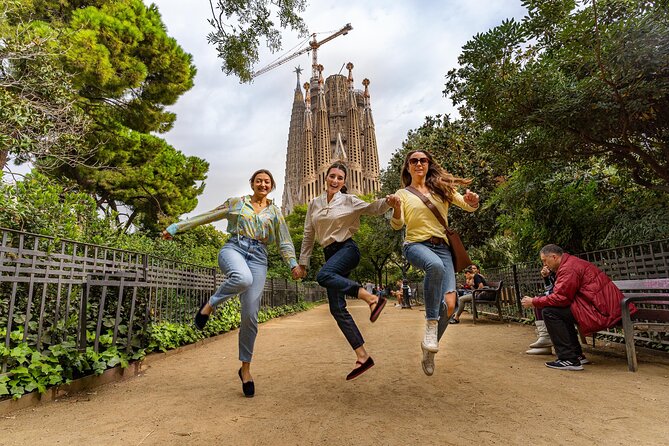
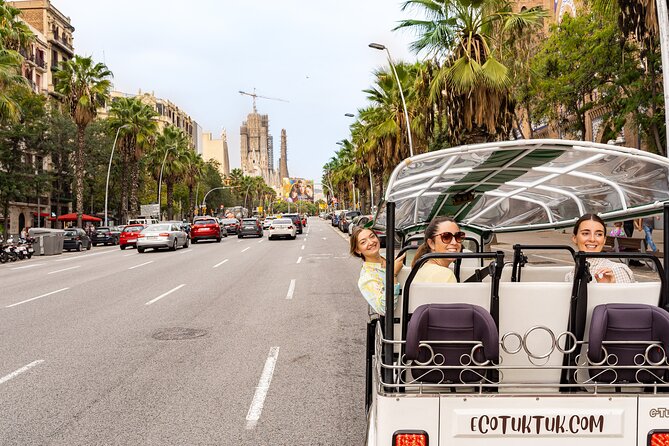
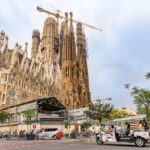
You’ll hit Sagrada Familia, Gaudí’s masterpiece basilica. Construction began in 1882 and it is still under construction—so every time you go back, it looks slightly different. From the tuk-tuk, you get a fast sense of why it grabs people. It’s not just a building; it’s a whole visual language.
From there you move into Gaudí’s “greatest hits,” including:
- Casa Milà (La Pedrera), built between 1906 and 1910 and later recognized by UNESCO. It’s the kind of façade that looks like it should be moving, like stone made soft.
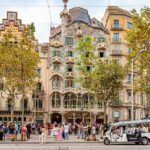
- The Casa Batlló story: you’ll see the building designed for the Batlló family, and it’s famous on Passeig de Gràcia for that instantly recognizable modernist look.
These stops are valuable because Gaudí can be overwhelming. When you see Sagrada Familia and then immediately see La Pedrera and Casa Batlló, your brain starts building connections. You understand the theme: form, texture, and imagination—whether it’s stone on a façade or shapes that seem to defy practical rules.
Just know: the experience is built around photography stops and set viewing points, not long ticketed interior visits. So if you want to go inside Sagrada Familia or spend an hour in a specific Gaudí building, plan that separately.
Plaça Catalunya and Passeig de Gràcia: The City’s Spine
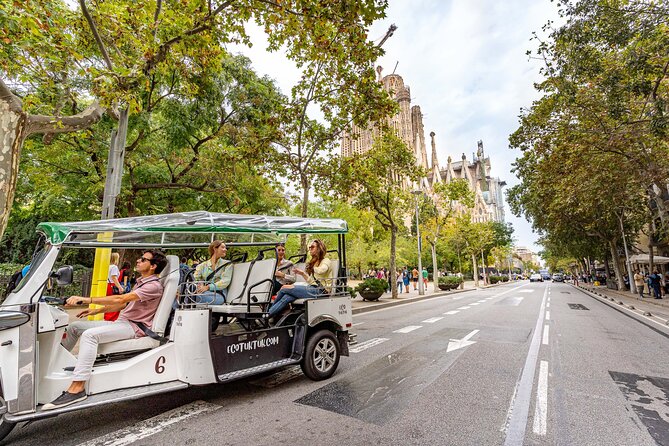
One of the most helpful parts of this tour is how it moves you through Barcelona’s “spine.” Plaça Catalunya links Ciutat Vella and the Ensanche neighborhood, and it’s also a convergence point for major streets and transit lines.
This is great for two reasons:
1) You’ll understand where the city center pulls people.
2) You’ll get a mental map for where to go next—especially if you’re doing a mix of old town wandering and modern shopping streets later.
Also, by riding along or near Passeig de Gràcia, you’re in the right corridor for modernist architecture. Even if you only notice one or two façades today, you’ll recognize them later when you’re walking around on your own.
Camp Nou and Pedralbes: Stadium Energy Meets Garden Quiet
If you love sports or you just like seeing how Barcelona organizes its massive spaces, Camp Nou is a great stop. It’s owned by FC Barcelona and inaugurated in 1957, with a current capacity of 99,354. That scale makes everything else feel human again.
Then the tour shifts tone toward Pedralbes, a neighborhood known for elegant villas and the Güell Pavilions at the entrance to the Pedralbes Gardens. You also get Pedralbes Monastery, a gothic complex with gardens around it. It’s a nice contrast: you go from stadium scale to a calmer, more contemplative corner of the city.
This segment is where I think the tour earns its “plus” label. Barcelona has a habit of being split into zones that feel disconnected when you’re on foot. Here, you connect them by ride: sports landmark to garden gates to monastery atmosphere.
Montjuïc, Plaza de España, and the Port Path: Views That Change With the Light
Montjuïc (177 meters above sea level) is one of those Barcelona hills that people talk about forever. Even without a long hiking day, just getting the ride and the viewpoint context helps. It’s also one of the tour’s main “duration payoffs.” If you pick the 120-minute option, Montjuïc is part of the experience. If you go longer, you’ll also stack other areas to balance the day.
Then there’s Plaza de España, built for the 1929 International Exhibition, and designed with key architects involved in the project. It’s a wide space that helps you understand Barcelona’s big-exhibition era planning—less intimate, more monumental.
After that, you move toward the sea with:
- Old Port, the oldest port area with over two thousand years of tradition, separated from the sea by a sea wall
- Barceloneta beach, the oldest and most famous beach, remodeled before the 1992 Olympic Games
- Olympic Port, a marina near the Olympic Village area
The takeaway is simple: you’ll see how Barcelona turns its waterfront into public space. If you’re planning dinner near the coast later, this gives you the orientation you’d otherwise only get after a long walk.
Barceloneta, Olympic Port, Ciutadella Park, and Arc de Triomf: The Best Ending Stretch
After Montjuïc and the port area, the tour keeps momentum and lands you back in “city livability” territory.
Ciutadella Park is laid out on the old grounds of a fortress and was once Barcelona’s only public park. It’s famous for its garden-style design, and it’s the right kind of green break after hard architecture time.
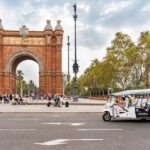
Then comes Arc de Triomf, designed for the 1888 Universal Exhibition and located at a major confluence of streets. It’s the kind of monument that reads like a doorway: you feel like you could walk into another era and still end up back in the modern city.
By the time you reach this point, you’re usually thinking, okay, I get it now. That’s the real value of an efficient tour like this. It gives you landmarks in the right order so you leave with a map in your head—not just a list of buildings.
Comfort, Climate, and the One Practical Limitation
Barcelona weather can be dramatic in either direction. The good news is the tour provides blankets and protective layers to help you handle rain and wind. That sounds small, but it’s the difference between “fun with regrets” and “I’m actually comfortable while taking pictures.”
The other comfort factor is that the vehicles are designed to be usable for older people, and drivers help with getting on when needed.
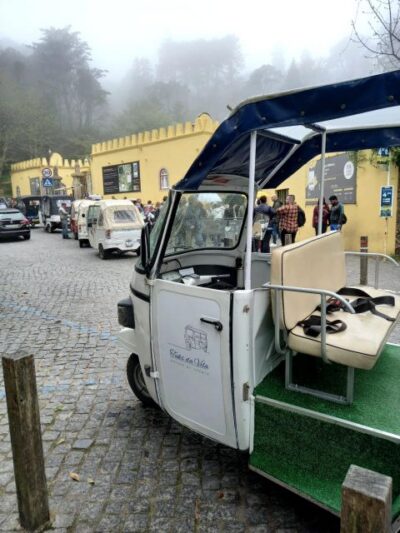
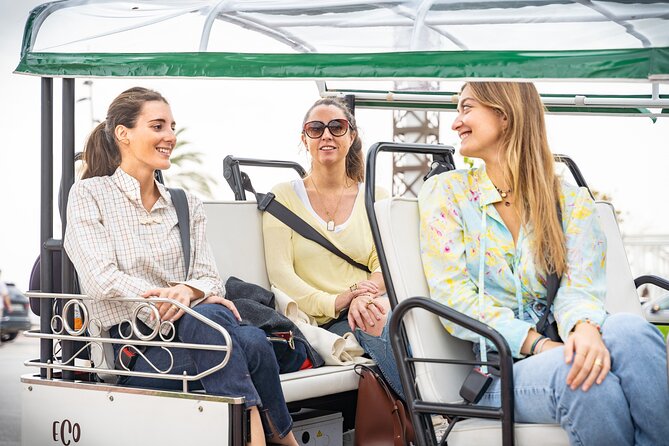
Still, keep expectations realistic about seating. The vehicles are compact, and at least one tall traveler noted that leg room felt cramped and the plastic roof could make it harder to enjoy sights from certain angles. If you’re tall or broad-hipped, think about bringing a chair-friendly mindset. Tight seatbelts were also mentioned by a small number of guests, so don’t treat this as a lounge car.
Who This Tour Is Best For (and Who Might Want Something Different)
This is a great fit if you want:
- A first-time overview that helps you plan the rest of the week
- A city hit list that reduces walking without skipping the major neighborhoods
- A guide who can explain what you’re seeing in plain language (guides like Nacho, Roger, Richard, Simone, and Diana have all been praised for being friendly and engaging)
It may be less ideal if you:
- Want long interior time at specific sites (this tour is built around viewing/photo moments, not extended museum-style visits)
- Hate structured routes and prefer to roam freely, stopping whenever a photo idea strikes
If you’re traveling with kids over the minimum age (minimum age two years), or you’re part of a small group and you want everyone to stay together, a private tuk-tuk setup can be a smart move.
Should You Book This Barcelona Expert Plus Tour?
I’d book it if you want Barcelona’s biggest highlights in a short, guided, low-walking format—and you like the idea of rain-ready comfort and photo stops that are planned for you. At $28.45 per person, you’re buying efficient sightseeing plus local context, not just transport.
I’d skip or swap plans if you’re the type who needs unhurried, extra-long photo lingering at every landmark, or if you know compact seating will be a problem for your body. Also, if you’re expecting multiple long stops for interior visits, this isn’t that kind of tour.
FAQ
How long is the Barcelona Expert Plus Tour?
It runs for about 2 to 4 hours, and the exact stop pattern depends on which duration you choose.
Is this a private tour?
Yes. It’s private, and only your group participates. Tuk-tuks are reserved for your group, with a legal maximum of 4 passengers per tuk-tuk.
What’s included in the tour price?
You get an expert companion guide/driver, a private 100% electric vehicle for your group, pre-selected photography stops, and blankets/protective layers for rain and wind.
Do you stop in Montjuïc?
Yes, if you choose the longer versions that include Montjuïc. On the 120-minute option you stop in Montjuïc.
Are there hotel pickup or drop-off options?
No. Hotel pickup and drop-off are not included.
Can I customize the route or add extra photo stops?
No. The itinerary and stops are set, and tours cannot be modified for additional photo stops.