REVIEW · MADRID
Tour Madrid in 2 hours! Electric Tuk – Fast, Fun, and Exclusive
Book on Viator →Operated by Green Tours · Bookable on Viator
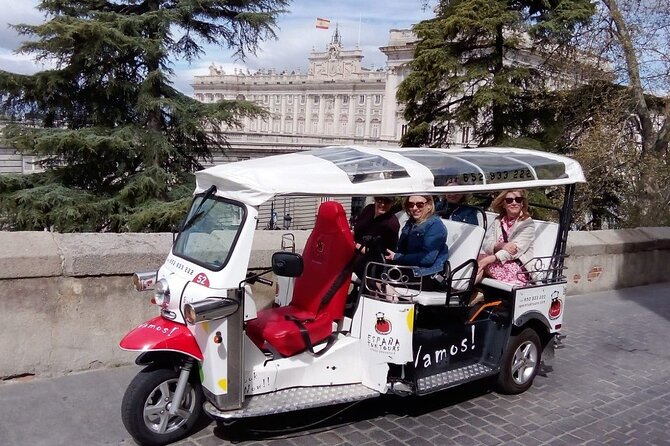
Two hours on an electric tuk-tuk works fast. You’ll hop from Plaza de Santa Ana to the royal area, then swing out to places like Puerta de Alcalá, Las Ventas, and Cibeles without burning your whole day in transit.
I love the speed of this format for first-day orientation, because each stop gets just enough time for context and a few good photos. I also like the mix of grand monuments and everyday Madrid stops, especially the chance to pop into Mercado San Miguel for local food vibes.
One thing to keep in mind: the pace is brisk. Many stops are short, and the Palacio Real admission fee isn’t included, so expect mostly exterior views unless you add separate time.
In This Review
- Key highlights you’ll actually feel in 2 hours
- Electric Tuk-Tuk Madrid: why the 2-hour format works
- Getting oriented from Plaza de la Lealtad to Plaza de Santa Ana
- Royal Palace and the Almudena Cathedral Museum in one tight block
- Sabatini Gardens, Debod Temple, and a top-tier photo moment
- Plaza Mayor plus Mercado San Miguel: old-town heart and food energy
- Cervantes, Lope de Vega, and Plaza de las Cortes power walks
- Neptune Fountain to Puerta de Alcalá: from decorative Rome-style to triumphal arches
- Las Ventas, Barrio de Salamanca, and Bernabéu: Madrid’s major contrasts
- Plaza Colón, the National Library, Cibeles, and Banco de España detail watching
- Guide, driver, and photo support: what to expect from the human part
- Price and value: what $215 per group really buys you
- Who should book this electric tuk-tuk tour
- Should you book this 2-hour Electric Tuk-Tuk Madrid tour
- FAQ
- How long is the Madrid electric tuk-tuk tour?
- What is the group size limit?
- What languages are offered?
- What does the price include?
- Are any major attractions included with admission?
- Where does the tour start and end?
- Is lunch or dinner included?
- What if I need to cancel?
- Is the tour fully private?
Key highlights you’ll actually feel in 2 hours
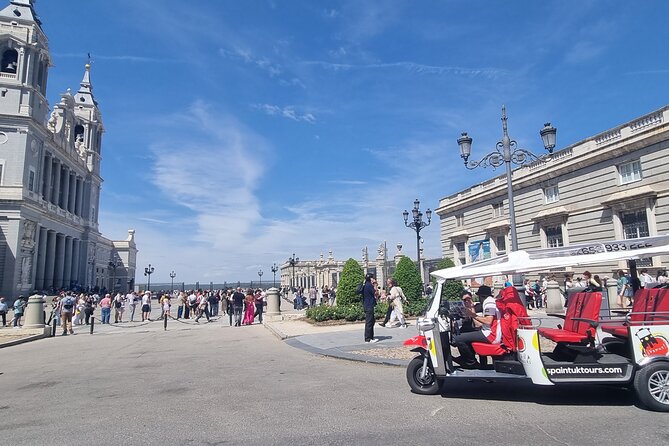
- Electric tuk-tuk coverage that compresses a lot of Madrid into one easy ride
- Small-group private tour (up to 4), so you’re not squeezed with strangers
- Many free stops, which makes your time feel more efficient
- Old Madrid to modern Madrid contrast, from Plaza Mayor to Las Ventas and Bernabéu
- Guide support that doubles as a photo helper, especially when you want better angles
Electric Tuk-Tuk Madrid: why the 2-hour format works
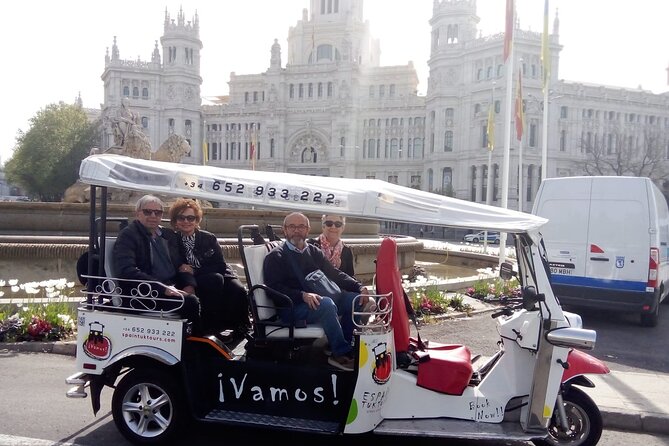
This is the kind of tour you do when your time is tight but you still want the big picture. The electric tuk-tuk isn’t about deep, museum-by-museum sightseeing. It’s about getting your bearings fast, snapping photos, and learning what connects all the neighborhoods you’re passing through.
Because you only have about two hours, the stops feel like “touch points.” You’ll get just enough time to look closely, ask questions, and move on—without the fatigue of crisscrossing the city on foot or figuring out which turn to take next. If you’re the type who hates wasting a vacation hour in transit, this format fits.
It’s also private (your group only), which usually means the guide can flex a bit around your pace and photo stops. And with a group size capped at four, it stays personal rather than chaotic.
You can also read our reviews of more tours and experiences in Madrid.


Getting oriented from Plaza de la Lealtad to Plaza de Santa Ana
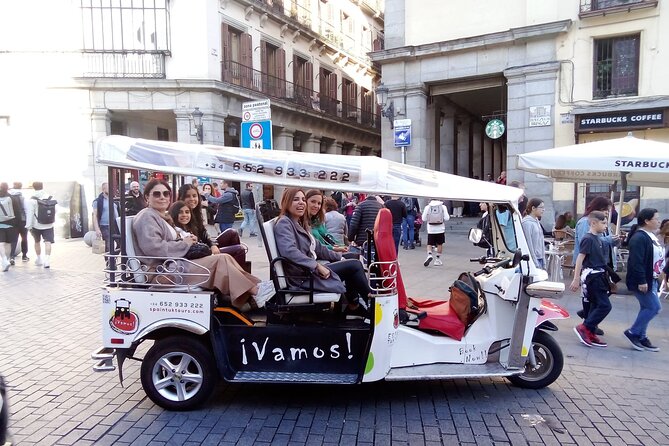
You start at Pl. de la Lealtad, 1 in the Retiro area, and the tour ends back at the meeting point. That matters because you’re not committing to a one-way journey across town at the end of your day—you can build the rest of your itinerary around going back to a known spot.
The first stop is Plaza de Santa Ana in the Centro district (Cortes neighborhood). It’s an open square dating from 1810, and the reason it’s a smart opening move is simple: it helps you learn the rhythm of central Madrid. You get a feel for the streets and the energy of the area before you head into royal and landmark territory.
In just a few minutes here, you’re mostly absorbing location—where Centro sits, what feels walkable, and how the city’s “center” changes as you move outward.
Royal Palace and the Almudena Cathedral Museum in one tight block
Next up is the Royal Palace of Madrid (Palacio de Oriente). Construction started in 1738 and took seventeen years, and Carlos III made it his habitual residence in 1764. The palace today is used for receptions, ceremonies, and official events because the Spanish monarchs live elsewhere (in the Palacio de la Zarzuela).
The practical catch: Palacio Real admission isn’t included, and the stop is short. So you should plan this as a quick look and photo moment from outside, not a full interior visit.
Right after, you’ll visit the Museo de la Catedral de la Almudena. This museum is free and designed for a quick win: it’s built around the story of the Madrid diocese and spreads through multiple rooms with items like mosaics and episcopal shields. The bigger context is the cathedral itself—Almudena was consecrated on June 15, 1993 by Pope John Paul II, and it was the first consecrated cathedral outside Rome.
In 10 minutes, you won’t “finish” the museum. But you will leave with enough details to understand what you’re seeing when you spot the cathedral from other angles later.
Sabatini Gardens, Debod Temple, and a top-tier photo moment
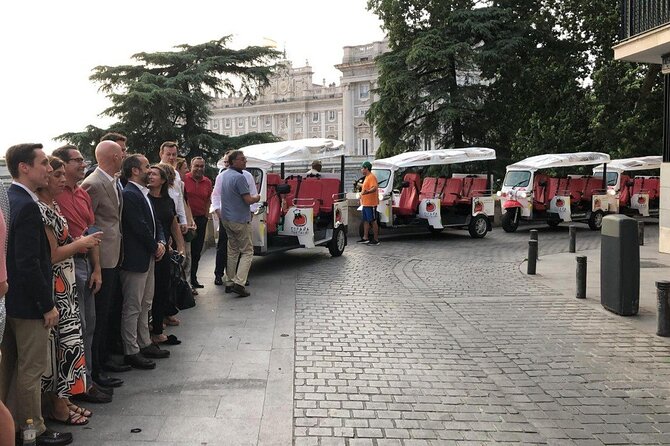
The Sabatini Gardens sit in front of the north façade of the Royal Palace, between Bailén street and the San Vicente slope. This section of greenery covers about 2.66 hectares, and it’s a nice pause in the day—more breathing room than another stone-and-steel landmark stop.
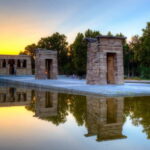
Then the route continues to Debod Temple. This is one of Madrid’s most memorable surprises: an ancient Egyptian temple that has been relocated to the city. It’s located west of Plaza de España near Paseo del Pintor Rosales, on a hill where the Mountain Barracks once stood.
Even if you don’t go deep into archaeology, the value here is atmosphere. Debod gives you that “Wait, how is this in Madrid?” feeling. It’s also a strong photo stop because the setting is different from the surrounding Madrid architecture.
Short stop or not, Debod is one of those moments you’ll remember when you think back on the day.
Plaza Mayor plus Mercado San Miguel: old-town heart and food energy
Plaza Mayor is next, and it’s the true old-town center of Madrid de los Austrias. This square sits on the site of an older plaza (Plaza del Arrabal) where the town’s popular market operated in the late 1400s. When Philip II moved the court to Madrid, the area became more important. In 1617, architect Juan Gómez de Mora was commissioned to unify the buildings here.
In other words, this isn’t just a photo backdrop. It’s a place that historically hosted major public life: popular celebrations, bullfights, beatifications, coronations, and faith-related events.
You get about 10 minutes here, which is enough to take in the scale and soak up the vibe before you head into Mercado San Miguel. The market is covered and dates to around 1916. It’s the kind of place where you can graze on local food and delicatessen in an elegant setting, without committing to a long meal.
Tip: treat Mercado San Miguel like a snack stop, not a full lunch. You want to keep your energy for the rest of the ride.





Cervantes, Lope de Vega, and Plaza de las Cortes power walks
The tour also passes by cultural Madrid through writers. You’ll see the former residence of Miguel de Cervantes, author of Don Quijote, where guided tours are offered. Nearby is the House of Lope de Vega, built in the 16th century. Lope acquired it in 1610 and lived there until his death in 1635.
Even though these are not long visits on a 2-hour schedule, they add a useful layer. The city isn’t only palaces and statues. It’s authors and ideas, and the street-level presence of literary landmarks helps you understand why Madrid feels so “cultural” even in short glimpses.
Then the tour goes to Plaza de las Cortes, tied to Spain’s political story. The Palace of the Spanish Courts was built on the former convent of the Holy Spirit, which served as the seat of Congress between 1834 and 1841. The main façade is neoclassical with a portico featuring six Corinthian columns. The triangular pediment and the flanking lions are part of the story too—the lions were sculpted using iron from cannons captured in the war in Africa.
Inside, the famous session room and the library (known as the lost steps room) are highlights, but on this tour you’re mostly absorbing the outside grandeur and the architectural details you can spot quickly.
Neptune Fountain to Puerta de Alcalá: from decorative Rome-style to triumphal arches
After Plaza de las Cortes, you’ll reach the Neptune Fountain. It’s a neoclassical fountain in the center of a roundabout in Plaza de Cánovas del Castillo. Proposed in 1777, construction began in 1782, and it was completed in 1786. It’s a quick stop, but it helps connect the dots between Madrid’s older monumental style and the city’s later growth.
Then comes Puerta de Alcalá. This monumental arch was built by mandate of Carlos III to replace an earlier 16th-century gate and was inaugurated in 1778. Designed by Francesco Sabatini, it’s a granite neoclassical triumphal arch with five openings—different from the typical three.
On the inner side, it includes four virtues: Prudence, Justice, Temperance, and Fortress. On the outside, decoration is richer, because that’s what people entering Madrid would see first.
This is one of the best “stand still and look up” stops on the day. Even with short timing, it’s worth lingering for the symmetry.
Las Ventas, Barrio de Salamanca, and Bernabéu: Madrid’s major contrasts
Madrid doesn’t stay in the old lane for long on this tour. Next you’ll see Las Ventas, Madrid’s famous bullring. It’s described as the biggest bullfighting venue in Spain, with 23,798 spectators. It’s listed as the third largest in the world (after those in Mexico and Valencia) and the second largest by ring diameter at 61.5 meters.
So yes, it’s a spectacle place. But the real value for most visitors is that Las Ventas shows how Madrid holds onto major traditions alongside global tourism.
Then the tour shifts to Barrio de Salamanca, one of the city’s more upscale zones. You’ll pass through streets named Velázquez, Ortega y Gasset, and Serrano. Even if you don’t shop, the area’s streets and layout give you a feel for Madrid’s modern pace.
From there, you head to Santiago Bernabéu Stadium. It was inaugurated on December 14, 1947, and its capacity is listed at 81,044. It’s a short stop, but it helps balance the day: you’re moving from royal heritage to contemporary icons in the same ride.
Finally, the route continues through the financial district along Paseo de la Castellana, giving you a fast visual survey of Madrid’s business spine.
Plaza Colón, the National Library, Cibeles, and Banco de España detail watching
Plaza Colón is next. At the center is the Christopher Columbus monument, a white marble neo-Gothic sculpture built in 1885 by Jerónimo Suñol for the wedding celebration between Alfonso XII and María de las Mercedes de Orleans. The monument measures 17 meters and sits on a stone-carved pedestal.
The square also includes the Gardens of Discovery, opened in 1970, where you can see sculptures tied to themes of discovery. There’s also the Cultural Center of the Villa Fernán Gómez in the basement area.
From there, you’ll pass the National Library of Spain (BNE). This is an autonomous body responsible for collecting, cataloging, and conserving Spain’s bibliographic and documentary heritage. It holds around thirty million publications produced nationally since the beginning of the 18th century, including books, magazines, maps, prints, drawings, scores, and brochures.
Then comes Cibeles Fountain. It’s one of Madrid’s true meeting-point monuments, surrounded by prominent buildings including the City Council building (Palacio de Comunicaciones), the Army Headquarters (Palacio de Buenavista), Casa de América (Palacio de Linares), and the Bank of Spain area. The fountain represents the Roman goddess Cibeles, symbolizing land, agriculture, and fertility, riding in a car pulled by two lions representing Hipomenes and Atalanta. It’s also a real sports symbol for Real Madrid fans because titles celebrations happen here.
After Cibeles, you’ll also be shown the Banco de España building. The tour notes that interior visits are limited: access is for groups from educational centers and universities, and exceptionally for certain nonprofit cultural or associational entities. So treat this as a look-and-learn stop—watch the façade and then move on.
The day also includes a pass along Gran Vía, one of Madrid’s main streets, running from the street of Alcalá to Plaza de España. It’s important commercially and from a tourist-leisure point of view since its early 20th-century development.
Guide, driver, and photo support: what to expect from the human part
The biggest difference between a “sightseeing ride” and a memorable tour is how you’re handled at the stops. In the feedback attached to this experience, the standout is that the guide often helps with photos and adds extra local context when you ask. One driver named Tadeo is specifically praised for being excellent with photos and keeping the experience moving smoothly.
There’s also a note about a guide referred to as Angel, described as friendly, informative, and helpful with pictures. That kind of hands-on support matters when your stops are short; it’s easy to miss good angles if you’re left to figure things out alone.
There’s one practical caution, though: pickup timing and language matching can make or break the day. One group reported a late tuk-tuk arrival after multiple contacts, and another had a mismatch between the booked language and what the guide spoke. I’d handle that the simple way: confirm your guide language in advance, and if you’re arriving near the meeting point with GPS trouble, give yourself extra buffer time.
Price and value: what $215 per group really buys you
The price is $215.07 per group for up to four people, with GST included. If you fill the group, that’s roughly $54 per person for about two hours of guided coverage. That math tends to work best when you’d otherwise pay for taxis plus pay for your time with “separate” sightseeing plans.
You’ll also notice the tour is built around mostly free stops—Plaza Mayor, Mercado San Miguel, Almudena Cathedral Museum, Sabatini Gardens, Neptune Fountain, and more. The main listed exception is the Palacio Real admission, which isn’t included. So if the Royal Palace interior is a must for you, budget extra time (and money) for a separate visit.
This is also good value if you want a structured first-day overview and you plan to return later for longer museum time. A 2-hour tour can’t replace deep visits, but it can tell you exactly what’s worth your next two or three hours.
Who should book this electric tuk-tuk tour
Book it if you:
- Want first-day bearings in Madrid without long walks
- Prefer photo-friendly stops with a guide’s explanations
- Travel with up to three friends or family members and want a private ride
- Like Madrid’s mix of old squares, royal buildings, markets, and modern icons
Skip it (or add extra planning) if you:
- Expect long, sit-down museum time in a single pass
- Need included entry tickets for the Royal Palace interior
Should you book this 2-hour Electric Tuk-Tuk Madrid tour
If your goal is to see a lot of Madrid in a short window, this tour is a strong fit. The route balances classic centers like Plaza Mayor and Plaza de las Cortes with major “outside Madrid” landmarks like Las Ventas, Bernabéu, and Cibeles. Because so many stops are short and mostly free, your day feels efficient.
My main advice is to go in with the right expectations: it’s fast, photo-forward, and built for quick orientation. If you want to treat the Royal Palace or a big museum like a full ticketed experience, plan to do those on another day.
FAQ
How long is the Madrid electric tuk-tuk tour?
The tour lasts about 2 hours.
What is the group size limit?
This is a private tour/activity with your group only, up to 4 people.
What languages are offered?
The tour is offered in English.
What does the price include?
The price includes GST (Goods and Services Tax). You’ll also get a mobile ticket.
Are any major attractions included with admission?
Palacio Real admission is not included. Other listed stops in the route are marked as free.
Where does the tour start and end?
It starts at Pl. de la Lealtad, 1, Retiro, 28014 Madrid, Spain, and ends back at the meeting point.
Is lunch or dinner included?
No, dinner and lunch are not included.
What if I need to cancel?
You can cancel for a full refund up to 24 hours in advance. If you cancel less than 24 hours before the start time, no refund is given.
Is the tour fully private?
Yes. Only your group participates.