REVIEW · BERLIN
Romantic Berlin Rickshaw City and Photo Tour – incl. pick-up
Book on Viator →Operated by Rikscha & Bier Bike & Party Beer Bike - Leo Rickshaw Tours · Bookable on Viator
Berlin looks good from a moving seat.
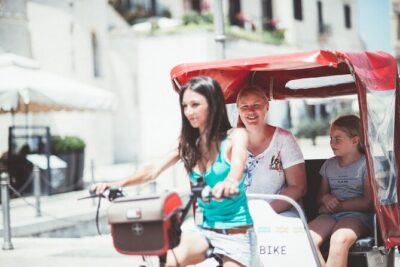
This private rickshaw photo tour is a smart way to see major landmarks without the “where do I stand?” stress, and it’s set up for couples with a photographer plus a warm blanket when the city is cold. You also get a guide, WiFi on board, and music you can request, so it feels less like a bus tour and more like a tailored night out.
The main drawback to think about: it runs about 1 to 2 hours, so if you want to linger forever at every sight or soak up heavy historical detail at each stop, you may wish the route had more time. Also, it depends on good weather, so plan for a backup date if Berlin decides to rain.
In This Review
- Key Things That Make This Rickshaw Photo Tour Worth It
- A Private Rickshaw Beats the Usual “Line Up and Listen” Berlin Plan
- Price and What You’re Getting for $183.35 (Up to 2)
- Where You Meet: Pariser Platz and Pickup Within 2 km
- The Romantic Berlin Route: From Brandenburg Gate to Alexanderplatz
- Brandenburg Gate: Classicism, Angles, and a Quick Photo Moment
- Reichstag Building: Big Turning Points in a Small Time Window
- Soviet Memorial Square: Tanks, Names, and a Quiet Shift
- Berlin Zoo Grounds: From Royal Pleasure Park to English Garden Style
- Potsdamer Platz: Modern Berlin’s Big Reset
- Topography of Terror: A Free Stop With Serious Content
- Martin-Gropius-Bau: Cultural History, Contemporary Art, and Photography
- The Wall: Cold War Reality, Without Needing a Textbook
- Checkpoint Charlie: The Most Famous Crossing in a Divided City
- Friedrichstraße: A Shopping Mile After the Fall of the Wall
- Gendarmenmarkt: Architecture, Huguenots, and a Beautiful Square
- German Cathedral and Parliamentary Democracy Exhibit
- Bebelplatz: Book Burning Memory That Hits Hard
- Neue Wache: A Small Building With a Big Memorial Role
- Museum Island: UNESCO Museum Power on One Central Stage
- The New Synagogue and Nikolaiviertel: Old Streets and Stored Memories
- Alexanderplatz: Berlin’s Lively Hub
- Comfort Tips for When Berlin Weather Turns
- Who This Tour Fits Best
- Should You Book It?
- FAQ
- How long is the Romantic Berlin Rickshaw City and Photo Tour?
- What does the tour cost, and how many people can join?
- Is pickup included, and how far is the pickup radius?
- Is this a private tour?
- Is the tour offered in English, and do I get a mobile ticket?
- What’s included in the price?
- What happens if the weather is bad?
- Where does the tour start and end?
Key Things That Make This Rickshaw Photo Tour Worth It
- Pickup near Brandenburg Gate makes it easier to start without a long walk
- On-board comfort: warm blanket, WiFi, and music on request
- A real photographer helps you get couple-friendly shots without awkward posing
- Big Berlin landmarks in one loop: from Brandenburg Gate to Alexanderplatz
- Mix of classic and modern Berlin: Unter den Linden sights plus Potsdamer Platz
- History stops that actually change the mood: Reichstag, Topography of Terror, Checkpoint Charlie
A Private Rickshaw Beats the Usual “Line Up and Listen” Berlin Plan
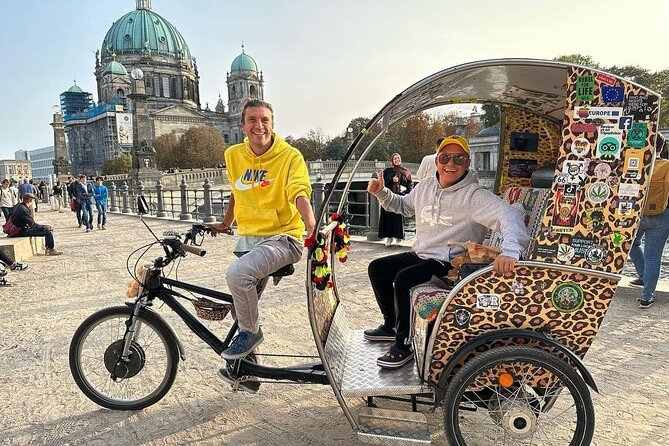
Berlin can be overwhelming. The city is so full of major sights that a typical sightseeing day often turns into: walk fast, glance quickly, repeat. This tour changes the rhythm. You sit, you move, and you get dropped into the right places for photos and context.
What I like is how the “photo tour” part feels built-in, not tacked on. There’s a photographer on board, and the route hits high-recognition backdrops like Brandenburg Gate, Checkpoint Charlie, and Gendarmenmarkt. That matters because good photos in Berlin are mostly about angle and timing, not about owning the best camera.
You can also read our reviews of more tours and experiences in Berlin.


Price and What You’re Getting for $183.35 (Up to 2)
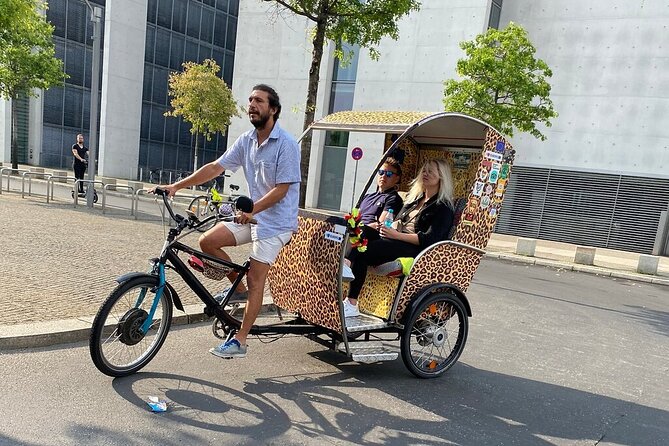
At $183.35 per group (up to 2), this is not a budget tour. But it can be good value if you’re thinking as a couple or as two friends who want a private plan.
You’re paying for:
- Private transportation (not sharing a vehicle with strangers)
- A photographer (not just a guide who tells you where to stand)
- A guide who sets the flow across multiple neighborhoods
- Comfort perks like WiFi on board, a warm blanket, and music on request
- Alcoholic beverages included
If you’re traveling solo, the per-person cost can feel steep. If you’re sharing the vehicle with someone else, it makes more sense because the group rate covers the experience rather than just the seats.
Where You Meet: Pariser Platz and Pickup Within 2 km
The tour starts at Pariser Platz 4A, 10117 Berlin, and it ends back at the same meeting point. If you’re staying around Museum Island or Unter den Linden, this is a convenient hub.
Pickup is included within a radius of 2 km from the Brandenburg Gate. Beyond that, there’s a charge of 10 € per km, paid on the spot. Practically speaking, that means you’ll want to check how close your hotel is before assuming you’ll be picked up.
The Romantic Berlin Route: From Brandenburg Gate to Alexanderplatz
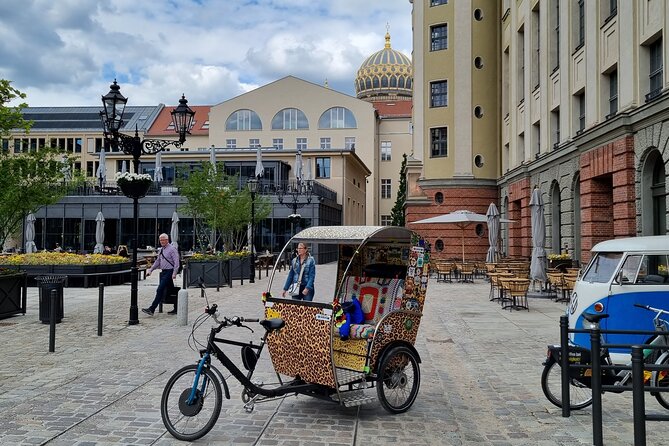
This is the kind of route that gives you a wide sweep of Berlin’s identity: imperial architecture, wartime memory sites, Cold War stories, and modern city planning. It also works well for photos because the landmarks keep changing, so your pictures don’t all look like the same street corner.
You’ll spend about 1 to 2 hours on the move, and the stops are short enough to keep momentum, but long enough to get the key shots.
Brandenburg Gate: Classicism, Angles, and a Quick Photo Moment
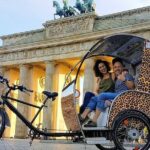
You start with the Brandenburg Gate, one of Germany’s best-known classical structures. It was built between 1788 and 1791 based on designs by Carl Gotthard Langhans the Elder, drawing inspiration from the Propylaea of the Athens Acropolis. The gate was ordered by King Friedrich Wilhelm II as a finishing statement for the boulevard Unter den Linden.
Why this stop works on a rickshaw: you get a clean, iconic backdrop without needing to navigate crowds on foot. It’s also one of those sites where your photo instantly communicates place—so even if you only get a few frames, the result usually looks “Berlin.”
Practical tip: wear something warm and consider face-covering layers if it’s cold. This is an outdoors landmark stop, and you’ll be standing for photos.

Reichstag Building: Big Turning Points in a Small Time Window
Next up is the Reichstag Building, tied to major shifts in German history. On November 9, 1918, Philipp Scheidemann (SPD) proclaimed the republic from the west portal balcony. Later, the Reichstag fire in February 27, 1933 destroyed the plenary hall and dome. Then on April 30, 1945, a Soviet symbol of victory appeared as a red flag was hoisted by two Red Army soldiers.
This is a heavy stop, but the advantage on this tour is pacing. You don’t get dragged through every detail. Instead, you get the key dates and imagery, so your brain can connect it all while you keep moving.
If you’re the type who loves deep political context, you may want to ask your guide follow-up questions at this moment. One review feedback pointed to limited background knowledge, and that’s exactly where it would matter most if you want more than the essentials.
Soviet Memorial Square: Tanks, Names, and a Quiet Shift
After that, the mood turns to remembrance at a memorial square. You’ll see a bronze statue of a Red Army soldier with his rifle on his shoulder, and the scene is framed by two T-34 tanks. Names of fallen Soviet soldiers appear on the pillars behind, and the memorial area includes graves for about 2,500 soldiers.
This stop is short, but it hits hard. Tanks aren’t subtle, and that’s the point: the city forces you to acknowledge the weight of history rather than treat it like background scenery.
For photography, this location can create strong contrast. Just be respectful: keep your pace calm and your photos quick.
Berlin Zoo Grounds: From Royal Pleasure Park to English Garden Style
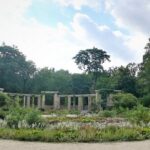
You then move toward a major green-space area associated with Berlin Zoo. The origin traces back to the end of the 17th century, when Elector Friedrich III created a pleasure park from former hunting grounds. The park evolved over time and was redesigned into an English-style public park between 1833 and 1838 by landscape designer Peter Joseph Lenné.
What you can expect here on a rickshaw tour is less about zoo animals and more about how Berlin blends city life with big park space. You’ll pass sights that include monuments and bridges, and you’ll get the feel of the park’s scale—covering roughly 200 hectares.
If you like photos with nature lines and soft edges, this is one of the most forgiving stops. The English Garden-style design around a pond can create calmer images than the strict angles of war memorials.
Potsdamer Platz: Modern Berlin’s Big Reset
Next comes Potsdamer Platz, an area planned as a district rather than a single monument. It includes cafes, cinemas, and shops between futuristic skyscrapers—something Berliners and visitors actually use.
What’s useful for you: Potsdamer Platz is where Berlin feels like the city is moving forward, even while everything around it remembers the past. It’s a nice contrast after memorial sites and Cold War checkpoints.
There’s also a sense of engineered space: a whole new district created on 6.8 hectares between Potsdamer Platz and Reichpietschufer.
Topography of Terror: A Free Stop With Serious Content
The Topography of Terror area is connected to the planning and control of many Nazi crimes, located on what became a central site for the SS and police institutions from 1933 to 1945. It’s presented as a free stop on this tour, which helps you spend your time and money wisely.
This is one of those places where a short visit works because you’ll likely want to process what you saw. If your mind starts racing, that’s normal. Keep your walk slow during the stop and let the images and information settle.
Martin-Gropius-Bau: Cultural History, Contemporary Art, and Photography
The tour also passes Martin-Gropius-Bau, a building dedicated to cultural history, contemporary art, and photography. Even if you don’t go inside, seeing it from the outside on a rickshaw gives you a quick sense of Berlin’s modern cultural engine—right alongside its heavy historical weight.
If you’re planning a longer stay in Berlin, this is a good signal that you might want to add museum time later.
The Wall: Cold War Reality, Without Needing a Textbook
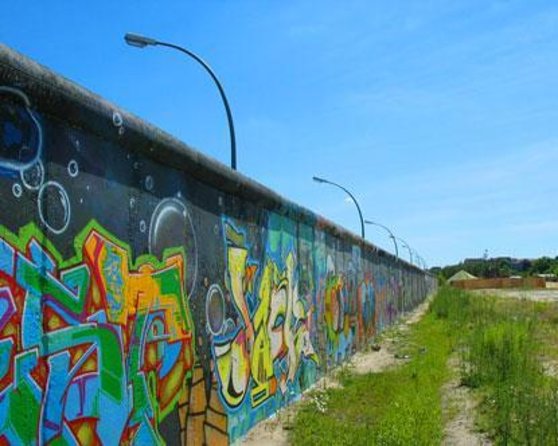
There’s a Wall stop, which usually gives you the visual shock of the barrier—Berlin isn’t shy about showing you what division looked like. On a short tour, it’s more about recognition and feeling than about detailed study.
If you’re a photography-first person, the Wall stop can also help you shift your picture style from grand monuments to documentary-looking scenes.
Checkpoint Charlie: The Most Famous Crossing in a Divided City
You’ll reach Checkpoint Charlie, historically the best-known border crossing during Berlin division, controlled by Americans along with other checkpoints such as Helmstedt-Marienborn (Checkpoint Alpha) and Dreilinden-Drewitz (Checkpoint Bravo). Passage was limited to foreigners and certain official categories (including employees of FRG representation in GDR and GDR functionaries).
This stop works well for couples because it’s dramatic, recognizable, and easy to photograph. But it’s also a chance to reframe the photos: the goal isn’t just to capture a famous sign—it’s to remember how real movement was restricted for decades.
Friedrichstraße: A Shopping Mile After the Fall of the Wall
Right near Friedrichstraße, the tour highlights how a lively shopping stretch emerged between Checkpoint Charlie and Friedrichstraße station after the Wall fell.
This is a softer moment in the route, a shift from Cold War sites to everyday Berlin life. If you want to keep the romantic mood, this is where it’s easiest to do it. You can point, glance, and snap photos without the emotional weight of memorial ground.
Gendarmenmarkt: Architecture, Huguenots, and a Beautiful Square
Gendarmenmarkt is a standout square built in the late 17th century by Johann Arnold Nering. French immigrants, especially French Protestants (Huguenots), settled in the area, and the square went through several names before becoming Gendarmenmarkt in 1799, tied to the guard stables of the regiment “Gens d’armes.”
On this tour, it’s a free stop and a great place to take pictures because the architecture gives you natural symmetry. You’ll also see the concert hall on the square, described as a masterpiece of classical architecture and one of Karl Friedrich Schinkel’s main works. There was even a small comedy house opened here in 1776, later growing into major theater importance.
German Cathedral and Parliamentary Democracy Exhibit
At Gendarmenmarkt, there’s also the German Cathedral area with a permanent exhibition titled Ways – Irrwege – Detours, shown across multiple floors. It focuses on the historical development of liberal parliamentary democracy in Germany.
This is where the tour balances emotion with political structure—how a country gets rebuilt into something different. You may not have time to read everything, but it gives a strong sense of how democracy developed on paper and in institutions.
Bebelplatz: Book Burning Memory That Hits Hard
The tour then moves to Bebelplatz, tied to the memory of book burnings. Under the Nazis, books were burned here on May 10, 1933—over 20,000 volumes. A memorial commemorates the act, and the information includes names of authors whose works were targeted, including Erich Kästner, the Mann family, Magnus Hirschfeld, Lion Feuchtwanger, Karl Marx, Else Lasker-Schüler, and almost 400 others, including Heinrich Heine.
This stop is powerful because it’s not just history trivia. It’s a reminder of what power does to ideas. For photography, the square is useful, but reading the memorial text (even briefly) is where the real impact lands.
Neue Wache: A Small Building With a Big Memorial Role
Right next to the armory (now housing the German Historical Museum), Neue Wache is a smaller site built between 1816 and 1818 according to plans by Karl Friedrich Schinkel. Since 1993, it has served as the central memorial in the Federal Republic of Germany for victims of war and tyranny.
The reason it belongs on a romantic photo tour is exactly this: Berlin’s romance is not sugar-coated. It includes grief, remembrance, and a willingness to face what happened.
If you’re feeling heavy after Bebelplatz, Neue Wache can feel like a slower landing.
Museum Island: UNESCO Museum Power on One Central Stage
The tour heads toward Museum Island, a major museum complex and a UNESCO World Heritage Site. Even if you’re not doing a full museum visit during the tour, it helps you understand why this part of Berlin is such a magnet. It also sets you up for a smart day plan later.
You’ll also pass Berlin Cathedral, described as a must for church lovers and visitors, plus Lustgarten, the spacious square once belonging to the Berlin City Palace.
The New Synagogue and Nikolaiviertel: Old Streets and Stored Memories
You’ll see the New Synagogue on Oranienburger Strasse—once the largest and most important synagogue in Germany. This matters because it adds another layer to Berlin’s story: not only political division and war, but also culture, faith, and community.
Then comes Nikolaiviertel, Berlin’s first and oldest residential area. With Nikolaikirche and historic houses plus restaurants and coffee shops, it feels like Berlin trying to hold onto its early urban texture.
For couples, this is where your photos can look more personal. Instead of another monumental backdrop, you get street-level charm.
Alexanderplatz: Berlin’s Lively Hub
Finally, the tour reaches Alexanderplatz, one of Berlin’s liveliest squares. It has stayed important across the 1920s, the GDR era, and today.
This stop gives a clean finish: you end with energy, not silence. If you’re heading out afterward for food, Alexanderplatz is an easy place to keep the evening going.
Comfort Tips for When Berlin Weather Turns
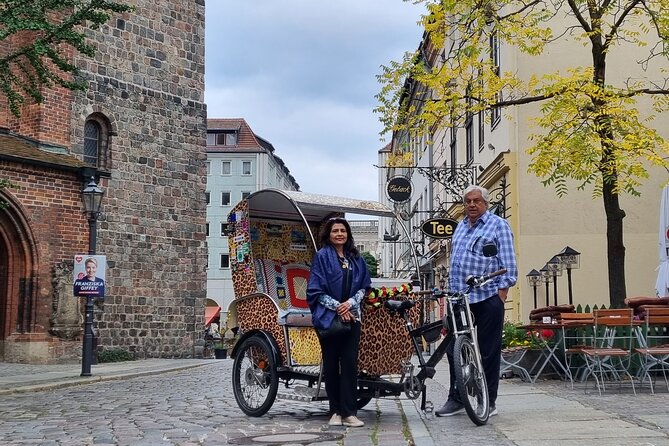
This tour includes a warm blanket, which helps, but it won’t erase wind. I’d dress like you’re going to stand outside for photos—because you are.
Also, because there’s music on request, decide what kind of vibe you want before you start. It can make the ride feel lighter, especially after you’ve walked through some intense history stops.
Who This Tour Fits Best
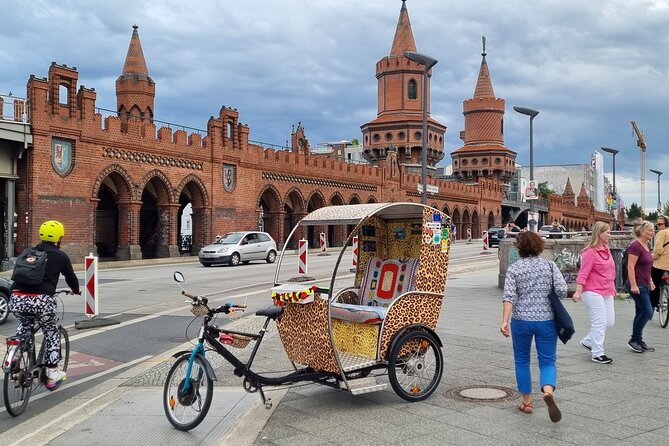
This is a strong choice for:
- Couples who want private time and help getting photos
- People who like mixing classic landmarks with Cold War and remembrance sites
- Travelers who want a guided route without committing to a full-day museum plan
It might be less ideal if:
- You want deep, minute-by-minute historical interpretation at every stop
- You’re hoping to maximize time on the rickshaw itself, since the route is built around short stops and quick transitions
Should You Book It?
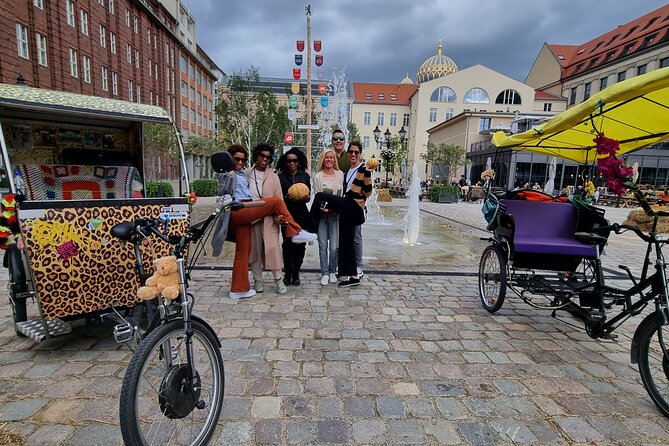
Yes—if you want an easy, photo-friendly way to see a lot of Berlin in a tight window, and you appreciate comfort extras like a blanket, WiFi, and music. The value makes most sense when you share the price for two, because you’re getting private transport plus a photographer.
I’d say book it on a day when the weather is likely to cooperate. Berlin is gorgeous, but this tour depends on it, and it’s the kind of experience you’ll want without last-minute stress.
If you care most about history detail, come with a couple of focused questions—especially around Reichstag and the Cold War stops—so you can steer your guide toward the level of context you want.
FAQ
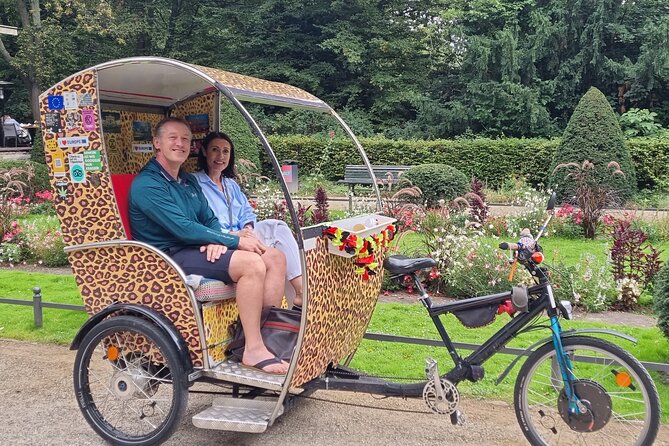
How long is the Romantic Berlin Rickshaw City and Photo Tour?
The tour lasts about 1 to 2 hours.
What does the tour cost, and how many people can join?
It costs $183.35 per group and accommodates up to 2 people.
Is pickup included, and how far is the pickup radius?
Pickup is included within a radius of 2 km from the Brandenburg Gate. Beyond that, there’s a 10 € per km charge paid on the spot.
Is this a private tour?
Yes. It’s a private tour/activity, and only your group participates.
Is the tour offered in English, and do I get a mobile ticket?
The tour is offered in English, and you receive a mobile ticket.
What’s included in the price?
Included items are private transportation, WiFi on board, a warm blanket, music on request, a travel guide, a photographer, and alcoholic beverages.
What happens if the weather is bad?
The experience requires good weather. If it’s canceled due to poor weather, you’ll be offered a different date or a full refund.
Where does the tour start and end?
It starts at Pariser Platz 4A, 10117 Berlin, Germany, and ends back at the same meeting point.