REVIEW · BERLIN
Rickshaw Tours Berlin – Groups of up to 16 people with several rickshaws
Book on Viator →Operated by Rikscha & Bier Bike & Party Beer Bike - Leo Rickshaw Tours · Bookable on Viator
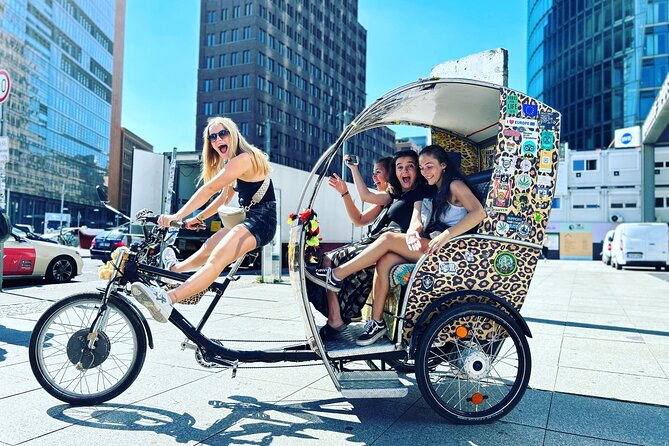
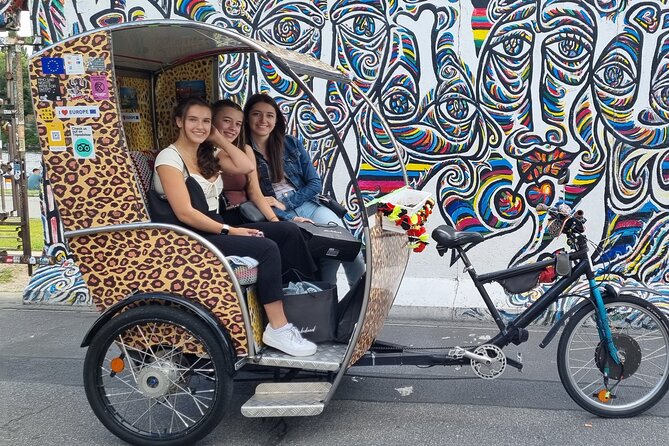
Berlin glides by rickshaw. This tour is a small-group ride that hits major landmarks fast, using several rickshaws so you’re not stuck in one long bus line. I really like the up-close street-level views and how guides can steer the pace toward what you want to see.
I also appreciate that it’s offered in English and includes extras that make the experience feel more like a guided city afternoon than a quick sightseeing shuffle. The main drawback to weigh is reliability and vehicle comfort: there have been reports of no-shows and, in colder weather, the operator has cited vehicle battery problems leading to cancellations.
In This Review
- Key Things That Make This Berlin Rickshaw Tour Work
- Price and Logistics: What $53.10 Buys You
- How the Rickshaw Format Changes Berlin Sightseeing
- Your Guided Circuit Through Berlin’s “Must-See” Landmarks
- Brandenburg Gate: Classicism Meets German Identity
- Reichstag / Bundestag: Balcony Moments and World-Altering Dates
- German Chancellery: The Choice to Look Transparent
- Soviet War Memorial Tiergarten: Tanks, Names, and Burial Ground
- Tiergarten and the English Garden Idea: A Park That’s Not Just Trees
- Potsdamer Platz: A Rebuilt District That People Actually Use
- Topography of Terror: How the Nazi Machine Operated
- Gropius Bau: Art Stops for Your Brain
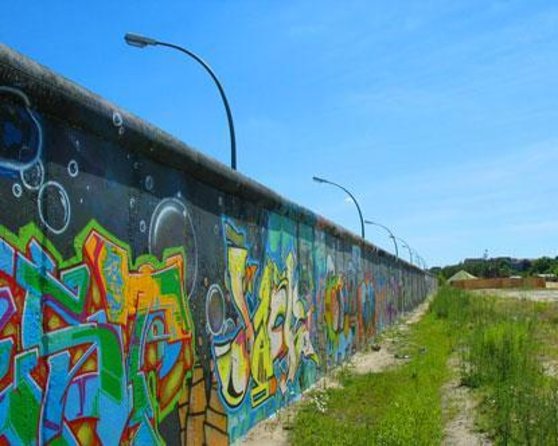
- Berlin Wall Memorial at Bernauer Straße: The Escape Story You Can See
- Checkpoint Charlie and the Border Reality
- Friedrichstraße: Where the Axis Becomes a Shopping Mile
- Gendarmenmarkt, Deutscher Dom, and Konzerthaus: Neat Symmetry and Civic Pride
- Bebelplatz: Book Burning and the Memorial That Points Back
- Museum Island and the Berliner Dom Dome View: Central Berlin in One Gaze
- Lustgarten and Alexanderplatz: Green Space, Fountains, and Modern Motion
- The Guide Makes the Tour: Hugo, Leo, and the Real Difference
- When This Tour Might Not Be Your Best Bet
- Should You Book? My Straight Advice
- FAQ
- How long is the Rickshaw Tours Berlin experience?
- Where does the tour start and is pickup included?
- Is this tour private?
- What language is the tour offered in?
- Are entrance tickets included for the sights?
- What’s included in the price?
- What if the weather is bad?
Key Things That Make This Berlin Rickshaw Tour Work
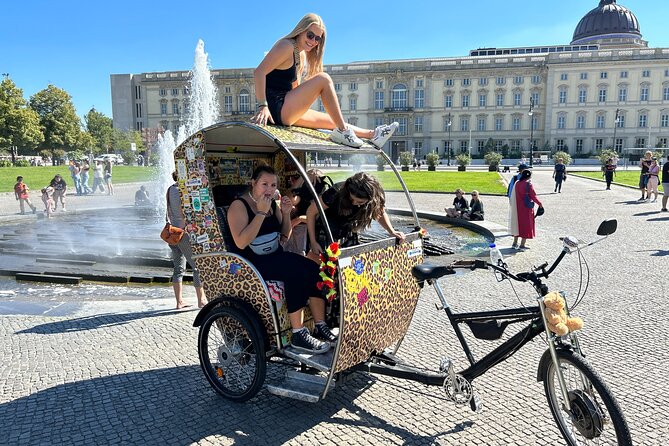
- Several rickshaws for groups up to 16: less crowding than one big vehicle, but you may still split into different rickshaws.
- Brandenburg Gate start: a natural anchor for the classic Berlin core.
- Big Cold War stops in short photo windows: you see the most famous locations without needing a full museum day.
- Music on request + onboard WiFi: small comforts that make sitting and riding feel easy.
- English guide and a photographer: you’re not only looking, you’re also getting help interpreting what you’re seeing.
Price and Logistics: What $53.10 Buys You
At $53.10 per person, you’re paying for convenience plus interpretation, not for big museum entries. The tour length is listed as about 1 to 4 hours, so the value really depends on whether you get a shorter sprint or the longer loop.
This is a private activity for your group (up to 16 people), and you’ll have a tour guide with you. Pickup is offered within a 2 km radius of the Brandenburg Gate; after that, there’s a charge of 10€ per km, so it matters where your hotel sits in relation to the center.
One practical point: this route leans toward quick stops and photo time. That’s great for getting your bearings, but it also means you should treat it as a guided circuit, not a slow, in-depth visit to every building.
You can also read our reviews of more tours and experiences in Berlin.


How the Rickshaw Format Changes Berlin Sightseeing
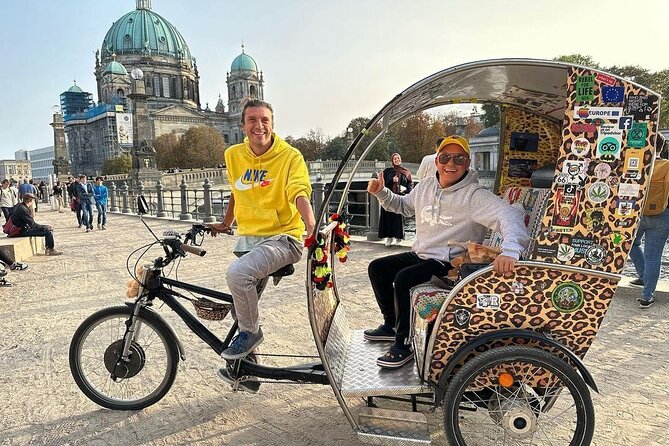
Berlin can be a lot on foot—especially if you’re trying to cover East/West history and central highlights in one day. Sitting in a rickshaw helps you focus. You see street details, building proportions, and changes in neighborhoods without constantly stopping to catch your breath.
You also get flexibility from the way guides operate with multiple rickshaws. Some guides are known for adjusting to what you want in the moment—where you want more time for photos, and which areas you want to understand better. In the best cases, the ride feels tailored without turning into a complicated planning headache.
The tradeoff is comfort and spacing. A few accounts mention seating tightness in certain rickshaws. If you’re booking with family, teens, or anyone who’s sensitive to cramped seating, it’s worth thinking about group layout when you arrive.
Your Guided Circuit Through Berlin’s “Must-See” Landmarks
This tour’s route is built around a classic Berlin sweep plus the Cold War story—then finishing in the central squares and viewpoints. Expect lots of landmarks tied to power, ideology, and rebuilding, with brief time windows at each stop.
A typical flow starts at Brandenburg Gate, moves through the parliamentary and government area, then shifts into memorials and border history. After that you’ll go into Potsdamer Platz and the central museum/ cathedrals zone, with Alexanderplatz as a lively final anchor.
Below is what you’ll be looking at and why each stop is worth your time.
Brandenburg Gate: Classicism Meets German Identity
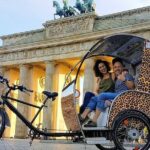
You begin at the Brandenburg Gate (sandstone, built 1788 to 1791). The design is credited to Carl Gotthard Langhans the Elder, and the gate’s inspiration traces back to the propylaea of the Athens Acropolis—so it’s not just Berlin being grand; it’s Berlin borrowing from a much older idea of ceremonial architecture.
This stop also matters because it sits at the end of the boulevard Unter den Linden, which historically functioned as a major urban axis. It’s the kind of place where you can understand Berlin’s “center” visually in minutes, even if you’ve only just arrived.
You’ll get a short window here—think orientation and photos more than lingering.
Reichstag / Bundestag: Balcony Moments and World-Altering Dates
Next comes the Reichstag building, where German history has repeatedly turned. On November 9, 1918, SPD politician Philipp Scheidemann announced the Republic from the west portal balcony—an event that still defines how people talk about the fall of the old order.
Then the Reichstag fire on February 27, 1933 destroyed major parts of the building. And by April 30, 1945, a Red Army flag was raised on that historic site, symbolizing the defeat of the Third Reich.
You’ll be viewing this in a short stop, and admission tickets aren’t included. Still, the context you get here helps the rest of the tour click—because you’ll understand why so many later sites are obsessed with control, borders, and propaganda.



German Chancellery: The Choice to Look Transparent

The German Chancellery stop shows a very different architectural message. The main administration building rises about 36 meters high between two wings, and the description emphasizes how the building feels “light” thanks to large glass surfaces and big cut-out openings.
This is the kind of place where architecture is part of the political story: glass, arches, and atriums communicate openness. Even in a brief viewing window, it’s worth looking closely at how the building shifts from solid concrete to areas of transparency.
Admission tickets aren’t included here, so focus on the exteriors and the overall layout.
Soviet War Memorial Tiergarten: Tanks, Names, and Burial Ground
Then you’ll move into the Tiergarten Soviet War Memorial. It’s flanked by two T 34 tanks, with a bronze statue of a Red Army soldier carrying a rifle on his shoulder in the middle of the square.
What hits hardest are the names carved onto the pillars behind him and the fact that the memorial’s rear holds graves of around 2,500 soldiers. This stop is short, but the emotional weight is heavy, and it’s one of those places where you’ll probably want a quiet minute before you roll on.
Admission is free at this stop, which makes it a good place to catch your breath in the middle of a high-speed circuit.
Tiergarten and the English Garden Idea: A Park That’s Not Just Trees

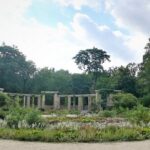
The route also passes through Tiergarten highlights, including the story of how Berlin’s zoo area and public green space developed. At the end of the 17th century, Elector Friedrich III created a pleasure park for the population from former hunting grounds.
Later, landscape designer Peter Joseph Lenné transformed the area between 1833 and 1838 into an English public park style. You’ll hear how the English Garden concept became one of the park’s most beautiful corners—especially around the pond.
This part of the tour is useful because it breaks up the heavy history with scenery and a different pace. Short ride breaks can make a longer day feel manageable.
Potsdamer Platz: A Rebuilt District That People Actually Use
Potsdamer Platz is the next major jump. It was planned as a full district by architects, and the description stresses that it succeeded because locals adopted the cafes, cinemas, and shopping spaces between the surrounding high-rises.
It’s also a good place to see Berlin’s layering: modern planning concepts placed on a site that has been shaped by 20th-century upheavals. The tour gives a brief look here, and admission isn’t required.
If you want a snapshot of how Berlin reassembled itself into a lived-in city center, this is one of the fastest ways to get that picture.
Topography of Terror: How the Nazi Machine Operated
Then comes Topography of Terror, tied to the planning and control of Nazi crimes between 1933 and 1945. The site was linked to major SS and police institutions, including the Secret State Police Office and the Reich Security Main Office.
This stop is free and short on purpose, which can be good if you want a clear introduction before committing time to readings or an extended museum visit on your own. The risk is also obvious: it’s a lot of information in a short time.
My advice: treat this as a compass point. If you leave wanting more detail, plan to come back later with extra time.
Gropius Bau: Art Stops for Your Brain
Gropius Bau (Martin-Gropius-Bau) is a contrast stop. It’s described as dedicated to cultural history, contemporary art, and photography.
Even when you’re not going inside, seeing how the route places an art-focused venue near heavy historical sites helps balance the day. It keeps the tour from feeling like a single emotional line of only politics and memorials.
Admission may not be included here, so focus on what you can see quickly and decide later if you want a full exhibition visit.
Berlin Wall Memorial at Bernauer Straße: The Escape Story You Can See
The Wall memorial is located at Bernauer Straße, where the street marked the boundary between Wedding (West) and Mitte (East). People in locked-down East Berlin faced unimaginable risk—jumping from windows into the West.
This stop is about 1 minute in your circuit, but the message is powerful. Berlin inaugurated the Wall Memorial on August 13, 1998 at the corner of Ackerstraße, and that modern memorial framing helps you place the Wall in a timeline that ends in remembrance.
Admission isn’t included here, and you’ll want to watch for the details that make the site feel specific rather than generic.
Checkpoint Charlie and the Border Reality
Checkpoint Charlie is next, and it’s presented as the most famous border crossing controlled by the Americans (among other controlled points). The tour emphasizes that crossings were limited—used by foreigners, by employees of the Permanent Representation of the FRG in the GDR, and by GDR officials.
This is one of those places where Berlin tourists often focus on the famous name. Your guide’s role matters because the real story is the rules and restrictions behind the name.
It’s a short stop, free to view, and a good anchor before you look at later shopping streets shaped by the post-Wall era.
Friedrichstraße: Where the Axis Becomes a Shopping Mile
Friedrichstraße runs through Berlin as a north-south axis. After the fall of the Wall, a popular shopping mile developed between Checkpoint Charlie and Friedrichstraße station.
This stop is short and free, but it shows you something important: borders don’t only change politics; they change daily movement. It’s a practical way to understand how Berlin life restarted in the central corridors.
Gendarmenmarkt, Deutscher Dom, and Konzerthaus: Neat Symmetry and Civic Pride
Gendarmenmarkt is created at the end of the 17th century, initially as a settlement area for French immigrants, especially Huguenots. The square changed names over time—Esplanade, Lindenmarkt, Friedrichstädtischer Markt, Neuer Markt—before becoming Gendarmenmarkt in 1799.
You’ll also see the German Cathedral (Deutscher Dom) and the Konzerthaus am Gendarmenmarkt area.
- The Deutscher Dom has a permanent exhibition described as Ways – wrong trails – detours, showing the development of liberal parliamentary democracy across five floors. Admission isn’t included, but the concept alone is worth noting because it mirrors the tour’s theme of political turning points.
- The Konzerthaus is linked to classicist architecture and is credited as a major Schinkel work. It traces back to a small comedy house opened in 1776 and later renamed the Royal National Theater in 1787.
Even if you don’t go inside, the architecture gives you a different kind of history lesson: how civic life tried to look stable and cultured.
Bebelplatz: Book Burning and the Memorial That Points Back
At Bebelplatz, you’ll hit one of the starkest ideological moments in modern Germany. On May 10, 1933, national socialists burned over 20,000 books here, labeling chosen works as non-German spirit.
The description lists authors and names, including Erich Kästner and Heinrich Heine, plus works tied to the Mann family and others. This stop is free, quick, and it’s built as a memorial site—so you’re meant to reflect, not just photograph.
Museum Island and the Berliner Dom Dome View: Central Berlin in One Gaze
Museum Island sits between the Spree and the Kupfergraben, described as world-famous with archaeological collections and 19th-century art housed in its buildings. The ensemble’s starting point includes the completion of the Old Museum in 1830, designed by Schinkel.
Then you’ll pass the Berliner Dom. It’s hard to miss thanks to its dome, and the tour notes that it’s richly decorated inside and out. There’s also an option for a dome view if you climb it, though admission tickets aren’t included in your circuit.
Both stops are short and not ticket-included, so treat them as high-impact visual markers. If you want museum time, plan a separate visit.
Lustgarten and Alexanderplatz: Green Space, Fountains, and Modern Motion
Lustgarten is a pleasure garden between Karl-Liebknecht-Straße, Kupfergraben, the Altes Museum, and the Berliner Dom. It originally belonged to the city palace, and today it has linden tree rows and a huge red granite bowl.
In summer, it’s described as a spot where tourists relax on lawns or cool off by the fountain. Then the tour ends with Alexanderplatz, one of Berlin’s liveliest central squares. It’s presented as an anchor from the 1920s through GDR times to today, with highlights like the television tower, world clock, and a fountain of friendship between peoples.
Alexanderplatz is free to view and a fun finish because it shifts your brain away from memorial mode and back into everyday city energy.
The Guide Makes the Tour: Hugo, Leo, and the Real Difference
This kind of sightseeing works only if the narration lands. In the accounts tied to this operator, Hugo and Leo show up as standouts—praised for mixing stories with pacing, helping groups get what they came for, and making the ride feel fun instead of robotic.
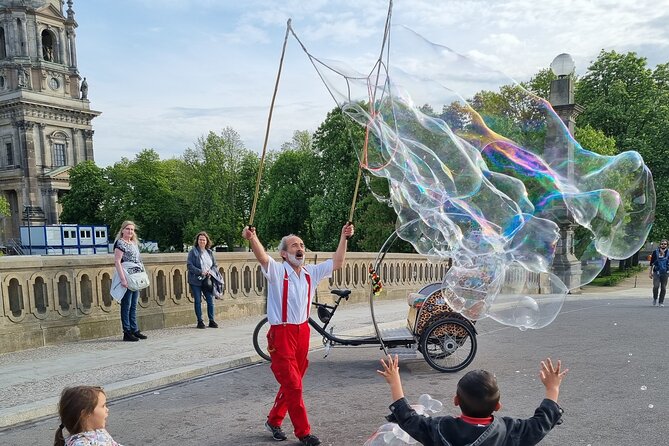
Music on request is part of what’s included, and in some cases it’s been a hit when used lightly. But there are also mentions of music being too loud for conversation, so if you’re the type who wants clear guide talk, just ask for the volume to stay conversational.
Also, the photographer element is real value if you want a set of group images from the road rather than relying on shaky phone attempts during stops.
When This Tour Might Not Be Your Best Bet
This tour is a strong choice if you:
- want a first-time Berlin loop with the biggest landmarks
- prefer sitting down over long walking days
- like a guide-driven story tying sites to dates and meaning
It may not suit you as well if you:
- need long museum time at specific interiors (your viewing windows are short)
- can’t handle cancellations or schedule disruption on a tight itinerary
- have specific comfort needs related to rickshaw seating and group splits
The operational caution is worth taking seriously. Some accounts report the operator failing to show up. Others mention vehicle battery problems in cold weather leading to cancellations. That doesn’t mean the tour is always unreliable, but it does mean you should plan with buffer time and keep a Plan B for that day.
Should You Book? My Straight Advice
If you’re on a time budget and you want the Cold War and central Berlin story without spending hours walking, I think this is a smart use of your limited vacation hours. The route is built around big, recognizable places and memorial points that help you connect the dots.
Book it if you can stay flexible with weather and timing. Also, if you’re traveling with a group of four or more, think about how you’ll be seated across multiple rickshaws so nobody gets stuck feeling squeezed.
If you’re traveling during colder stretches or you’re counting on this tour as the single anchor of your day, add extra slack to your schedule. That one habit can protect your trip from the biggest downside—when the unexpected happens.
FAQ
How long is the Rickshaw Tours Berlin experience?
The duration is listed as about 1 to 4 hours.
Where does the tour start and is pickup included?
It starts at Brandenburger Tor (10117 Berlin). Pickup is included within a 2 km radius of the Brandenburg Gate; more than that costs 10€ per km.
Is this tour private?
Yes. It’s a private tour/activity, and only your group participates.
What language is the tour offered in?
The tour is offered in English.
Are entrance tickets included for the sights?
Not always. Some stops are marked free, while others specify admission tickets are not included (for example, several major buildings and museums).
What’s included in the price?
Included items are WiFi on board, private transportation, music on request, a photographer, and a tour guide.
What if the weather is bad?
The experience requires good weather. If it’s canceled due to poor weather, you’ll be offered a different date or a full refund.