REVIEW · PORTO
Porto Guided Tour to the Historical Center on a Tuk Tuk
Book on Viator →Operated by Portuk · Bookable on Viator
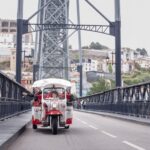
Want Porto fast and fun? This private Tuk Tuk ride zips you through narrow lanes, then parks you at the sights that matter, with photo time built in. I also like the included port wine taste, because Porto isn’t shy about letting you try the real deal.
One heads-up: on busy traffic days, you may find the guide harder to hear while you’re driving, so keep an eye out for stops where you can get the full story.
The route works well if you want to get your bearings fast and decide what to revisit later on foot (or by tram) without burning a whole day on logistics.
In This Review
- Key highlights you’ll actually feel
- Why a Tuk Tuk is a smart way to see Porto’s center
- Porto in 1h50: how the timing really works
- From the old theatre site to the Fernandina wall
- Cathedral area and the Pelourinho terrace: law, faith, and what changed
- Paco Episcopal and São Bento: façades and a station lobby full of stories
- Praça Nova, the Lions fountain, and Porto’s rococo churches
- Cordoaria Garden and Torre dos Clérigos: green breaks and a sky marker
- Stock Exchange Palace, D Pedro’s monument, and Lello’s Art Nouveau façade
- Praça and monument to Infante D. Henrique, then São Francisco’s gold interior
- Alfândega Nova do Porto: iron engineering and a transport museum setting
- Serra do Pilar monastery and the two iron bridges: the view payoff
- What’s included, and what costs extra
- Guide style: why the best tours feel playful and precise
- Price and value: does $42.33 make sense?
- Tips to avoid the common hiccups
- Should you book this Porto Historical Center Tuk Tuk tour?
- FAQ
- How long is the Porto Historical Center Tuk Tuk tour?
- What language is the tour offered in?
- What’s included in the price?
- Are monument entrance fees included?
- Is this a private tour?
- What weather does the tour require?
Key highlights you’ll actually feel
- Tuk Tuk access to cobbled, tight streets that larger buses struggle with
- Port wine glass included, a small stop that lands perfectly in the middle of sightseeing
- Mix of big-name monuments and quieter architectural details so Porto doesn’t feel like a checklist
- Short, timed viewing stops that help you cover a lot without feeling trapped
- A view-focused finale at Serra do Pilar and two major iron bridges
- English mobile-ticket tour with a private group setup for your family or friends
Why a Tuk Tuk is a smart way to see Porto’s center
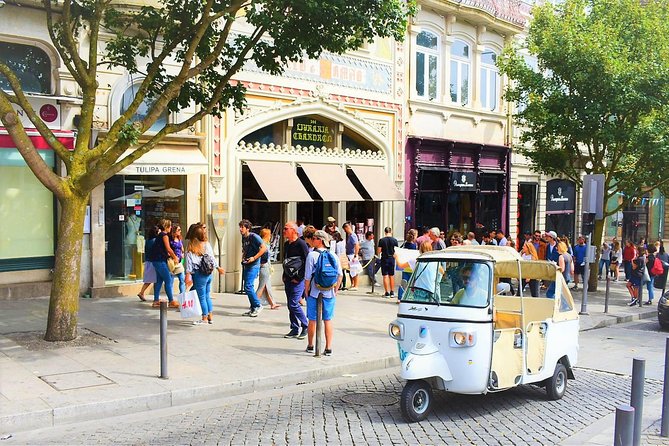
Porto’s historic core is packed with steep hills, narrow streets, and winding turns. A Tuk Tuk tour solves the main problem: getting from sight to sight without turning your day into a leg-day workout.
You’ll also get a practical kind of sightseeing. This isn’t just “look at a monument.” It’s more like: here’s how the city is laid out, where the viewpoints sit, and which streets are worth wandering later when you’re not on a schedule.
And the vibe is usually light. In the reviews, guides named like Victor, Natalia, Anna, and Ana come across as energetic and fun, not just reciting dates. That matters in a fast-paced tour, because it helps you remember what you saw and why it’s important.
The only real caution is sound. The Tuk Tuk setup is great for mobility, but if the street noise and traffic spike, you might miss parts of the narration while you’re in motion.
You can also read our reviews of more tours and experiences in Porto.


Porto in 1h50: how the timing really works
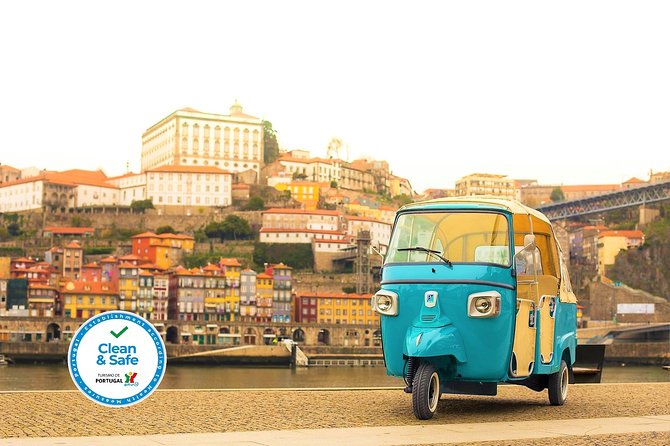
The tour runs about 1 hour 50 minutes, with multiple stops ranging from about 5 to 15 minutes. That short window is the point. It lets you see a spread of highlights, then move on before your interest drops.
At each stop, aim for two things:
1) a quick look at the exterior details (Porto loves façades, stonework, and tile patterns)
2) a short “orientation moment” where you understand the building’s place in the neighborhood
If you want to go inside any churches, stations, cloisters, or museums, know that monument entrances are not included. You can still enjoy plenty from the outside, but budget a little extra time/money if you decide to step in.
From the old theatre site to the Fernandina wall
The early part of the route gives you two very Porto contrasts: theatrical ambition on one side, and medieval fortification on the other.
First up, you’ll come to a theatre building constructed in 1910. It sits on the ruins of the Real Theatre, which burned down in 1908. What makes this stop interesting is the idea of layered time—modern-Porto architecture sitting on an earlier disaster site. The façade references a renovation style linked to Luís XVI, and the building is tied to theatre production and the encouragement of access to classic and contemporary drama.
Next, you’ll see Muralha Fernandina do Porto, one of Porto’s most tightly guarded secrets. This is a military wall built between 1368 and 1437, extending for around 3,000 steps and reaching roughly 30 feet in height. It’s not just impressive because it’s old—it’s impressive because it explains how Porto protected itself, and why the streets around the center feel the way they do.
If you’re short on time, this early sequence works because it sets the pattern: you’ll spend the rest of the tour bouncing between architecture, power, and the city’s habit of turning history into streets you can still walk through.
Cathedral area and the Pelourinho terrace: law, faith, and what changed
Then the tour shifts toward the cathedral zone.
You’ll stop at Catedral do Porto, with construction dating back to the 12th/13th century. It started in Romanesque style and was enlarged and renewed over the years, even into the 20th century, creating an “idealized reconstitution” of the medieval cathedral. Even if you don’t go in, the setting helps you picture how the center evolved.
Right nearby is the Pelourinho area. In 1940, surrounding buildings linked to the cathedral complex were demolished under national policy, and a paved terrace replaced them. A stone monument representing local government (the pelourinho) was placed later, in 1945, built as a reproduction of a drawing from 1797.
This stop is a reminder that Porto’s center hasn’t been frozen in time. It has been edited, repaired, and reshaped—sometimes for political reasons, sometimes for practical ones.
Paco Episcopal and São Bento: façades and a station lobby full of stories
Next you’ll see Paco Episcopal (Episcopal Palace). It’s likely rooted in the 13th century or earlier structures, but the major remodel came in 1737, with design changes associated with Nicolau Nasoni. The façade features a large arch opening, pilasters, a decorated fronton, and a coat of arms above the central window. Lateral façades repeat the framing-window + fronton pattern, so if you like symmetry and stone details, this is worth your time.
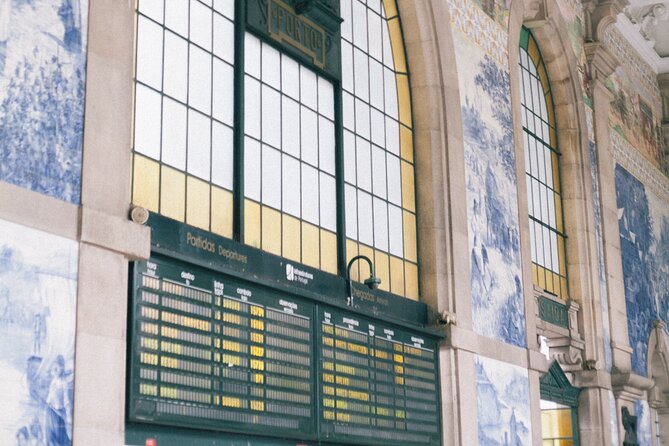
Then comes the big crowd-pleaser: São Bento Railway Station. It’s in the center, built in the early 20th century with a glass and cast iron roof attributed to Marques da Silva. But the real star is the lobby: it’s covered with around 20,000 narrative tiles by painter Jorge Colaço.
Even if you don’t catch a train, you’ll feel why this station is treated like a cultural monument. It’s storytelling in ceramic form. You can stand, look, and keep discovering new scenes without needing a ticket for a show.





Praça Nova, the Lions fountain, and Porto’s rococo churches
One part of the route you’ll notice right away is how it balances grand landmarks with “blink-and-you’ll-miss-it” city moments.
You’ll spend time around a square whose roots go back to the early 18th century. In 1718, the area was urbanized with new streets and an ample space called Praça Nova. Over time, the medieval walls and palaces that originally limited it disappeared, which is a theme you’ve already seen: Porto keeps rearranging space as it grows.
You’ll also learn how the square used to be called Praça dos Ferradores—blacksmiths worked here for centuries. Later, the Palace of the Viscondes de Balsemão appeared on the east side and eventually served as a guesthouse, hosting King Charles Alber of Sardinia, who came exiled to Porto. That connection is why the square bears its current name. In the garden’s center, there’s a monument remembering Portuguese people who died in the Great War (1914–1918).
Then the tour moves to Fonte dos Leões (Fountain of the Lions). It’s a 19th-century fountain built by a French company, and cast by the Val d’Osne foundry in France. What’s fun here is the cross-European link: it’s a copy, partly, of a fountain in Leicester, England. Porto loves these international echoes.
After that come the rococo churches, and this is where you start to understand Porto’s flair for interior drama. One church has a classical façade dating from the 1850s, and the design has been attributed to Nicolau Nasoni. Its altarpiece is described as Porto rococo and considered stylistically revolutionary.
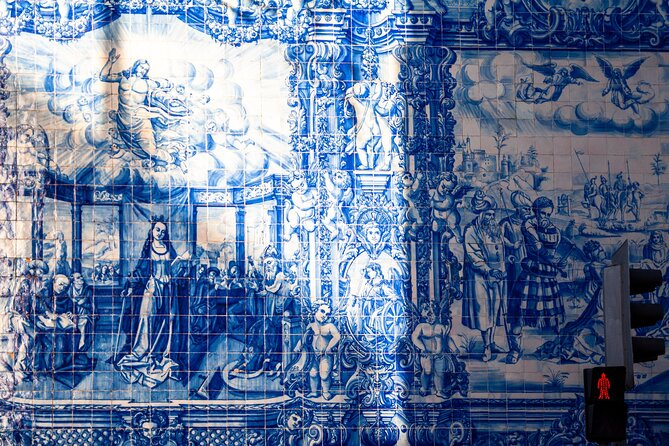
Another church from the second half of the 18th century is known for interior carvings and for a lateral façade that was covered with tiles in 1912, with drawings designed by Silvestre Silvestri. Those tile drawings include figurative compositions tied to the cult of Nossa Senhora (Our Lady).
If you love ornate church interiors, plan your future visits carefully. The exterior and quick stop here give you the vibe; entrances aren’t included, so you’ll have to decide whether to pay to see the full payoff inside.
Cordoaria Garden and Torre dos Clérigos: green breaks and a sky marker
At some point, your legs will thank you for the pauses, and the tour gives you that in Cordoaria Garden (also called João Chagas Garden since 1924).
This garden connects to an older craft story. The name is tied to rope makers who stayed in the area for about 200 years. Later, the municipality transformed the area into a public space, using a project by German landscaper Emile David in 1865/1866. There are statues, including Ramalho Ortigão and António Nobre, plus sculptures by Juan Muñoz from 2001.
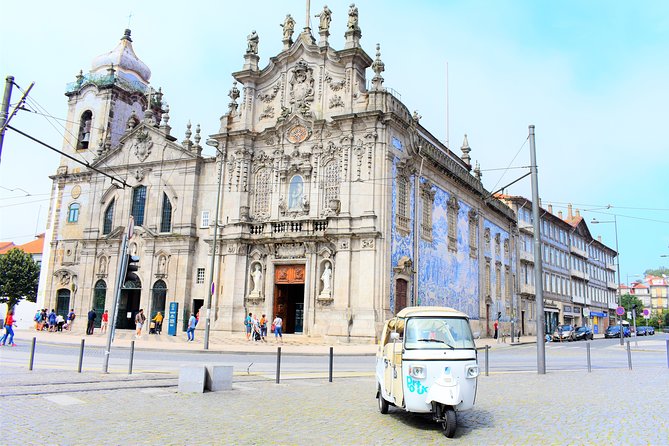
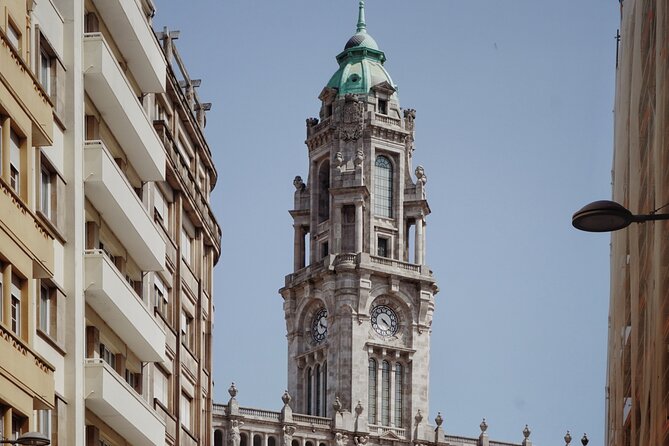
Then you reach one of Porto’s most recognizable skyline icons: Torre dos Clérigos. The Clérigos Church is Baroque, and the bell tower is the famous vertical landmark you can see from many parts of the city.
This stop is strategic for first-timers. You’ll start to connect what you see on the street with what you’ll spot later from viewpoints—Porto has a way of turning skyline shapes into navigation cues.
Stock Exchange Palace, D Pedro’s monument, and Lello’s Art Nouveau façade
By the time you hit the next run of highlights, the tour shifts from “look at the details” to “here’s Porto’s prestige.”
One of the biggest must-sees is Palácio da Bolsa (Stock Exchange Palace). Designed in 1842 in neoclassical style, it’s tied to the Commercial Association of Porto. Its top draw is the Arabian Room, and the building is also noted as part of the Urban Wine Route. If you like architecture that mixes wealth, trade, and design theatre, this stop is a big signal that Porto wasn’t just a ship-and-fish port. It was a business hub too.
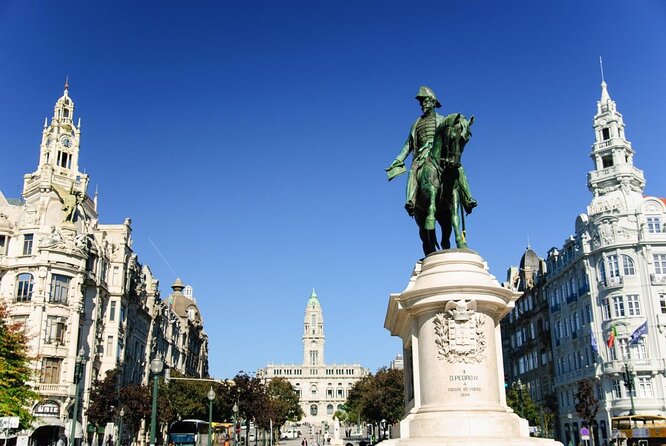
Nearby is a statue connected to D. Pedro. The monument was unveiled in October 1866 and was cast in Belgium. The sculpture shows D. Pedro offering the constitutional charter to the city, and the base has two-sided symbolism: the donation of his heart to Porto and his arrival in Mindelo.
Then comes Livraria Lello (the famous bookstore building). The building where the library sits was inaugurated in 1906 with an Art Nouveau façade plus neo-Gothic details. Inside, you’ll find painted plaster that imitates wood, and a major staircase linked to the upper floor—one of the early reinforced-concrete works in Porto. The huge stained-glass skylight carries the library monogram and the motto Decus in Labore. It’s been recognized internationally for beauty, including mentions by major media outlets.
Finally, you’ll pass an iron market built in 1885 that replaced the old Mercado da Ribeira. It ran as a market briefly, then shifted uses, and later became entertainment space—now associated with Hard Club. This is another Porto signature: industrial materials turning into culture.
Praça and monument to Infante D. Henrique, then São Francisco’s gold interior
You’ll also visit an area surrounded by the Stock Exchange and the market, with Mercado Ferreira Borges and the Bolsa close by.
Under the small garden in the square sits an underground car park, and there’s a Monument to the Infante D. Henrique. The monument was started in 1894, finished in 1900, and celebrates Portuguese navigation and faith.
After that, the tour leads you to São Francisco, Porto’s Gothic showcase. The church’s construction began in the 14th century, and the interior is where it gets dramatic: a gilded Baroque interior from the 17th and 18th centuries. The carved wood work is so famous that it earned the nickname Church of Gold, and the site includes the Tree of Jesse and catacombs. It’s a National Monument since 1910 and a UNESCO World Cultural Heritage site since 1996.
Even if you only catch a quick look, you’ll understand why this place pulls people back repeatedly. The shape of the space matters, but the material finish is the real story.
Alfândega Nova do Porto: iron engineering and a transport museum setting
From churches and statues, you shift to an engineering-world stop: Alfândega Nova do Porto.
This is a neoclassical 19th-century building designed by engineer Jean F. G. Colson. It has two sides—one facing the Douro River, and another facing the city. The design is notable for structural solutions using iron combined with other materials like stone, brick, or wood depending on the function of each space.
In 1987, it was decided to house the future Museum of Transport and Communications. Restoration and adaptation were carried out with architecture by Eduardo Souto Moura, and the site also manages congress-center space across different areas.
If you like buildings that feel functional and clever, this stop broadens the tour beyond just ornament. Porto isn’t only stone and tile. It also makes a big deal of how things move.
Serra do Pilar monastery and the two iron bridges: the view payoff
The tour’s final stretch is built for payoff—especially the viewpoint.
You’ll visit Mosteiro da Serra do Pilar, recognized as a UNESCO World Cultural Heritage site. Construction began in 1538 and finished around 1670. It started for Augustinian friars, then got pulled into the turmoil of the Civil War (1832–1834) when the liberal army settled there. After attacks and neglect, the monastery was restored in later stages, including the Royal Brotherhood of Lady of the Pilar and a revival group in 1925.
Architecturally, the church has a circular plan with a dome ringed by a balcony, while the cloister is circular too, with 36 Ionic columns, described as the only example of that kind in Portugal. The terrace views are the big draw. From here, you can see riverside Porto and Gaia up to the Arrábida Bridge, plus the historic center featuring the Cathedral and D. Luís I bridge. You can also look toward Fontainhas and the São João bridge area.
Then the tour heads to the bridges—two big names made of iron.
First is D. Luís I Bridge, designed by engineer Teófilo Seyrig, a disciple of Eiffel. It was inaugurated in 1886 and has two overlapping iron decks. It’s 395 meters long and 8 meters wide. The upper deck today carries Porto Metro, linking from the Cathedral area toward the Garden of Morro and Avenida da República in Vila Nova de Gaia.
Next is Ponte de Maria Pia, inaugurated in 2003 under engineer Adão da Fonseca. This bridge replaces an upper deck lane from D. Luís I used by the metro line. It’s 371 meters long and 20 meters wide, with a Maillart-type arch design and a 280 m arch span, described as a world record. It connects Fontainhas to Oliveira do Douro in Gaia and is known for its elegant form.
This is the part where you feel why the tour’s not just a set of stops. It’s a way to read the city. Porto’s riverfront and bridges are the structure under everything else.
What’s included, and what costs extra
Included:
- A port wine glass
- Driver/guide and a local guide
- Mobile ticket and English service
Not included:
- Monument entrances (so churches, libraries, and indoor attractions may cost extra if you choose to enter)
That means you can still have a great day just from outdoor viewing and quick stop time. But if you’re the type who hates “seeing it from outside,” you’ll want to budget a little for entries—especially at major sites like the station tiles, São Francisco, and any interior highlights along the route.
Guide style: why the best tours feel playful and precise
This tour lives or dies by the guide. And the pattern in feedback is clear: guides like Natalia, Anna, Ana, Victor, Gabby, Bernardo, and Gonçalo are praised for being energetic, positive, and good at making Porto make sense fast.
In a Tuk Tuk, you don’t have long to absorb each stop. A strong guide gives you:
- the one or two details that make each place click
- smart photo angles from where the Tuk Tuk can stop
- practical tips for what to revisit later
If your guide is more laid-back, the stops can still be worthwhile for the architecture alone. But if you want stories with your sightseeing, pick a time slot when you can hear well and pay attention during the driving segments.
Price and value: does $42.33 make sense?
At $42.33 per person for about 1 hour 50 minutes, you’re paying for three things:
1) the transport advantage (Tuk Tuk access through tight lanes)
2) a pre-built route that covers key sights without you plotting bus lines
3) a port wine tasting moment that feels local, not gimmicky
If you’re the kind of traveler who can handle some walking and likes planning, you could cover a lot of this on your own. But the real value here is the way the tour compresses orientation. You finish with a mental map of Porto, then you decide what deserves your longer time later.
For families, this can be a win too. A couple of reviews mention that young kids handled the stops well, mainly because the pace stays moving and you’re not stuck in one long waiting line.
Tips to avoid the common hiccups
A few practical pointers based on what often matters in Porto:
- Bring a rain layer or poncho. One review called out a very wet day, and yes, the Tuk Tuk helps, but your stop photos still happen in real weather.
- Arrive a few minutes early at R. de Augusto Rosa 180 so you can start on time.
- Expect that traffic can affect hearing and the last stretch. If the tour feels slowed, don’t panic—use that time to watch street details and keep your camera ready.
- If you care about interiors, decide before the tour which places you’re willing to pay to enter later.
Should you book this Porto Historical Center Tuk Tuk tour?
Book it if:
- you have about two hours and want to get your bearings fast
- you dislike long climbs or crowded buses
- you want a mix of major monuments and lesser-seen city structure
- you’ll enjoy a port wine stop as part of the experience
Skip it (or consider a different approach) if:
- you mostly want deep indoor visits and long time in museums (entrances aren’t included)
- you’re sensitive to noise and you hate missing narration while moving
- you prefer to wander without a route and would rather build your own day
If you’re arriving in Porto for the first time, this tour is a solid launch pad. It won’t replace a slower second pass. It will tell you where that second pass should go.
FAQ
How long is the Porto Historical Center Tuk Tuk tour?
It runs for about 1 hour 50 minutes.
What language is the tour offered in?
The tour is offered in English.
What’s included in the price?
You get a port wine glass, plus the driver/guide and local guide.
Are monument entrance fees included?
No. Monuments entrances are not included, so if you want to go inside, you may need to pay separately.
Is this a private tour?
Yes. It’s listed as private, meaning only your group participates.
What weather does the tour require?
The experience requires good weather. If it’s canceled due to poor weather, you’ll be offered a different date or a full refund.