REVIEW · SEVILLE
Tour Welcome Seville with Local Guide in Eco Tuk Tuk Private
Book on Viator →Operated by Eco Tuk Tuk - Spain · Bookable on Viator
Seville has a way of catching you off guard, fast. This private electric eco tuk-tuk ride gives you an instant sense of the city, with an English-speaking guide and smart photo stops along the way. I love how it starts without queues or waiting, and I love that the route targets Seville’s biggest “where am I?” landmarks like Triana and Plaza de España. One drawback: you won’t get hotel pickup, and the photo stops aren’t changeable.
You’ll also want to plan around a fixed, short schedule (about 1–2 hours). That means the tour is great for orientation, not for slow wandering. Still, you get blankets for cooler weather and protective layers for wind, which is genuinely useful in Seville’s odd moments.
In This Review
- Key highlights worth knowing
- Why an Eco Tuk Tuk makes sense for first-time Seville
- Price and value: what $28.66 buys you
- Meeting point at Parking APK2 Arjona: how to not lose time
- Triana Bridge and market-side Seville (Isabel II Bridge)
- San Telmo Palace: a baroque building with administrative weight
- Royal Tobacco Factory: Spain’s big industrial landmark
- Plaza de España: architecture you can read like a map
- María Luisa Park and Plaza de América: shade, paths, and museum neighbors
- Torre del Oro and the river line you’ll remember
- Maestranza bullring: an 18th-century landmark in Arenal
- The 2-hour option: Cartuja Island added to your loop
- How the guides run this tour (and why names come up)
- What to pack and plan for (rain, heat, and short stops)
- Who this private Seville eco tuk-tuk tour fits best
- Should you book this Eco Tuk Tuk welcome tour?
- FAQ
- How long is the Seville welcome tour?
- Is the tour private?
- Is it really electric and eco-friendly?
- Does the price include admission tickets?
- Where do we meet for the tour?
- Is hotel pickup included?
- Can the driver change the route or add extra photo stops?
- What if streets are closed or there’s a demonstration?
- Is the tour canceled if it rains?
- Are tips included in the price?
Key highlights worth knowing
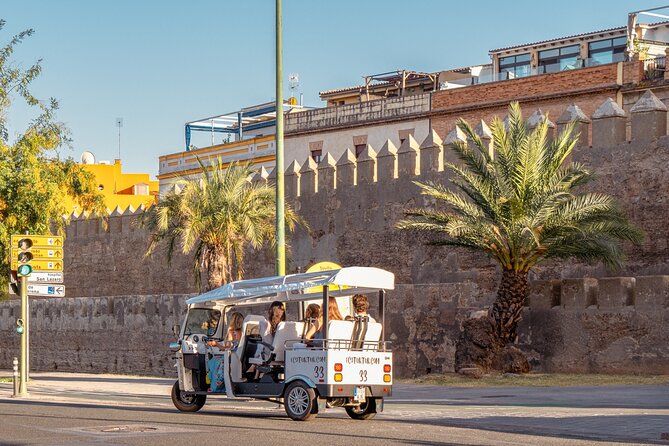
- 100% electric tuk-tuk: quiet, modern-feeling transport that’s easy on your legs
- Private vehicle for your group: a more personal pace than a bus tour
- Photo stops that are planned: you’ll know where to point your camera before you’re driving past
- Triana + Plaza de España focus: two of Seville’s most recognizable moods in one ride
- Guides like Alejandro, Juan, Jorge, and others: names that show up again and again for storytelling and pacing
- Blankets included: small detail, big comfort if the breeze hits
Why an Eco Tuk Tuk makes sense for first-time Seville
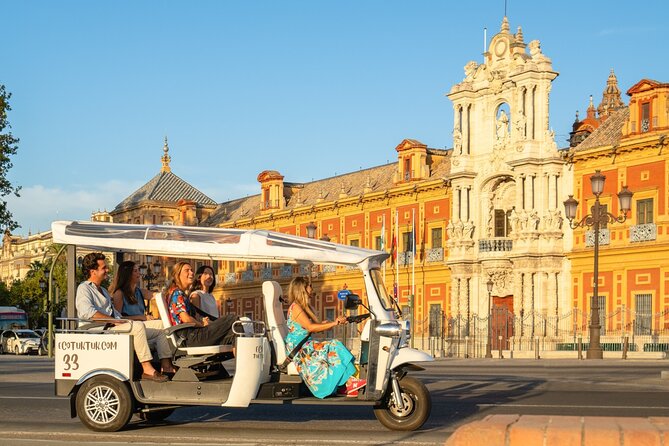
If Seville is your first stop on an Andalusian trip, this kind of tour is a smart shortcut. A tuk-tuk lets you cover a lot of ground without the constant stop-and-start you get when you’re on foot. And because it’s private, you’re not stuck matching someone else’s pace.
I also like that the ride feels practical. It’s not a gimmick version of sightseeing; it’s a workable way to connect neighborhoods and landmarks. The route is designed to get you oriented quickly, so later you can pick neighborhoods to explore on foot with more confidence.
Price and value: what $28.66 buys you
At about $28.66 per person, this tour is priced for real sightseeing, not just a quick drive-by. You’re paying for a few things that add up fast in Seville: a private electric vehicle, an expert guide/driver, and pre-set stops so you don’t waste time figuring out the best angles.
It also helps that the tour starts without queues or waiting. That matters in Seville, where timing can turn into a time tax. Add in blankets for weather comfort and the “take pictures here” planning, and the value starts to feel more like a guided route than a transport service.
The only real price-related consideration is your expectations. This is not a ticket-inclusive museum day. Some places are photo stops and viewpoints, not entry stops, so you should budget for that mindset.
Meeting point at Parking APK2 Arjona: how to not lose time
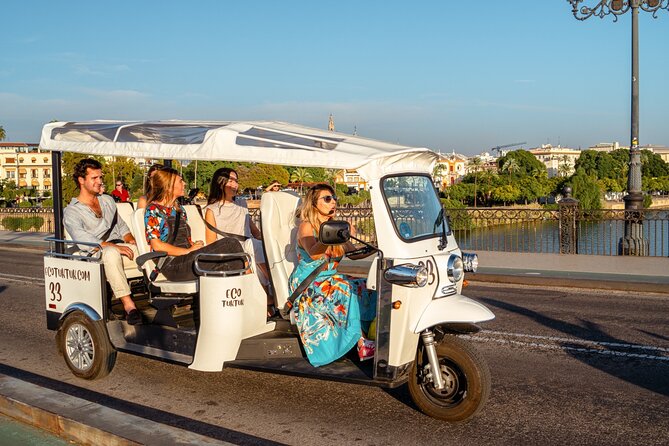
The meeting point is at Parking APK2 Arjona, near Puente del Cristo de la Expiración, in the Casco Antiguo area (746, 41001 Sevilla). The good news is that it’s near public transportation, so you’re not trapped if you arrived earlier than expected.
Because there’s no hotel pickup, I’d treat this as a “show up, hop in, go” tour. If you’re planning to grab coffee before you meet the group, do it close to the meeting area. That way, you don’t run late and end up with a shortened experience.
Triana Bridge and market-side Seville (Isabel II Bridge)
The tour connects you to Seville’s river life immediately, starting with the Isabel II Bridge—also called the Triana Bridge. This is the link between the city center and Triana, so it’s a perfect place to understand how Seville “flows” rather than just how it “looks.”
Triana itself is one of the most lived-in parts of the city, with a lively market near the bridge. You’ll get the feel of everyday food culture here, including classics like salmorejo and croquettes from stalls and small spots near the arch. If you like tapas as a concept (not just a checklist), this stop sets the tone.
Expect another Triana layer along Calle Betis by the river: restaurants, bars, and flamenco tablaos in the same general orbit. If you’re into crafts, look around the area near the Centro Cerámica Triana museum, where you’ll find shops tied to local ceramic traditions.
A practical consideration: admission tickets aren’t included for some stops. For this Triana/bridge segment, you’ll mostly be soaking up the atmosphere and taking photos rather than paying to enter something.
San Telmo Palace: a baroque building with administrative weight
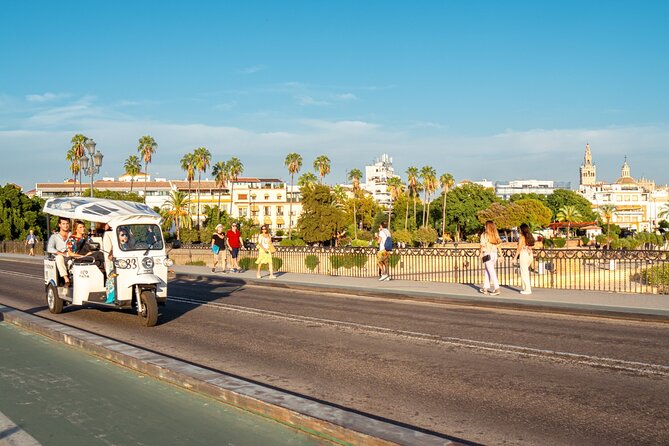
Next up is the Palace of San Telmo. This building is the seat of the Presidency of the Junta de Andalucía, so it’s not just decorative architecture—it’s functional power housed in baroque style.
The palace was built between the 17th and 18th centuries and originally served as the headquarters of a sailors’ college. That maritime angle is the kind of detail that makes a stop like this more than a quick photo: you’re seeing a building that once trained people for life at sea, now repurposed for government.
Because the tour is tight, you’re not here to linger for hours. But it’s a helpful contrast: from Triana’s food-and-river vibe to a serious, formal baroque presence.
Royal Tobacco Factory: Spain’s big industrial landmark
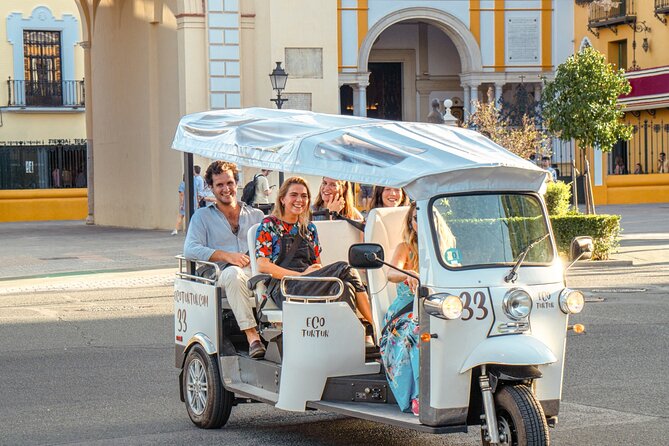
Then you’ll roll to the Royal Tobacco Factory of Seville. This is the headquarters of the first tobacco factory established in Europe, and it’s often described as the most important industrial building in Spain from the 18th century.
The site is classified as an Asset of Cultural Interest (Historical Monument). Translation: you’re looking at a major landmark that changed the city’s economic story, not just its postcard look.
In a short tour, this is where a guide’s storytelling really helps. The building’s purpose—tobacco manufacturing on a Europe-first scale—makes it easier to understand why it looks the way it does and why Seville developed around industry as well as culture.
Plaza de España: architecture you can read like a map
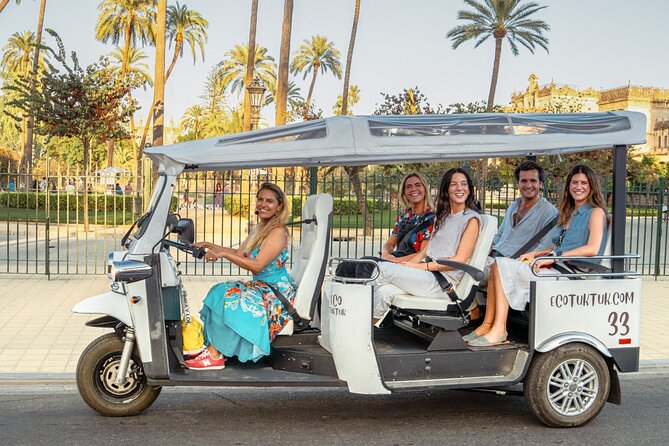
Plaza de España is the star you should understand early. It’s an architectural complex in María Luisa park designed by Aníbal González and built between 1914 and 1929 for the Ibero-American Exposition of 1929.
What I like about this stop is that it’s visually organized. You can walk a little, take photos, and still feel like you’re learning the city’s layout. It’s open-air and built for strolling, so even if you only get a short window, you can do something useful with it—like compare your mental map from the tuk-tuk ride to what’s right in front of you.
The tour notes that a 60-minute option includes Plaza de España, while the 120-minute option extends beyond that. Either way, this is the kind of stop where you’ll probably spend extra time at the boundaries—just because it’s so easy to frame and reframe photos.
María Luisa Park and Plaza de América: shade, paths, and museum neighbors
María Luisa Park is Seville’s “green lungs,” described as the first urban park in the city. It was declared an Asset of Cultural Interest in the category of Historic Garden.
You’ll also get Plaza de América, a landscaped space inside the park. It sits near the Museum of Popular Arts and Customs to the north, the Archaeological Museum to the south, and the Royal Pavilion to the east.
The value here is timing. If you’re in Seville during warm hours, having a park stop inside your route is smarter than only chasing stone under direct sun. Also, even if you don’t go into the museums, the park area gives you a calmer rhythm before you head back to more city-energy scenes.
Torre del Oro and the river line you’ll remember
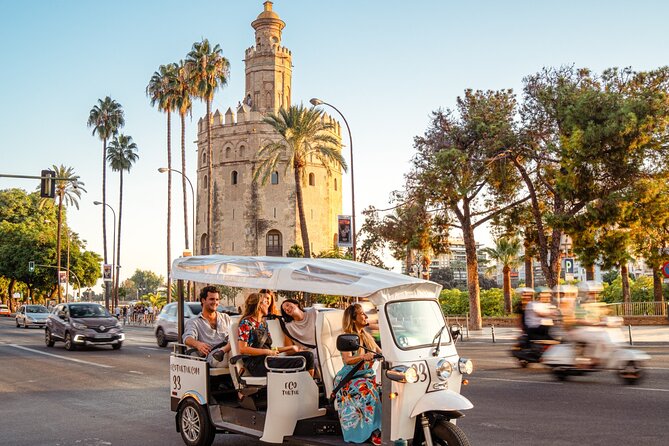
Torre del Oro is a watchtower on the left bank of the Guadalquivir River. It’s around 36 meters tall and has a tower structure formed by three bodies. Built around 1221, it’s one of those landmarks that instantly makes you pay attention to history in the river corridor.
From a sightseeing point of view, this is a payoff stop. You’re not just looking at buildings; you’re connecting viewpoints along the Guadalquivir. If you like photographing rivers, light changes, or skyline reflections, this is the kind of stop that sticks.
The tour also includes the Maestranza bullring, so you’ll keep moving through Seville’s identity markers—river defense watchtower to a major 18th-century arena.
Maestranza bullring: an 18th-century landmark in Arenal
The Maestranza bullring sits in the Arenal neighborhood. It was built in the 18th century and is owned by the Real Maestranza de Caballería de Sevilla.
Even if bullfighting isn’t your thing, this stop still has value. It’s part of Seville’s public-life history and architectural footprint, and it’s a major landmark that helps you understand which neighborhoods became centers of civic display and ceremony.
In a private tuk-tuk setting, you’ll typically get the big “what it is and why it matters” context without needing to commit to a long exterior-only walk.
The 2-hour option: Cartuja Island added to your loop
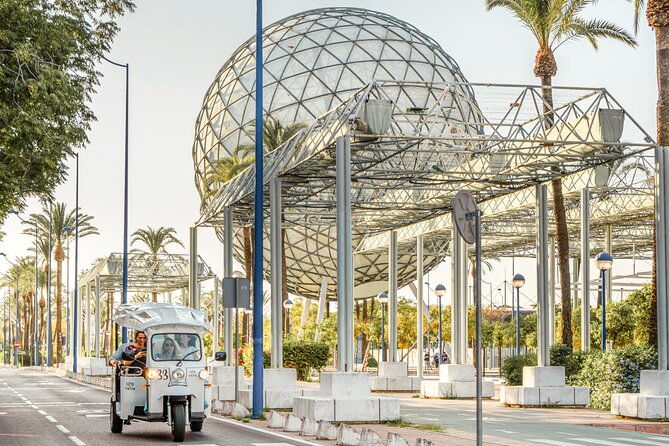
If you book the longer (about 120-minute) tour, the route also includes Cartuja Island. That extra area tends to help you broaden your Seville “map” beyond the classic postcard cluster.
You won’t have to plan extra transit yourself; the tour design handles the connection. The practical point: the 2-hour version fits you best if you want orientation plus a bit more variation in scenery and neighborhood feel.
How the guides run this tour (and why names come up)
This tour is built around an expert companion guide/driver, and that matters because your time in Seville is limited. A strong guide helps you understand not just what you’re seeing, but why that particular piece of Seville exists in the first place.
In the feedback you’ll see recurring names like Alejandro, Juan, Jorge, Tamara, Javier, Alberto, Pilar, Emelio, and Nasai. What those guides appear to share: clear English, storytelling that adds context, and comfort with stopping for photos at planned points.
There’s also a practical comfort layer. The tuk-tuks are described as suitable for older people, and drivers help if you need assistance getting on. So if you’re traveling with someone who doesn’t love long walks, this is more forgiving than a purely on-foot orientation.
One thing to keep in mind: your experience can depend on your guide’s style and how talkative they are that day. If you want deeper explanations, bring questions. For example, ask why a building was used, or how Triana’s river setting shaped everyday life.
What to pack and plan for (rain, heat, and short stops)
Seville tours run in rain or heat, and the experience is only canceled under extreme conditions. That means your comfort depends on the weather and your clothing choices.
Luckily, this tour includes blankets and protective layers to reduce cold from wind and rain. Still, I’d bring a light layer, especially if you’re doing the late afternoon when temperatures can drop fast.
Also plan for the reality of short stops. Some sites are photo stops, not entry stops. The tour says admission tickets for stops aren’t included, so don’t assume you’ll be going inside museums or monuments.
Who this private Seville eco tuk-tuk tour fits best
This is a strong fit if you want:
- A fast first-day welcome to get your bearings
- Easy transport that reduces walking fatigue
- A photo-focused route through Triana and Plaza de España
- A private group experience with an English-speaking guide
It can also be a family-friendly choice. One account highlights that the guide was patient with kids, and a private tuk-tuk keeps young attention more stable than long guided walks.
If you’re the type who wants to linger for long at one location or redesign the route day-of, this probably won’t feel flexible enough. The stops and photo points are predetermined, and the itinerary can shift only due to closed streets or demonstrations.
Should you book this Eco Tuk Tuk welcome tour?
I’d book it if you want an efficient, comfortable way to understand Seville quickly—especially if you’re short on time. The combination of electric private transport, planned photo stops, and big landmarks like Triana Bridge and Plaza de España makes it a high-value orientation tool.
You might skip it if you’re in Seville for a long stay and you’d rather wander slowly on foot without a fixed route. Also consider your timing: because hotel pickup isn’t included, you’ll want to be near the meeting point and ready to start on time.
If you’re aiming to build a solid “what to see next” list for the rest of your trip, this is the kind of tour that helps you do exactly that.
FAQ
How long is the Seville welcome tour?
The tour is about 1 to 2 hours, depending on the option you select.
Is the tour private?
Yes. It’s a private tour/activity, and only your group participates.
Is it really electric and eco-friendly?
Yes. The vehicle is described as 100% electric and sustainable.
Does the price include admission tickets?
No. Admission tickets are not included.
Where do we meet for the tour?
The meeting point is Parking APK2 Arjona, Puente del Cristo de la Expiración, 746, Casco Antiguo, 41001 Sevilla, Spain.
Is hotel pickup included?
No. Hotel pickup and drop-off are not included.
Can the driver change the route or add extra photo stops?
No. The photo stops are pre-selected, and the itinerary can’t be modified.
What if streets are closed or there’s a demonstration?
The itinerary may vary depending on closed streets or demonstrations on the day of the tour.
Is the tour canceled if it rains?
It takes place in rain or heat, and can only be cancelled under extreme conditions.
Are tips included in the price?
No. Tips to the driver guide are not included.