REVIEW · SEVILLE
Expert Tour of Seville in Private Eco Tuk Tuk
Book on Viator →Operated by Eco Tuk Tuk - Spain · Bookable on Viator
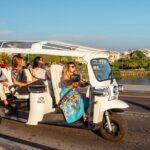
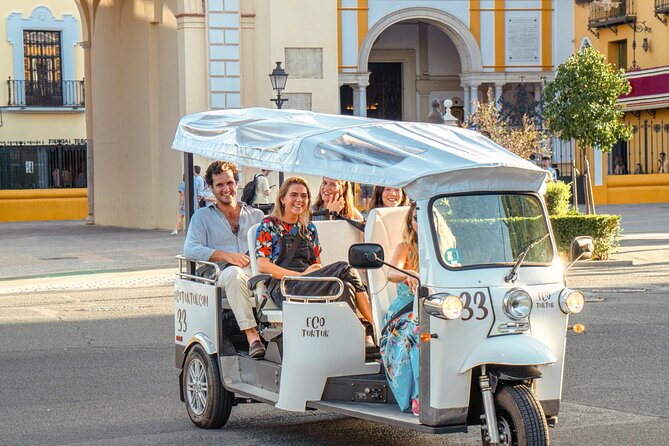
Seville clicks fast on an eco tuk tuk. You’ll get a private ride with an accompanying guide, plus short photo-focused stops that help you see big Seville sights without walking yourself into a salsa-shaped sore ankle. I especially like how the tour sets you up for fast orientation (Triana to the river to Parque de María Luisa) and how guides such as Karen, Juan, and Miguel bring friendly, practical context on what you’re looking at. One possible drawback: part of the route leans into repurposed Seville Expo-era buildings, so if you want deep, slow, museum-style storytelling, this may feel like highlights more than depth.
Because it’s built around a fixed route and set photo stops, you won’t be able to customize where you stop or how long you linger. I also like that the tuk-tuks are winterized with protective layers and blankets, and the drivers can assist seniors getting on, but you should expect to move in and out quickly at each point. For me, the sweet spot is using this as a top-of-the-trip overview—then you decide what deserves your extra time.
In This Review
- Key things to know before you go
- Why this private eco tuk tuk is a smart intro to Seville
- Starting at Puente del Cristo de la Expiración: getting onto the tuk tuk
- Triana and Isabel II Bridge: the river crossing that sets the mood
- Triana streets: market energy, tapas, and ceramic craft
- San Telmo Palace and the Royal Tobacco Factory: big landmarks, quick context
- Plaza de España and María Luisa Park: the 1929 showpiece you’ll actually see
- Plaza de América, Torre del Oro, and the Maestranza bullring: river views and local drama
- Monasterio de la Cartuja and Isla de la Cartuja: old monastery meets Expo leftovers
- The bioclimatic sphere and what Isla de la Cartuja adds to your photos
- Basilica de la Macarena: finishing in Casco Antiguo’s church quarter
- Price and what you’re paying for with $80.23 per person
- Timing, fixed photo stops, and why the plan can’t bend
- Who should book this tour (and who should pick something else)
- Should you book this private Eco Tuk Tuk tour of Seville?
- FAQ
- How long is the private eco tuk tuk tour in Seville?
- Is the tour private?
- What’s included in the price?
- Are entry tickets included for each stop?
- Where do we meet and where does the tour end?
- Can I bring a baby or pets?
- What happens if the weather is hot or rainy?
- What if I’m late to the meeting point?
- Can I change the route or request different photo stops?
- Is there free cancellation?
Key things to know before you go
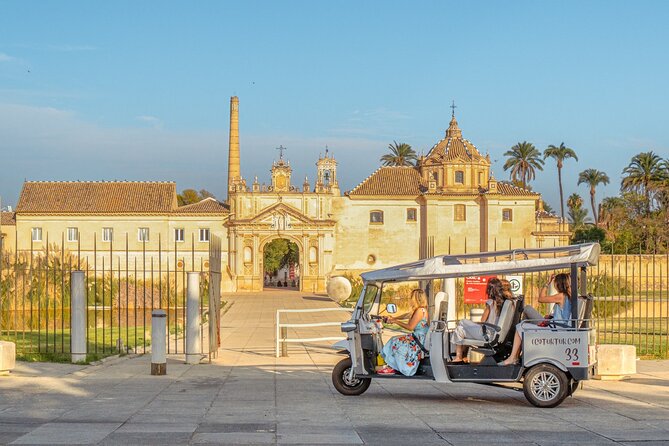
- Private eco tuk tuk comfort with a small group setup (max 4 passengers per tuk-tuk)
- Photo stops at showpiece spots, including Plaza de España, and (on the longer tour) Isla de la Cartuja
- Early Triana + river views from the Isabel II/Triana Bridge area
- Plaza de España + María Luisa Park framed as an Ibero-American Exposition design moment
- Cartuja Monastery and Isla de la Cartuja where old spiritual space meets newer cultural uses
- A Macarena finish at the Basilica de la Esperanza Macarena in the Casco Antiguo area
Why this private eco tuk tuk is a smart intro to Seville
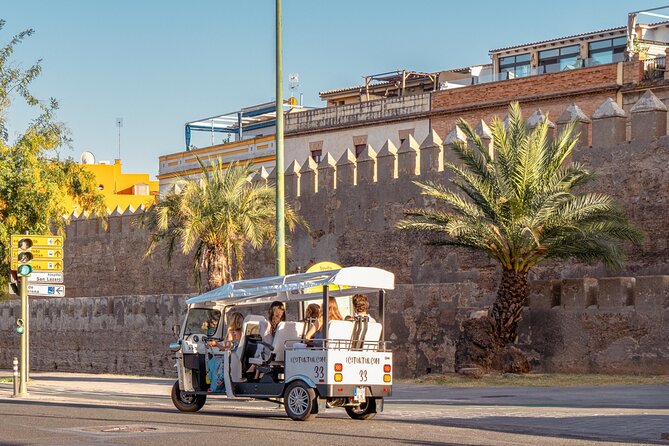
Seville can be a lot in one day. Old streets are gorgeous, but they’re also full of turns, hills, and “wait, where are we?” moments—especially if it’s your first time. This tour is designed to knock out the big visual landmarks in a small, comfortable way while a guide helps you connect what you’re seeing to the city’s layout.
The ride format matters. You’re not doing this as a long walking slog, and because it’s private, you can keep the experience calm and paced for your group. The small-group model also makes the guide’s explanations feel more personal, not like you’re stuck listening while everyone else shuffles past.
Starting at Puente del Cristo de la Expiración: getting onto the tuk tuk
You meet near Puente del Cristo de la Expiración (Parking APK2 Arjona, 746, Casco Antiguo, 41001 Sevilla). It’s close to public transportation, which helps if you’re bouncing from another neighborhood before you start.
Bring the usual Seville essentials: sunscreen, water, and comfortable shoes even if you won’t walk far. In winter, the tuk-tuks come with protective layers against rain and wind and even blankets to keep you warm, so you can stay outside a bit longer during photo stops.
Triana and Isabel II Bridge: the river crossing that sets the mood
The tour begins with a classic Seville introduction: the Isabel II Bridge, also called the Triana Bridge. Standing near the bridge gives you a natural “Seville in one view” moment because it links the city center to Triana across the Guadalquivir.
This stop is quick, but it’s a smart one. Bridges in Seville aren’t just functional—they’re part of how the city moves and how neighborhoods feel different on each side. The guide’s context helps you understand why Triana has always held onto its own character.
Triana streets: market energy, tapas, and ceramic craft
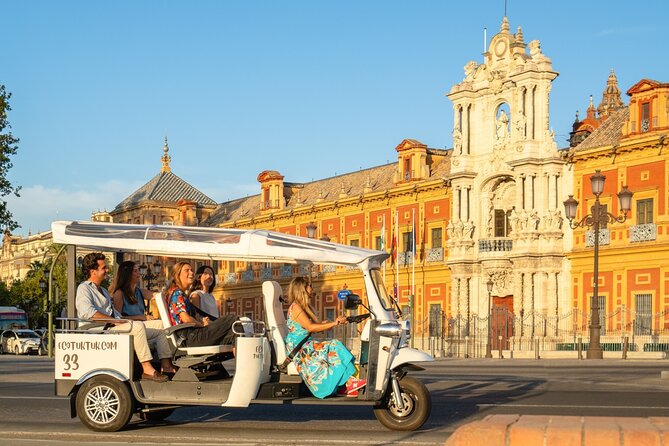
Once you’re in Triana, you get the neighborhood vibe fast. Triana sits next to the bridge and includes the area where you’ll find a lively market scene, plus casual food stalls and small places serving local favorites like salmorejo and croquettes. Even if you’re not eating during the stop, it’s the kind of area where your senses start mapping the city instantly.
Along Calle Betis, near the river, you’ll also find restaurants and bars, and you’ll be close to flamenco tablaos. If you enjoy shopping for souvenirs that don’t feel mass-produced, pay attention around Centro Cerámica Triana—the tour passes by the museum area where craft shops are known for local ceramic styles.
San Telmo Palace and the Royal Tobacco Factory: big landmarks, quick context
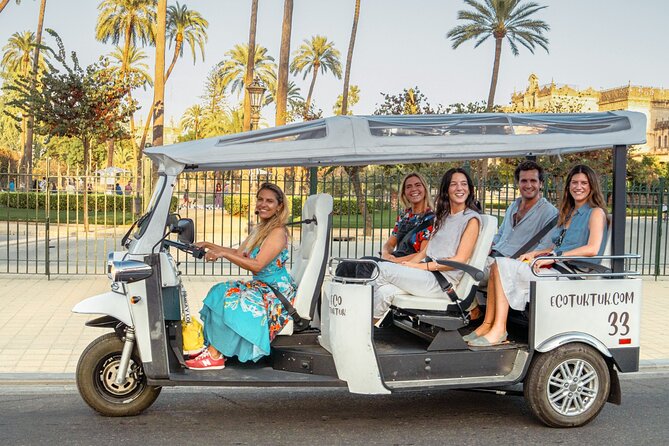
Two impressive “Seville power buildings” show up on the route back toward the center.
First is the Palace of San Telmo. It’s a Baroque building built between the 17th and 18th centuries, and today it’s the seat of the Presidency of the Junta de Andalucía. It originally ties to maritime education too, since it was built as headquarters for a sailors’ college. The guide’s job here is to help you read the architecture without needing a long stop.
Then you’ll pass the Royal Tobacco Factory of Seville, one of the most important industrial buildings in Spain from the 18th century. It was the headquarters of the first tobacco factory established in Europe, and it’s been classified as an Asset of Cultural Interest since 1959. Even on a quick stop, this is one of those places where Seville suddenly feels bigger than tourism—like you’re looking at the machinery behind past wealth.
Plaza de España and María Luisa Park: the 1929 showpiece you’ll actually see
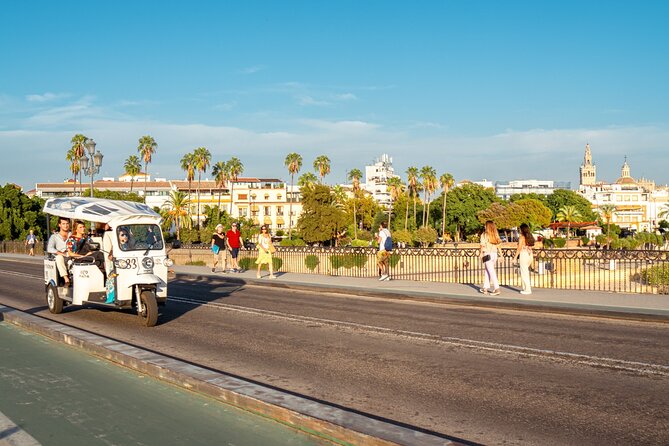
If Seville has a “postcard you can stand inside,” it’s Plaza de España. This architectural complex sits inside Parque de María Luisa and was designed by Aníbal González. Construction ran from 1914 to 1929, tied to the Ibero-American Exposition of 1929, so the whole setting carries that fair-and-future design mood.
The tour makes a brief stop here, and the important practical detail: the site stop is marked as free for admission. That means you can spend time simply looking, photographing, and soaking in the layout without adding ticket costs to your day.
Right after, you’re in María Luisa Park, Seville’s first urban park and often described as one of the city’s green lungs. It was declared an Asset of Cultural Interest as a Historic Garden in 1983, and it opened April 18, 1914 as the Infanta María Luisa Fernanda urban park. Even if you’re not a garden person, the reason to care is simple: the park makes Plaza de España feel less like a monument and more like a lived-in outdoor space.
Plaza de América, Torre del Oro, and the Maestranza bullring: river views and local drama
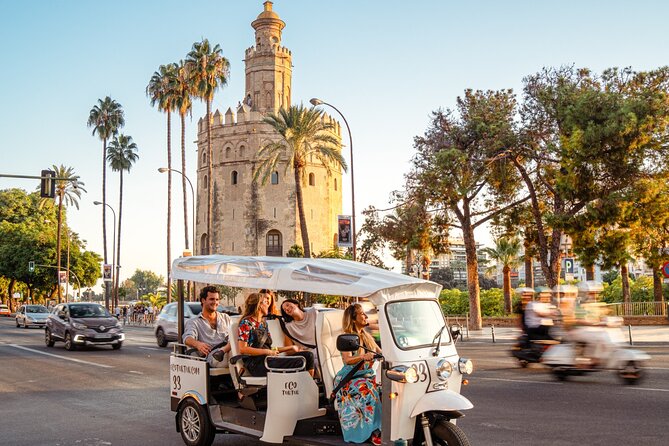
After the park, the tour threads toward a trio of landmarks that each tell a different Seville story.
Plaza de América is a landscaped space within Parque de María Luisa, flanked by major nearby institutions: the Museum of Popular Arts and Customs (north), the Archaeological Museum (south), and the Royal Pavilion (east). It’s a good pause for wide-angle photos because the edges frame the space and guide your eye.
Then comes Torre del Oro, a watchtower on the left bank of the Guadalquivir. Dating from 1221 and standing about 36 meters tall, it’s made up of three bodies. Even from outside viewing points, it’s the kind of structure that helps you picture the river as a defensive corridor, not just a scenic walk.
Finally, the route includes the Maestranza bullring in the Arenal neighborhood. It was built in the 18th century and belongs to the Real Maestranza de Caballería de Sevilla. Whether you’re into bullfighting as a tradition or prefer to treat it as local culture history, this exterior stop gives you a sense of scale and civic identity.
Monasterio de la Cartuja and Isla de la Cartuja: old monastery meets Expo leftovers
Seville doesn’t only live in centuries-old streets. It also has a strong “20th-century vision” side, and that’s where Cartuja fits in.
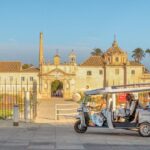
The route stops at the Monastery of Santa María de las Cuevas, also known as Cartuja Monastery, on the island of La Cartuja. It’s one of the four Carthusian monasteries in Andalusia, so even without a long visit, it signals a quieter, more devotional side of the city.
Then you head to Isla de la Cartuja, which is now used for cultural and avant-garde leisure, entertainment, and art spaces. Here’s why this matters: if you only see Seville’s old center, you miss how the city reuses space. The monastery and the newer island uses sit close enough that you can feel the contrast.
The bioclimatic sphere and what Isla de la Cartuja adds to your photos
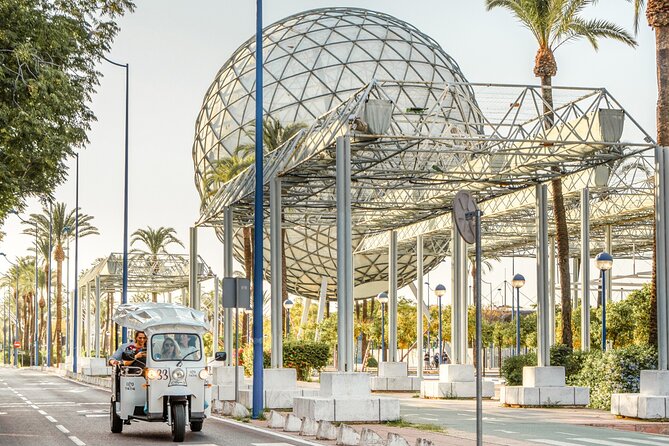
On Isla de la Cartuja, the tour includes a stop for the bioclimatic sphere on Marie Curie street. This object is one of the most recognizable icons from the Universal Exposition of Seville in 1992, and it’s one of those “only Seville would think of this” moments.
If you’re the kind of traveler who likes photos that show more than one era, this is a good catch. It also explains why some people feel the tour includes Expo buildings: yes, it does—but not as a random stop. The expo-era sites are part of Seville’s visual identity too, and this tour uses them to give you a complete city picture rather than a single-style postcard.
Basilica de la Macarena: finishing in Casco Antiguo’s church quarter
The tour ends at a very Seville-feeling religious landmark: the Basilica de la Esperanza Macarena (also called Basilica de la Macarena). It sits at Calle Bécquer 1, in the San Gil neighborhood of the Casco Antiguo district.
This finish is useful because it lands you back in a more traditional neighborhood setting. Even if you only get a short stop, you’ll have seen Seville’s river, parks, and Expo-era island elements before returning to the older city fabric.
Price and what you’re paying for with $80.23 per person
At $80.23 per person for a tour that runs about 1 to 2 hours, the value depends on your travel style.
Here’s what you’re getting that’s not “just sightseeing”:
- Private tuk-tuk setup where pricing is based on how many tuk-tuks your group needs (with a legal max of 4 passengers per tuk-tuk).
- An accompanying guide who helps you connect the dots quickly.
- Photo stops at fixed spots, including Plaza de España and (on the longer option) Isla de la Cartuja.
- A mobile ticket and group discounts.
It can be especially good value if you’re traveling with family, older relatives, or anyone who doesn’t want long walking days. If you’re traveling as a couple and you can split a tuk-tuk, the cost can feel more reasonable than you’d expect—though private pricing is always group-dependent.
Also keep in mind the admission situation: Plaza de España is listed as free. Other stops are marked as admission not included, so you may pay if you decide to enter any sites beyond the quick stop views.
Timing, fixed photo stops, and why the plan can’t bend
The tour is built around a route with pre-established stops, mostly designed for photos. The operator notes that on a 60-minute tour there’s a stop at Plaza de España, and on the 120-minute tour there’s also a stop at Isla de la Cartuja. Photo stops can’t be modified, and the itinerary may shift due to street closures or demonstrations.
This is important because it changes how you should plan the rest of your day. Treat this tour as your “get the lay of the land” block, then schedule your deeper, flexible exploring afterward. If you want to roam slowly, linger in museums, or chase a specific corner of Triana, you’ll get more satisfaction doing that after you understand the big geometry of the city.
If you’re late, the tour may be reduced based on time lost, with the possibility of cancellation if delay goes beyond 15 minutes, and refunds are not offered in that case. So show up a little early, especially if you’re using a first-time pickup point.
Who should book this tour (and who should pick something else)
This works best for:
- First-timers who want Seville highlights in a short window
- Families who want comfort and fewer steps
- Travelers who appreciate quick orientation: river landmarks, park design, and key neighborhoods
- Anyone who likes photos with clear, guided angles
It may not be the best fit for:
- Travelers who want museum-level detail and long interior time at fewer sites
- People who strongly dislike Expo-era architecture or expect only medieval sights
- Travelers who need total itinerary flexibility, since stops and routes are fixed
The balance is good if you hold the right expectation: this is a structured overview with smart stops, not a slow, deep-dive course.
Should you book this private Eco Tuk Tuk tour of Seville?
If you want a comfortable, guided way to see major Seville landmarks without wrestling transit lines or committing to long walks, I’d say this is a very reasonable booking. The private format keeps it relaxed, the guide support can make the places click, and the route covers a range from Triana and the river to Plaza de España and out to Cartuja and the Macarena.
I’d hesitate only if you’re chasing heavy, slow cultural depth at a handful of sites. In that case, you’ll probably prefer a tour with fewer stops and more time per stop. But if your goal is to walk away with strong photos and a clear map of what to revisit, this is the kind of “start here” experience that pays off for the rest of your trip.
FAQ
How long is the private eco tuk tuk tour in Seville?
The tour runs about 1 to 2 hours. The shorter option includes a stop at Plaza de España, and the longer option also includes a stop at Isla de la Cartuja.
Is the tour private?
Yes. It’s a private tour/activity, and only your group participates.
What’s included in the price?
An accompanying guide is included. You also receive a mobile ticket.
Are entry tickets included for each stop?
Plaza de España is listed as free for admission. Other stops are marked as admission not included.
Where do we meet and where does the tour end?
You meet at Parking APK2 Arjona near Puente del Cristo de la Expiración in Casco Antiguo. The tour ends back at the same meeting point.
Can I bring a baby or pets?
Babies are not allowed. Pets and companion animals are not allowed for security reasons.
What happens if the weather is hot or rainy?
The tours run in rain or heat. In winter, the tuk-tuks have protective layers against rain and wind and include blankets to keep you warm.
What if I’m late to the meeting point?
If you’re delayed, the activity may be reduced based on the time lost, which could change the fixed route. If the delay is greater than 15 minutes, the activity may be canceled and the amount paid will not be refunded.
Can I change the route or request different photo stops?
No. Tours cannot be modified, and photo stops are fixed at pre-established locations. The itinerary may vary due to street closures or demonstrations on the day.
Is there free cancellation?
Yes. You can cancel up to 24 hours in advance for a full refund. Canceling less than 24 hours before start time means the amount paid will not be refunded.