REVIEW · SEVILLE
Express Tour of Seville in Private Eco Tuk Tuk
Book on Viator →Operated by Eco Tuk Tuk - Spain · Bookable on Viator
Seville looks different from a tuk-tuk. This private eco tour gives you a quick, guided circuit with well-timed photo stops, so you leave with clear bearings. I especially liked that guides like Juan and Hugo keep the narration moving and tailored to what you’re actually passing.
Two things I’m glad about: first, the Plaza de España stop hits hard for photos and orientation, even if you’re only on a short visit. Second, the route strings together neighborhoods and big landmarks without turning your day into a long walkathon.
One drawback to consider: the itinerary is fixed and photo stops aren’t interchangeable, so if you want extra time in one spot, you’ll need to plan a return trip on your own schedule.
In This Review
- Key highlights worth your time
- Seville by Eco Tuk Tuk: how this 60-minute plan pays off
- From the Triana Bridge to Triana’s food-and-ceramics streets
- San Telmo’s Baroque presence and the Royal Tobacco Factory’s big scale
- Plaza de España: the 5-minute photo stop that anchors your day
- María Luisa Park and Plaza de América: green lungs and museum-flanked geometry
- Torre del Oro on the Guadalquivir: a 36-meter landmark with a date stamp
- Maestranza bullring: a late-stage orientation checkpoint
- Price and group size: what $42.30 buys you in real terms
- Guide style matters: Juan and Hugo set expectations, not just facts
- Weather, comfort, and the fixed route reality
- When a tuk-tuk tour beats walking (and when it doesn’t)
- Should you book this Seville eco tuk-tuk tour?
- FAQ
- How long is the Express Tour of Seville in Private Eco Tuk Tuk?
- Is this tour private?
- How many people can ride in one tuk-tuk?
- Where does the tour start?
- What stops are included on the route?
- Are there any entrance fees at the stops?
- What are the age restrictions?
- Does the tour run in rain or hot weather?
- What if I’m late to the meeting point?
- Can I cancel for a refund?
Key highlights worth your time
- Private eco tuk-tuks with real guide time: only your group, with an accompanying guide onboard.
- Triana + river views: starting near the Isabel II Bridge (Triana Bridge) sets the tone fast.
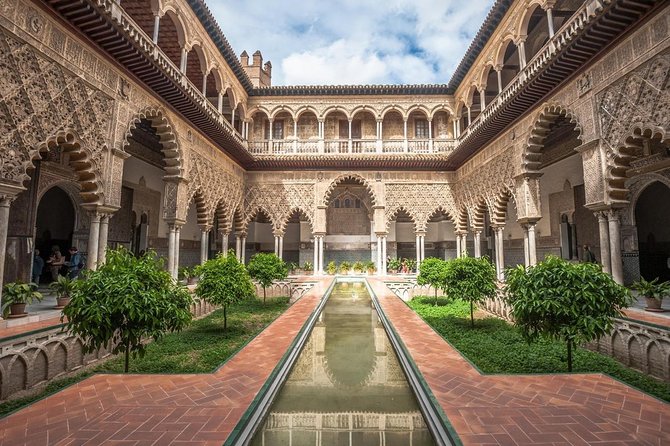
- Plaza de España in a short window: a dedicated stop (about 5 minutes) makes it efficient.
- María Luisa Park and Plaza de América: quick looks that help you decide what to explore later.
- Great “photo pacing”: planned stops for pictures, not just driving past monuments.
Seville by Eco Tuk Tuk: how this 60-minute plan pays off

If Seville is your first stop in Andalusia, this tour style makes a lot of sense. You get a guided overview without committing to a full-day tour, and you can still build the rest of your day around what you care about most.
The key word here is short: the main experience runs about 60 minutes, with a route built around pre-set stops for photos. If you choose the longer option (up to about 120 minutes), you add additional coverage, including a stop at Isla de la Cartuja. Either way, you’re not stuck in traffic on a giant bus line. You’re on a tuk-tuk with a guide calling out what you’re seeing as you go.
And yes, it’s fun. The eco tuk-tuk format is part of the charm, but the real value is practical: you’ll learn where places sit relative to each other, so later when you walk on your own, you’ll feel like you know the city. That’s what makes these “short orientation” tours worth the money instead of just being transportation.
From the Triana Bridge to Triana’s food-and-ceramics streets
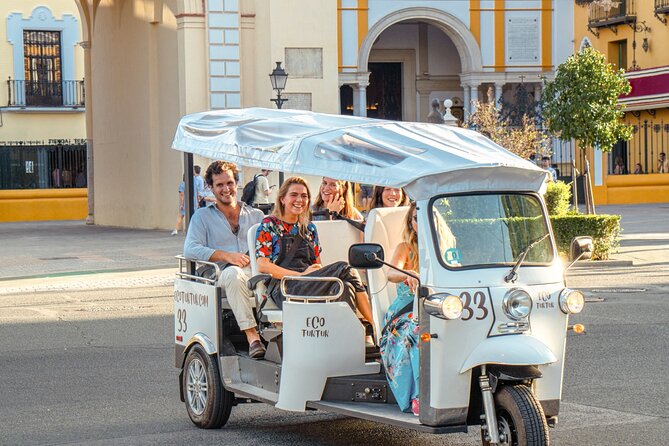
You start near Parking APK2 Arjona by the area around the Cristo de la Expiración, and the route quickly drops you into the river-crossing story of Seville.
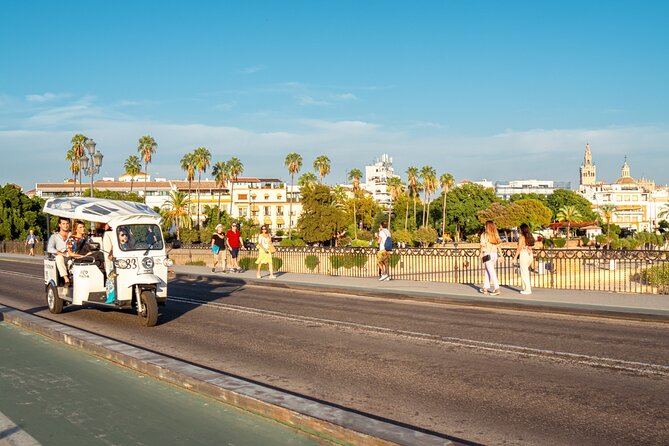
One of the first big landmarks on the drive is the Isabel II Bridge, popularly called the Triana Bridge, which links the city center to Triana across the Guadalquivir. This matters because Triana isn’t just another stop—it’s a different feel across the river. You’ll get that change in vibe right away.
Then you roll into Triana, where the tour focuses on the neighborhood’s everyday character: you’ll be near a lively market by the bridge, with classic local foods like salmorejo and croquettes showing up in stalls and small establishments. If you like eating your way through cities, Triana is exactly where your brain starts going, I want to come back for lunch.
The tour also points you toward the craft side of Triana. Around Centro Cerámica Triana, you’ll find shops for local ceramics. It’s a small detail, but it helps you understand why people buy things here beyond magnets.
How long do you get? The stop listed for Triana is about 5 minutes, and it’s framed as a quick look with a photo component. That’s enough time to orient yourself, grab a couple photos, and pick a direction for later—but don’t expect this to replace an actual Triana wandering session.
San Telmo’s Baroque presence and the Royal Tobacco Factory’s big scale
After Triana, the route shifts toward major institutional and industrial architecture—two themes Seville does well.
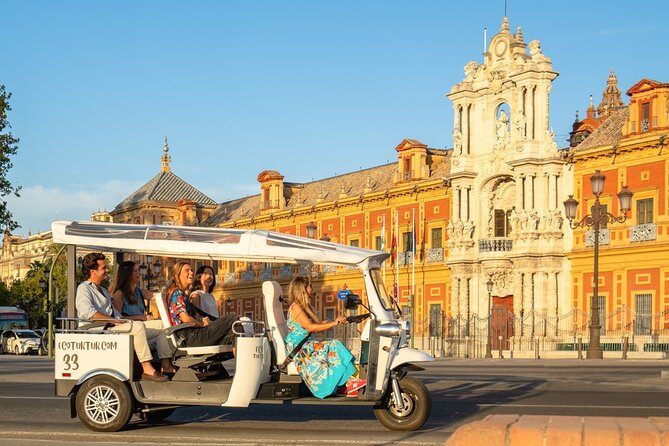
You’ll pass by the Palace of San Telmo, a Baroque building built between the 17th and 18th centuries. It’s also functional: it’s the seat of the Presidency of the Junta de Andalucía and originally served as the headquarters of a sailors’ college. Even if you don’t go inside, this is the kind of stop where a guide’s explanations help you see the building as more than just a façade.
Next comes one of the most striking “wait, that’s that?” moments: the Royal Tobacco Factory of Seville. The tour frames it as the headquarters of the first tobacco factory established in Europe, and it’s described as the most important industrial building in Spain from the 18th century. It’s classified as a Historical Monument (Asset of Cultural Interest) since 1959.
Why do these architecture stops matter in a tuk-tuk tour? Because if you’re only in Seville for a couple days, you’ll likely spend your walk time in the postcard zones. This portion helps you balance that by showing you how the city also grew through industry and power, not just through palaces and plazas.
You don’t linger long here—this is still a short guided loop. But if your goal is “get my bearings and understand what I’m looking at,” these are exactly the types of places worth flagging.
Plaza de España: the 5-minute photo stop that anchors your day
If you pick the 60-minute tour, your biggest dedicated landmark stop is Plaza de España.
This place is famous for a reason, and the tour is efficient about it. You’re told the plaza is part of María Luisa Park, designed by architect Aníbal González, and built between 1914 and 1929 for the Ibero-American Exposition of 1929. That gives you a helpful frame: this isn’t only beauty; it’s a purpose-built landmark from a specific historical moment.
The listed time at the plaza is about 5 minutes, with a photo stop built in. Here’s the practical trick: treat this like your “overview photo” moment. Snap a few pictures that show the plaza layout, then use what you see to choose where you want to spend real walking time later.
One review specifically praised the Plaza de España stop for being guided well—easy to understand, timely, friendly—and it comes up often as a highlight in the overall experience. That lines up with how the tour is structured: Plaza de España is the visual centerpiece.
Even if the stop feels short, it’s the kind of short that can save your energy. You’ll be able to say, okay, I know what this looks like and where it sits in relation to the rest of the route.
María Luisa Park and Plaza de América: green lungs and museum-flanked geometry
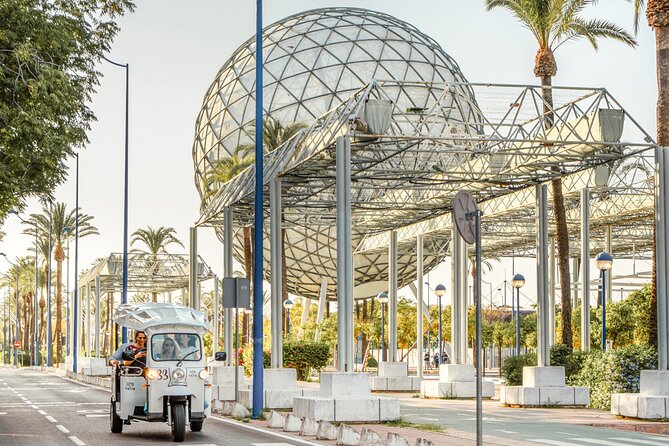
Right after the Plaza de España stop, the tour continues into María Luisa Park. The tour describes it as the first urban park in Seville, with the role of being one of the city’s green lungs. It was declared a Historic Garden (Asset of Cultural Interest) in 1983, and it opened on April 18, 1914 as the Infanta María Luisa Fernanda urban park.
This matters because it helps you “decode” the vibe of the area. You’re not just passing a park—you’re moving through a designed green space built into the same cultural complex that produced Plaza de España.
From there, the route references Plaza de América, a landscaped area inside Parque de María Luisa. It’s flanked by the Museum of Popular Arts and Customs to the north and the Archaeological Museum to the south, plus the Royal Pavilion to the east. That’s useful information for you if you like to plan your next step: you’ll know what museums are nearby even if you don’t enter them that day.
Expect another “photo and orientation” kind of stop rather than a long meander. If you want a slow park stroll, you’ll probably come back later. But as an add-on within a tight tuk-tuk route, it does its job: it gives your day contrast, not just stone and façades.
Torre del Oro on the Guadalquivir: a 36-meter landmark with a date stamp
Then you head toward the river again for one of Seville’s instantly recognizable shapes: the Torre del Oro de Sevilla.
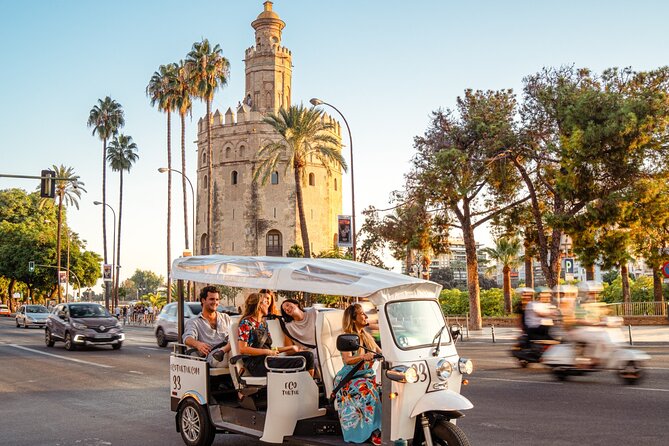
The tower is described as a watchtower on the left bank of the Guadalquivir River, dated to 1221, with a height of 36 meters. It’s also described as a tower formed by three bodies. That level of specificity is exactly what makes a guided quick stop feel more meaningful. You’re not only looking at a photo spot; you’re learning what you’re looking at.
Even without extra time, it’s a strong moment in the route because it anchors the river visually. Seville’s river presence can be easy to overlook if you’re only walking around the center. A stop like this fixes that.
If you like photography, this is a good place for a couple angles: one that includes the river context and one that focuses on the tower shape. The tour is built around this kind of pre-planned picture timing, so you’re not scrambling to find the best spots while also trying to follow a moving group.
Maestranza bullring: a late-stage orientation checkpoint
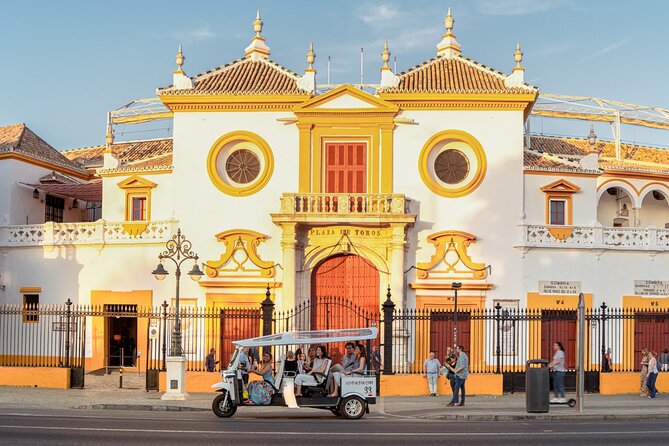
The last major landmark called out in the route description is the Maestranza bullring in the Arenal neighborhood. It was built in the 18th century, and it’s owned by the Real Maestranza de Caballería de Sevilla.
Whether you care about bullfighting or not, the bullring functions as a big orientation marker. Large architecture like this is useful for mapping your mental grid. When you later return to the area on foot or by taxi, you’ll recognize it instantly.
This is also where the tour’s “overview” style shows itself. You’re not trying to cram in a deep visit to a single site. You’re using the tuk-tuk circuit to build a mental map—then using that map to choose what to explore more slowly after.
Price and group size: what $42.30 buys you in real terms
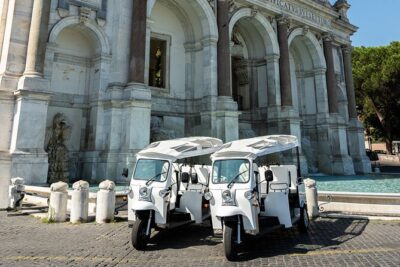
The price listed is $42.30 per person, and the experience is positioned as private with an eco tuk-tuk. That sounds straightforward, but here’s the practical part: tuk-tuks are booked privately, and the legal maximum is 4 passengers per tuk-tuk.
So if your group is larger—say you’re traveling with kids—your total may require more than one tuk-tuk, which can increase the effective cost per person. One review noted exactly this: for 4 adults and 1 child, they had to do two tuk-tuks, which made the price feel higher. That’s normal, not a surprise.
On the plus side, group discounts are mentioned, and since the tour is private, you’re paying for time with a guide and the convenience of moving between neighborhoods efficiently. In a city where walking routes can eat up half your day, that convenience can be worth real money.
If you’re a couple, a small family, or a trio, this can be a very good value because you’re likely within the 4-person capacity and you won’t need a second tuk-tuk. If you’re a bigger group, just plan for the math: count seats first.
Guide style matters: Juan and Hugo set expectations, not just facts
The biggest theme across the reviews is guide energy and communication. Multiple people praised guides named Juan and Hugo for enthusiasm and for making the ride fun while still giving a helpful overview.
Juan is described as multilingual, personable, courteous, and full of detailed explanations. Hugo is repeatedly called out for friendliness and passion, plus for encouraging you to follow his suggestions. One review even mentioned that Hugo recommended looking at Italica and catching a flamenco show at Tablao El Arenal with authentic cuisine.
That’s a great sign for you: a good guide doesn’t just narrate the landmarks. They help you decide what’s worth doing after the tuk-tuk ride ends.
Now the honest balance: one review also mentioned a guide who didn’t stop talking, with what felt like too much information overload and a fast delivery that made the accent harder to catch. That doesn’t mean it’s the norm, but it tells you what to watch for.
My advice: if you don’t want a nonstop narration, look for a moment to ask a question mid-ride. The tour design is stop-based, so it’s not like you’re trapped in a lecture the whole time.
Weather, comfort, and the fixed route reality
This tour runs in rain or heat, and the guide/driver setup includes practical gear. In winter, the tuk-tuks have protective layers against rain and wind and include blankets to keep you warm. In hot conditions, you’ll still be moving quickly through shaded breaks where possible, but it’s still an outdoor circuit.
The tour also notes that vehicles are suitable for seniors and that drivers can assist you getting on if necessary. There’s also a moderate physical fitness level requirement—more about being able to handle a small amount of mobility and getting on/off than about endurance.
A few hard limits matter:
- Minimum age is 2
- Babies are not allowed
- Pets and companion animals are not allowed
- You can’t modify the route, and photo stops are fixed
That fixed-stop design is part of what makes the timing work. It’s not ideal if you’re the type who hates being on a schedule. But if you want a predictable route with efficient photo moments, it’s exactly the point.
Also, the route may vary due to street closures or demonstrations on the day. That’s another reminder that your plan should include flexibility, even when you’re on a guided itinerary.
When a tuk-tuk tour beats walking (and when it doesn’t)
This kind of tour shines when:
- You’re short on time and need a map in your head by the end.
- It’s hot or raining and you’d rather sit than sweat.
- You want a guide to connect places so you understand what each stop represents.
- You prefer photo-focused stops over museum-style wandering.
It may not be the best fit when:
- You want long, unbroken time inside specific sites. This is built around planned photo stops, not extended visits.
- You hate guided narration without much pause.
- You’re traveling with a group that will force multiple tuk-tuks, which can change the cost feeling.
For most people, the smartest approach is to use the ride as your “first-day” or “first-two-days” anchor. Then go back later on foot to the exact spots that grabbed your attention.
Should you book this Seville eco tuk-tuk tour?
I’d book it if you want an efficient Seville overview that mixes river views, neighborhood character, and major architectural landmarks—without spending the whole day walking. The high recommendation rate and the repeated praise for guides like Juan and Hugo point to strong guide quality, and the Plaza de España stop is the kind of anchor moment that helps you enjoy the rest of your trip.
Skip it or plan around its limits if you specifically want flexible photo timing or longer visits. The route and photo stops are fixed, and babies aren’t allowed. Also, if your group is large enough to need multiple tuk-tuks, double-check the per-seat math so the price feels fair.
If you’re trying to make Seville feel easy on day one, this tour is a solid bet.
FAQ
How long is the Express Tour of Seville in Private Eco Tuk Tuk?
The trip is about 60 minutes for the shorter option. A longer option is also offered at about 120 minutes.
Is this tour private?
Yes. It’s a private tour/activity, and only your group participates.
How many people can ride in one tuk-tuk?
The legal maximum is 4 passengers per tuk-tuk, so larger groups may need more than one tuk-tuk.
Where does the tour start?
The start point is Parking APK2 ArjonaPuente del Cristo de la Expiración, 746, Casco Antiguo, 41001 Sevilla, Spain. The tour ends back at the meeting point.
What stops are included on the route?
The route includes the Isabel II Bridge (Triana Bridge), Triana, the Palace of San Telmo, the Royal Tobacco Factory, Plaza de España, María Luisa Park, Plaza de América, Torre del Oro, and the Maestranza bullring. The longer option also includes Isla de la Cartuja.
Are there any entrance fees at the stops?
The itinerary lists Triana and Plaza de España as admission ticket free stops. Other sites are not listed with specific admission details.
What are the age restrictions?
Minimum age is 2 years. Babies are not allowed.
Does the tour run in rain or hot weather?
Yes, tours take place in rain or heat. The tuk-tuks have protective layers against rain and wind in winter and include blankets to keep you warm.
What if I’m late to the meeting point?
If you’re delayed, the activity will be reduced based on lost time, which may cause a change in the fixed route. If the delay is greater than 15 minutes, the activity may be canceled and the amount paid will not be refunded.
Can I cancel for a refund?
Yes. Free cancellation is available up to 24 hours in advance for a full refund. If you cancel less than 24 hours before start time, the amount paid is not refunded.