REVIEW · MADRID
Christmas Lights Tour of Madrid in Eco Tuk Tuk Private
Book on Viator →Operated by Eco Tuk Tuk - Spain · Bookable on Viator
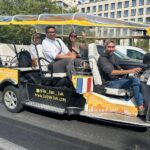
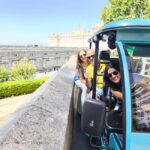
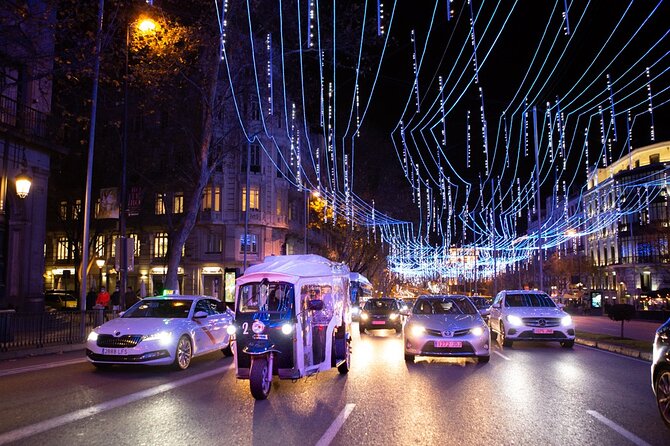
One hour, and Madrid feels lit. On this Eco Tuk Tuk Private Christmas lights tour, I love the private electric ride and the blankets and wind/rain covers that make winter comfortable. The trade-off is that the route is fixed, so you can’t linger longer at the exact spot you like most.
This is a smart way to get your bearings fast, especially if Madrid traffic makes wandering feel like a chore. You’ll roll past major landmarks and holiday displays while your English guide connects the lights to what you’re actually looking at, from Puerta de Alcalá to the Prado area.
In This Review
- Key highlights worth planning around
- How the Eco Tuk Tuk Christmas route works (and why it’s efficient)
- Puerta de Alcalá to Salamanca: the classic Madrid glow with real street flavor
- Plaza de Colón and the Discovery Gardens: Christmas lights meet major monuments
- National Library of Spain (BNE): a nighttime pause for bookish Madrid
- Cibeles Square and the Palacio de Cibeles area: where the lights feel big
- The Banco de España building: impressive even when you only see the façade
- Plaza de Canalejas and the Cortes: neoclassical drama without the museum crowds
- Neptune and the Prado zone: the fountains and paintings meet
- San Jerónimo el Real: the church lights you’ll remember after the route ends
- Guides and comfort: what tends to make or break the experience
- Price and value: is $47.77 worth it?
- Should you book this Christmas Lights Eco Tuk Tuk private tour?
- FAQ
- How long is the Christmas Lights Tour of Madrid in an Eco Tuk Tuk Private vehicle?
- Is this tour private, and is the tuk-tuk electric?
- What language is the guide?
- Are blankets or rain protection provided in winter?
- Is hotel pickup or drop-off included?
- Are pets allowed on the tour?
Key highlights worth planning around
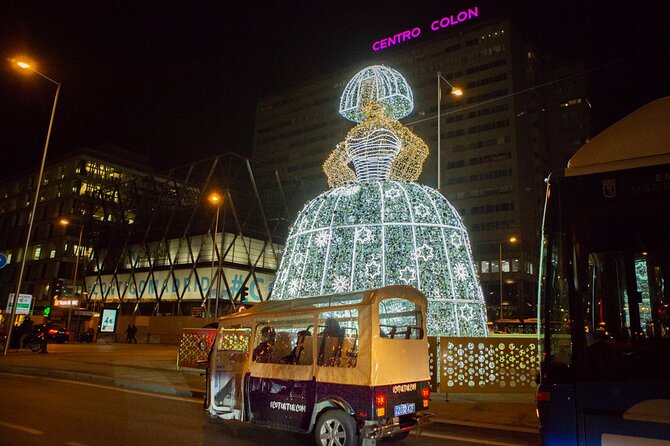
- Private, 100% electric tuk-tuk: your group travels together, and it’s designed for comfort in cooler weather.
- Blankets + protective layers: the winter kit matters more than you’d think once the sun drops.
- Pre-selected photo stops: you’ll stop where the view and lighting line up.
- A guided route through Madrid’s showpieces: Puerta de Alcalá, Salamanca streets, Columbus, Cibeles, and the Prado zone.
- Short and efficient timing: about 59 minutes, with route changes possible due to closures or traffic.
How the Eco Tuk Tuk Christmas route works (and why it’s efficient)
This tour is short on purpose: it runs about 59 minutes and uses a private, 100% electric tuk-tuk for your group. That means you’re not spending the evening circling for parking, pushing through crowds, or getting stuck walking the same route back.
You also avoid a classic holiday problem: waiting. The tour starts without queues or waiting, and you end back at the same meeting point. The meeting spot is C. de Antonio Maura, 13, Retiro, 28014 Madrid, which is handy because you’re not locked into some far-off pickup scheme.
The tour gives you comfort tools that are genuinely practical:
- Blankets for warmth
- Protective layers on the tuk-tuk for rain and wind in winter
- Drivers who help people get on when needed
Also, the stops are set ahead of time. That’s good for flow, but it does mean you can’t swap locations on the fly if your favorite light display is just around the corner.
You can also read our reviews of more tours and experiences in Madrid.
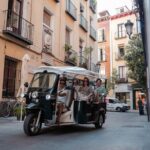
Puerta de Alcalá to Salamanca: the classic Madrid glow with real street flavor
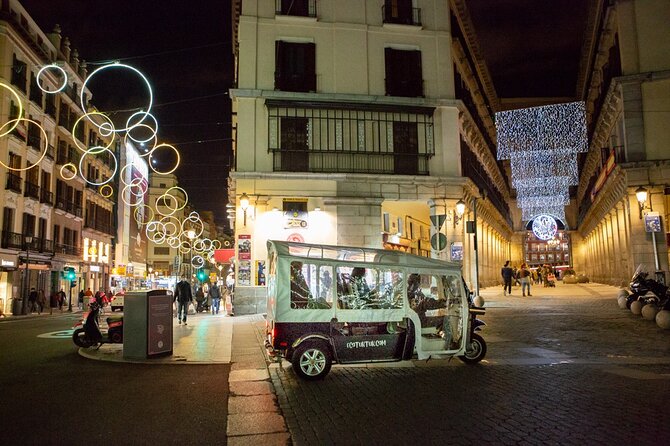
The first stop is Puerta de Alcalá, the monumental gate built on orders from Carlos III to replace an earlier 16th-century gate. It opened in 1778, and seeing it at night works because the structure is built for spectacle. When the holiday lighting is up, the gate feels less like a “check it off” landmark and more like a stage set.
From there, the route aims you toward the Salamanca neighborhood’s main streets, including Velázquez, Ortega y Gasset, and Serrano. This is where the Christmas lighting tends to feel extra polished. More importantly, you get a sense of how Madrid’s neighborhoods change in style and scale.
Why I like this part of the route for your planning:
- You get an early hit of iconic Madrid (Puerta de Alcalá).
- Then you move into a more “street-level” holiday look through Salamanca’s showpiece avenues.
- You’re traveling by tuk-tuk, so you’re not losing time to distance on foot.
A possible drawback here is timing. Because the tour is only about an hour, you’re seeing these places as windows from the road and at fixed photo stops. If you love long photo sessions, you’ll need to come back later on your own.
Plaza de Colón and the Discovery Gardens: Christmas lights meet major monuments
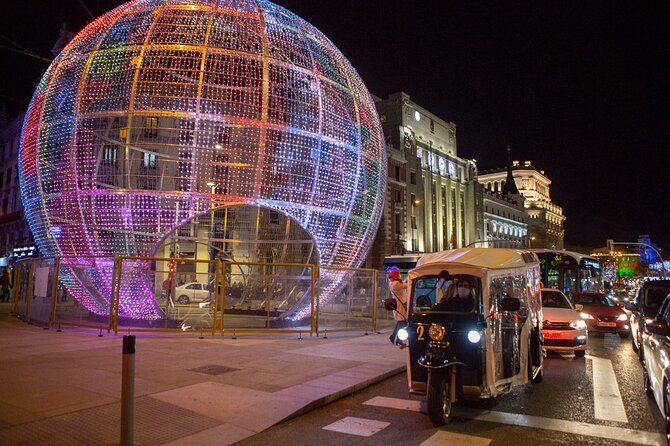
Next up is Plaza de Colón, with the Christopher Columbus monument presiding from the center of its fountain-like layout. The sculpture is neogothic white marble, set on an imposing carved stone pedestal, and it was built in 1885 by Jerónimo Suñol for the wedding of Alfonso XII and María de las Mercedes de Orleans.
At night, this area gets two effects at once:
- The monument reads clearly from multiple angles.
- The fountain and surrounding space give the lights something to bounce off.
The tour also connects you to the Discovery Gardens, a park inaugurated in 1970 where you can spot sculptures linked to the theme of the discovery of America. Even if you don’t get long viewing time, it’s a nice contrast to the big, famous statues nearby. It’s the kind of place that turns a quick stop into something you remember.
If it’s raining, don’t underestimate the value of the tuk-tuk setup. You’re more likely to enjoy the stop instead of rushing because you’re cold and wet.
National Library of Spain (BNE): a nighttime pause for bookish Madrid
The National Library of Spain (BNE) is one of those spots that sounds quiet on paper but feels important in person. It’s an autonomous body tasked with protecting Spain’s bibliographic heritage, including works produced since the start of the 18th century—books, magazines, maps, engravings, drawings, music scores, and brochures.
The library also has the Library Museum and exhibition rooms, which is where the collections and the building’s role in cultural life get shared. During a short tuk-tuk tour, you should treat this as a strong “see it, learn what it is, and snap a photo if timing allows” stop—not a museum visit.
Still, it’s a clever add. Christmas lights tours often focus only on street decorations. This one keeps one foot in Madrid’s everyday cultural identity, where institutions like the BNE play a real role.
Cibeles Square and the Palacio de Cibeles area: where the lights feel big
This is the “main event” zone. You’ll circle around major buildings around Plaza de Cibeles, including the Buenavista Palace (Army Headquarters), Linares Palace (America House), the former post office now known as the Communications Palace (today tied to Madrid City Council), and the Bank of Spain.
Then the spotlight lands on the Cibeles fountain itself. The fountain represents the Roman goddess Cibeles, tied to land, agriculture, and fertility, riding a chariot pulled by two lions. The myth references include Hipómenes and Atalanta. The goddess sculpture is by Francisco Gutiérrez, while the lions were sculpted by Roberto Michel.
Why this stop pairs well with Christmas:
- You get a monumental, open-space setting.
- Holiday lighting tends to look more dramatic when there’s a large stone/architectural mass nearby.
- The fountain’s composition makes it easy to frame photos even from a short stop.
From here, you also hit the Palacio de Cibeles (the City Hall building area). It was designed and built by Antonio Palacios and Joaquín Otamendi as the headquarters of the Spanish Post and Telegraph Society, inaugurated in 1909. In 1993, it was declared a Site of Cultural Interest.
A quick note on expectations: you’re not touring the interior here. You’re catching the feel of the architecture and letting the outside lighting do the work.

The Banco de España building: impressive even when you only see the façade
The route includes another major “don’t-miss-looking” building: the Banco de España headquarters. It was built to match the importance of Spain’s national bank functions, like the single issue of coins and bills across Spanish territory.
The building was designed with materials like stone, iron, and glass elements (as described for this broader civic area), and there’s also a special remark in its story about how it was recognized at the National Exhibition of Fine Arts in 1884.
Here’s how to make the most of the stop:
- Take in the façade proportions rather than expecting a full interior visit.
- Use your guide’s explanation to understand what makes it important beyond its looks.
One more reality check: the tour is short, and interior access isn’t part of the standard flow.
Plaza de Canalejas and the Cortes: neoclassical drama without the museum crowds
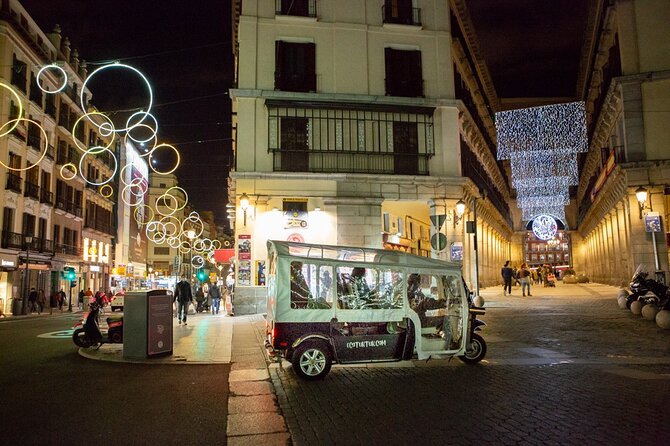
You’ll pass Plaza de Canalejas (formerly known as the Four Streets). It sits in Madrid’s Centro district between Carrera de San Jerónimo and Calle de la Cruz, and it’s around Sevilla and Príncipe. This is the kind of spot where the streets feel connected, which makes it a good “traveling pause” in a tuk-tuk route.
Then comes the Palace of the Spanish Cortes. The site has layers: it used to be a convent, and the building became the Congress headquarters between 1834 and 1841. The façade includes a neoclassical portico with six fluted Corinthian columns, topped with a triangular pediment with relief work by Ponciano Ponzano. The lions flanking the entrance were cast from iron from cannons captured during the African War.
The bronze door under the pediment is only opened on very special occasions, so you’re really there for the exterior drama and the guide’s story.
If you’re traveling with kids or anyone who gets restless at night, this is one of the better types of stops. It’s visual, quick, and easy to react to without needing a long line or a slow museum pace.
Neptune and the Prado zone: the fountains and paintings meet
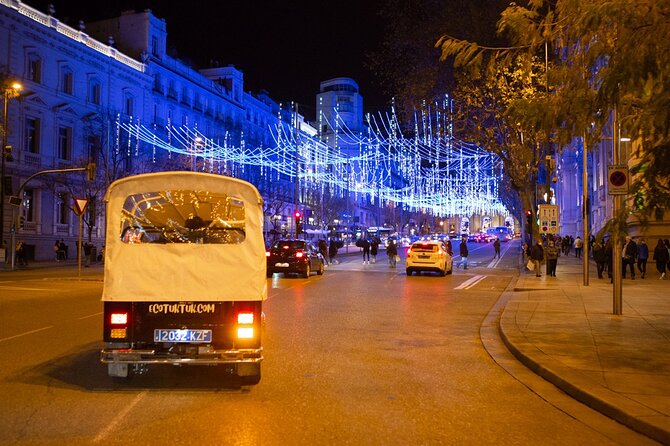
The route also includes the Plaza del Dios del Mar area tied to Neptune and the Cánovas del Castillo square. The fountain story connects back to planning decisions made at the end of the 19th century, when Cibeles and Neptune were relocated to occupy the centers of their respective squares.
It’s a nice pairing because you can notice how the city’s mythological icons are placed in relation to important public spaces and walking routes.
Next, the tour reaches the Prado Museum area. The Museo del Prado is often described in terms of European painting masterpieces spanning the 16th to the 19th centuries. It’s known especially for artists like Velázquez, el Greco, Goya (the most represented artist there), plus Titian, Rubens, and Bosco. The collection also includes major groups by artists like Murillo, Ribera, Zurbarán, and even painters such as Rafael, Veronese, Tintoretto, and others.
In a 59-minute lights tour, you’re not there to “do the museum.” You’re there to recognize the building and set yourself up to return later if you want the full museum experience.
This is exactly where the tuk-tuk shines. If you were trying to do a Prado-focused walk on a cold night, you’d spend most of your energy just getting from one place to another.
San Jerónimo el Real: the church lights you’ll remember after the route ends
To finish, you get the Parish Church of San Jerónimo el Real, popularly known as Los Jerónimos. It’s next to the Prado Museum area, behind it, and it’s in late Gothic style with Renaissance influences from the early 1500s.
Because so much has been remodeled and restored over centuries, the building isn’t a pure “original structure” story. But it’s still a powerful companion to the Prado. Museums and churches make sense in winter. They’re tall, stone, and light-reactive, so you can get a clean sense of Madrid’s scale even when the tour stays brief.
The church is tied to Spanish kings historically, including royal investiture in the absence of a cathedral and the wedding of Alfonso XIII. If you like understanding why monuments matter—not just that they exist—this ending stop usually lands well.
Guides and comfort: what tends to make or break the experience
This tour lives or dies on two things: the route flow and how the guide keeps the story moving.
The strongest feedback points highlight guides who:
- explain what you’re seeing in plain language,
- handle the navigation smoothly,
- and make cold weather feel less annoying.
You might hear stories from guides like Carlos, David, Christian, Laura, Ana, Alex, Belén, Arturo, or Gloria. Even if your name differs, the pattern is the same: the best tours use the lights as a doorway into real Madrid details.
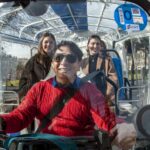
On comfort, the provided winter gear matters. Rainy nights can still feel fun because you’re not trapped outside shivering. One practical point from real-world experiences: some tuk-tuk seat setups can feel a bit tight if you sit so your face hits the side bars. If you’re tall or broad-shouldered, it’s worth asking your guide to help you find the most comfortable position at the start.
Also, the route can run short due to traffic. That’s not a quality issue; it’s how the city works in peak hours.
Price and value: is $47.77 worth it?
At $47.77 per person for about 59 minutes, the value is mostly about what you avoid: time, walking distance, and the stress of figuring out which lights to hit first.
You’re getting:
- a private vehicle for your group (not shared with strangers),
- a 100% electric tuk-tuk,
- blankets and rain/wind protection,
- pre-selected photo stops,
- and an English guide.
That combination tends to make sense if you:
- want a holiday highlight loop without committing to a long night,
- have kids or older relatives who won’t enjoy a cold, long walk,
- arrive in Madrid and want a first evening that gives you bearings,
- or simply want to see a lot of landmarks without spending your limited time fighting traffic.
Where the value can fall flat is if you expected a longer, looser walking tour with more flexible stops. This one is fixed and timed. One small reality check to keep in mind: on major holidays (like Christmas Day), some displays might not be fully operating, and traffic and demonstrations can affect what you see.
Should you book this Christmas Lights Eco Tuk Tuk private tour?
Book it if you want an easy, comfortable way to experience Madrid’s holiday atmosphere while still learning what you’re looking at. It’s a strong choice for a first night in town, a family-friendly winter outing, or anyone who prefers “see the highlights quickly” over “wander until you’re tired.”
Skip it only if you’re chasing one thing: lots of unscheduled photo time or a long museum-and-lights hybrid night. This tour is built for efficiency. You’ll get the big visual moments, but you won’t get endless lingering.
FAQ
How long is the Christmas Lights Tour of Madrid in an Eco Tuk Tuk Private vehicle?
The tour lasts about 59 minutes.
Is this tour private, and is the tuk-tuk electric?
Yes. It’s private for your group only, and the tuk-tuk is described as 100% electric and sustainable.
What language is the guide?
The tour is offered in English.
Are blankets or rain protection provided in winter?
Yes. In winter the tuk-tuks have protective layers against rain and wind, and blankets are provided to help keep you warm.
Is hotel pickup or drop-off included?
No. Hotel pickup and drop-off are not included (not legal).
Are pets allowed on the tour?
No. Pets and companion animals aren’t allowed for security reasons, but service animals are allowed.