REVIEW · MADRID
Madrid Sightseeing Tuk Tuk Tours
Book on Viator →Operated by Madrid Tuk Tours · Bookable on Viator
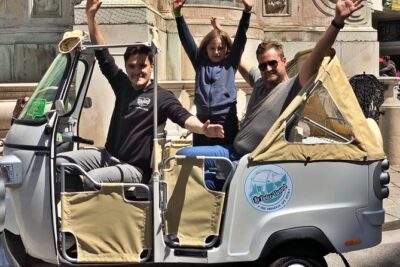
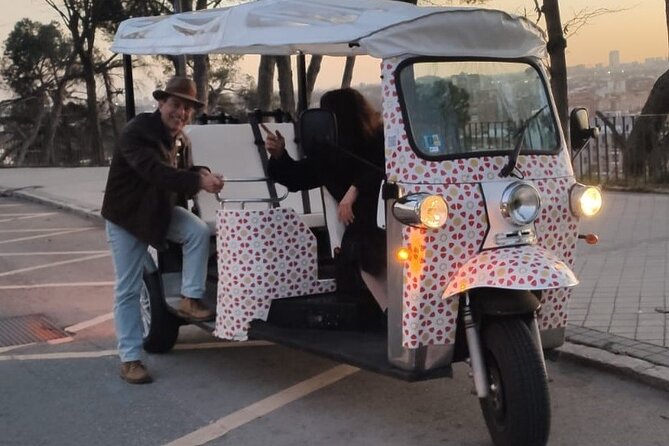
A tuk-tuk makes Madrid feel bite-sized. You zip between big-name sights and walk-in moments, with an English guide pointing out details you’d miss on your own. I love how the route mixes monuments with local streets, then gives you just enough time at each stop to take photos and get oriented.
I really like the private setup for your group, and I like that the stops include both famous places like the Prado and more everyday favorites such as Mercado San Miguel and La Latina. Those are the kinds of contrasts that make a short trip feel full without turning into a blur.
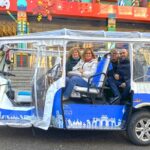
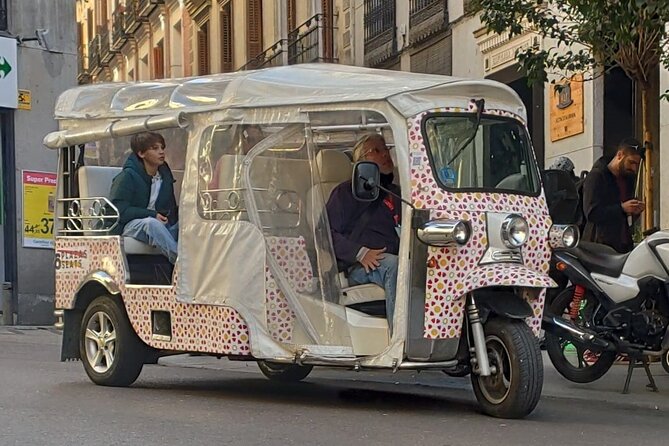
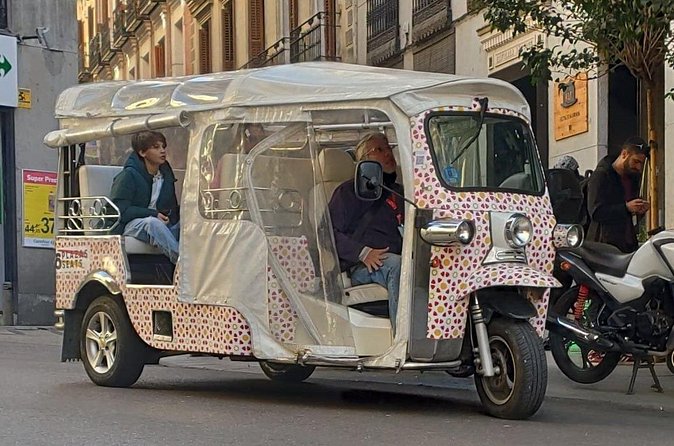
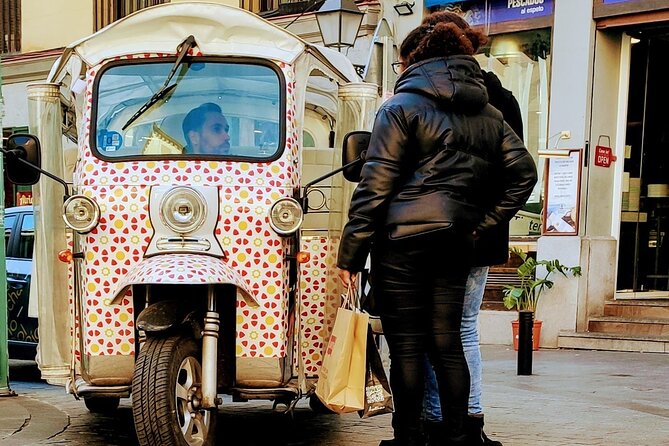
One thing to consider: the tuk-tuk’s cover design can affect sightlines, so if you’re sensitive to not seeing clearly from your seat, plan your seating and ask the guide where visibility is best.
In This Review
- Key points before you go
- What this Madrid tuk-tuk tour is really good at
- The price: what you’re paying for (and where extra costs can pop up)
- Meeting point and time reality: start clean, end back where you began
- Stop-by-stop: what to expect and what each place gives you
- Royal Palace area: history you can see without paying yet
- Almudena Cathedral: a major church moment, free admission
- Plaza de la Villa and the old town rhythm
- Mercado San Miguel: iron architecture that still has presence
- La Latina: medieval streets and classic central Madrid energy
- Church of San Isidro: baroque style plus a 1930s story
- Barrio de Las Letras: writers, shopping, and food breaks
- The UNESCO-recognized boulevard: Paseo del Prado in motion
- Prado Museum, Retiro Park, and the art-and-escape pairing
- Museo Nacional del Prado: the big-ticket stop that changes your day
- Los Jerónimos: a national monument stop
- Parque del Retiro: green refuge with centuries of trees
- Real Jardin Botánico: a neoclassical garden with central location
- Madrid’s gates and civic icons: Puerta de Alcalá, Puerta de Toledo, and Cibeles
- Puerta de Alcalá: a royal gate from 1778
- Plaza de Cibeles: where the fountain anchors the square
- Fuente de Neptuno: Neptune’s dramatic pose on Paseo del Prado
- Puerta de Toledo: the last monumental gateway
- Modern Madrid signals: Salamanca, Castellana, Picasso Tower, and Bernabéu
- Barrio de Salamanca: a residential, important-feeling district
- Paseo de la Castellana: palatial remains along a main road
- Torre Picasso: 157 meters and a skyline marker
- Santiago Bernabéu Stadium: big football energy, entrance not included
- How the guide style changes the whole experience
- Weather and comfort: what to plan around
- Who should book this Madrid Sightseeing Tuk Tuk Tour
- Should you book this tour?
Key points before you go
- A guide-led route through the Prado area, Retiro, and Madrid’s major gates
- Many free stops (Almudena Cathedral, Mercado San Miguel, Plaza de Cibeles, and more)
- Short photo stops plus walk-in moments, so you’re not stuck riding the whole time
- Well-liked guides such as Offito, Alexander, David, Gerardo, and Cesar (each with a different strength)
- Weather handling matters, including blankets during heavy rain in at least one run
What this Madrid tuk-tuk tour is really good at
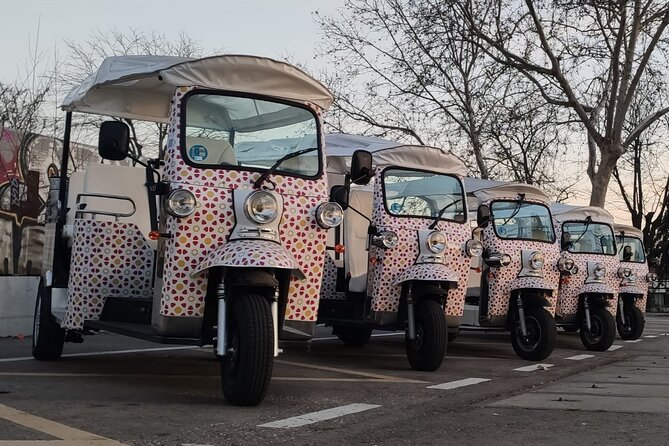
This tour works because it’s designed for movement. Madrid is huge on foot, and you can spend half a day crossing neighborhoods just to reach the next “must-see.” Here, the tuk-tuk gets you close, then your guide helps you make the most of the time you have.
The biggest value is the blend of “headline” sights and city texture. You’ll see the Royal Palace of Madrid and Prado from the outside, but you also swing through areas like La Latina and Barrio de Las Letras, where Madrid feels more like lived-in streets than museum walls. That mix is especially helpful if this is your first day or your only “major sights” window.
Also, because it’s a private tour/activity, you’re not sharing the ride with random strangers. That matters when you want to stop for photos, ask questions, or adjust the pace to your group.
You can also read our reviews of more tours and experiences in Madrid.


The price: what you’re paying for (and where extra costs can pop up)
The tour price is $108.02 per person for 1 to 3 hours (approx.). What you’re paying for isn’t just transport—it’s the combination of private tuk-tuk ride + an accompanying personal guide. In a city where getting from Point A to Point B can take forever, that guide-led efficiency can be worth it.
Admissions are mixed. You’ll find several major places marked as not included—most notably:
- Royal Palace of Madrid
- Museo Nacional del Prado
- Santiago Bernabeu Stadium
- Real Jardin Botanico
- Real Basilica de San Francisco el Grande
On the other hand, many stops are listed as free admission, including Almudena Cathedral, Mercado San Miguel, Los Jerónimos, Parque del Retiro, Puerta de Alcalá, Plaza de Cibeles, Fuente de Neptuno, Puerta de Toledo, and others.
So the value depends on your plan: if you want to pay for big-ticket interiors at the palace or the Prado, budget for extra tickets. If you’re happy with exterior viewing plus free-access moments, this can feel like a smart way to see a lot without stacking multiple entrance fees.
Meeting point and time reality: start clean, end back where you began
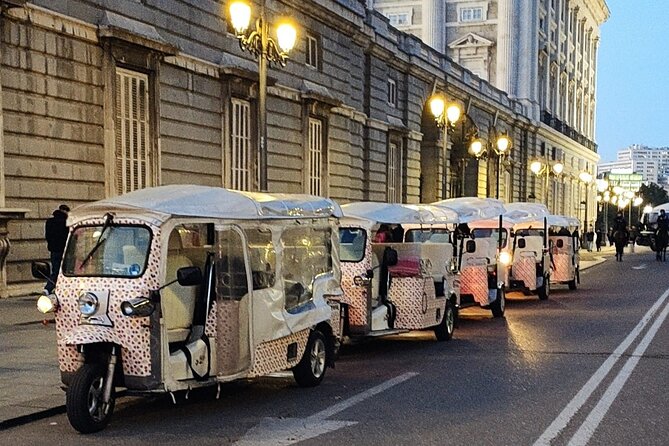
The tour starts at C. de Vergara, 1, Centro, 28013 Madrid, Spain, and it ends back at the meeting point. That round-trip structure makes planning easier—you don’t have to worry about how you’ll get back across the city afterward.
One practical note from real-world operations: punctuality at the start matters. There was a case where the group missed the tuk-tuk because the meeting pickup didn’t match their arrival, which left them without the tour. If you’re using transit, give yourself buffer time and be ready at the pin, not a block away.
Stop-by-stop: what to expect and what each place gives you

Royal Palace area: history you can see without paying yet
The ride begins with the Royal Palace of Madrid, whose origins go back to the 9th century—first a defensive building linked to the Emirate of Córdoba, then later expanded by the Spanish Crown until it became the seat of the court under Philip II. It’s a great opener because it instantly sets the “big Madrid” tone.
Admission isn’t included here, so you’ll likely get more from the viewpoint and the guide’s context than from walking inside—unless you’ve budgeted extra. Still, even a short look helps you understand why this part of Madrid is such a magnet.



Almudena Cathedral: a major church moment, free admission
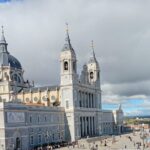
Next is Catedral de Sta Maria la Real de la Almudena. It’s described as the most important religious building in Madrid, and it was consecrated on June 15, 1993, by Pope John Paul II. The standout fact: it’s noted as the first cathedral consecrated outside Rome.
This stop lists free admission. One review specifically highlighted getting to go inside the cathedral and take pictures. So if you can, try to use this moment for a walk-in pause rather than treating it like a quick photo stop.
Plaza de la Villa and the old town rhythm
At Plaza de la Villa (formerly Plaza de San Salvador), you’re in a square tied to early civic life. The guide-style detail here matters: the site remembers a church standing on the main street, and it also references the town hall portico and a plaque marking where the temple once stood.
This is a free stop, and it works well as a breather between larger monuments—especially if you want to catch small historical context without paying for interiors.
Mercado San Miguel: iron architecture that still has presence
Mercado San Miguel is a standout for one reason: it’s described as the last example of iron architecture still standing in Madrid, with similar structures from the late 19th century already demolished.
You don’t need a ticket to appreciate the setting, and even a short visit helps you understand why markets in Madrid aren’t just “places to eat”—they’re architecture with personality.
La Latina: medieval streets and classic central Madrid energy
La Latina is traditional, central, and built around medieval-origin streets that revolve around squares like La Cebada and La Paja. This is where the tour stops being only about famous landmarks and starts showing you how neighborhoods actually feel.
Admission is free. If your group wants a photo break with a real local vibe, this is one of the best parts of the route.
Church of San Isidro: baroque style plus a 1930s story
Church of San Isidro is a 17th-century baroque church shaped on a Latin cross plan. It belonged to the former Monastery of the Imperial College of the Society of Jesus, and it suffered a major fire in 1936 that left it almost completely destroyed.
This stop is free admission. You’re getting more than a quick facade check: the style and the historical damage-and-recovery angle make it a memorable stop even if you don’t go inside.
Barrio de Las Letras: writers, shopping, and food breaks
Barrio de Las Letras is central and tied to some of Spain’s greatest writers. Today it’s described as a mix of literature, bohemia, fun, shopping, and good cuisine.
It’s free to see, and it’s one of the best neighborhoods to walk a little if your tuk-tuk stop gives you time to stretch your legs.
One review also mentioned a guide taking the group to a churro and chocolate shop. If you get a food-minded guide, this area can turn into a practical bonus.
The UNESCO-recognized boulevard: Paseo del Prado in motion
You’ll ride along a historic boulevard marked as the first example of an urban avenue since the 16th century, stretching from Glorieta de Carlos V to Plaza de Cibeles. Since 2021, it’s recognized as a UNESCO World Heritage Site.
This part is more than a scenic pass. It’s where Madrid’s grand “show” and its artistic pull overlap. Even if you don’t enter museums at every stop, the boulevard layout helps you see the city’s big axes.
Prado Museum, Retiro Park, and the art-and-escape pairing
Museo Nacional del Prado: the big-ticket stop that changes your day
The Museo Nacional del Prado is one of Madrid’s most visited attractions. It houses about 8,600 paintings and more than 700 sculptures. Admission isn’t included, so you’ll likely get an exterior-oriented stop unless you add tickets separately.
Even so, the Prado area is worth seeing because you can connect the museum’s scale to the city’s grand planning. If you’re a first-timer, this helps you decide later if you want to return for a deeper museum day.
Los Jerónimos: a national monument stop
At Los Jeronimos (San Jeronimo el Real), you’re at one of the two most important convents in Madrid. The church is classified as a National Monument (1925).
This stop is listed free admission. It’s also often a good “change of mood” after the busier core—more serious, more historical, and a nice pause for your eyes and photos.
Parque del Retiro: green refuge with centuries of trees
Parque del Retiro is a massive green escape: 125 hectares with more than 15,000 trees. There’s even mention of the oldest tree in Madrid, the Cipreste, believed to be around 400 years old.
Admission is free. This is a smart stop if you want a mental reset. The main value isn’t just the greenery—it’s the way the park provides breathing space between heavy sightseeing moments.
Real Jardin Botánico: a neoclassical garden with central location
The Royal Botanical Garden is founded by Fernando VI in 1755. It’s known for its neoclassical layout and its location in the city center, making it one of Europe’s more unique botanical garden settings.
Admission isn’t included here. Still, seeing it from the tour route helps you understand why people make time for it on longer trips.
Madrid’s gates and civic icons: Puerta de Alcalá, Puerta de Toledo, and Cibeles

Puerta de Alcalá: a royal gate from 1778
Puerta de Alcala was inaugurated in 1778. It was one of the five royal gates used to access the town and is described as a witness to Madrid’s more recent history.
This stop is free. Even a short look makes sense because it’s an easy landmark for orientation later, and the architecture is bold without needing an entry ticket.
Plaza de Cibeles: where the fountain anchors the square
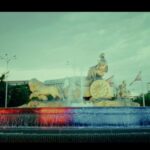
At Plaza de Cibeles, the Cibeles Fountain sits in the center. It’s described as a symbol of Madrid, designed in 1782, with a goddess of nature and protector of the people.
Free stop. This is one of the best photo opportunities in the route because the square is structured for it and because the fountain is visually dominant.
Fuente de Neptuno: Neptune’s dramatic pose on Paseo del Prado
Fuente de Neptuno is on Paseo del Prado, built by order of King Carlos III. Neptune holds a trident and a coiled serpent, standing on a carriage pulled by two seahorses, surrounded by dolphins.
Free admission. It’s a great place for a quick “wait, that’s amazing” moment—especially if you like sculptures with movement and symbolism.
Puerta de Toledo: the last monumental gateway
Puerta de Toledo stands 19 meters tall and was inaugurated in 1827. It’s described as the last monumental gateway erected in Madrid, with granite construction beginning in 1812. It also became the reception venue for King Ferdinand VII.
Free admission. This is a solid “capstone gate” stop—one that closes the loop on the earlier royal gate feeling without repeating the same style.
Modern Madrid signals: Salamanca, Castellana, Picasso Tower, and Bernabéu
Barrio de Salamanca: a residential, important-feeling district
Barrio de Salamanca is described as one of the most relevant areas in Madrid, with a notable distribution pattern and residents. This stop is free admission.
On a tight schedule, this is helpful because it shows you Madrid beyond the historic core. You’ll get a sense of the city’s layout shift from older quarters into more modern patterns.
Paseo de la Castellana: palatial remains along a main road
Paseo de la Castellana runs north-south in the 17th and 18th centuries, from what’s now Plaza de Colón. A first section still preserves remains of the palatial architecture from that era.
Free stop. Even if you don’t enter anything, this gives your eyes a different scale and helps you understand why Madrid feels layered rather than frozen in time.
Torre Picasso: 157 meters and a skyline marker
The Torre Picasso is 157 meters tall and was Madrid’s tallest building until the construction of the Four Towers. Today it’s described as one of the city’s most emblematic buildings.
Free stop. It’s a quick way to snap yourself out of “classic only” mode.
Santiago Bernabéu Stadium: big football energy, entrance not included
The Santiago Bernabeu Stadium field opened in 1947 as Nuevo Estadio Chamartín. After renovations it’s now described as state-of-the-art, with the highest UEFA score. It holds more than 80,000 fans and is noted as the second largest football stadium in Spain.
Admission isn’t included. You may not get inside as part of the basic stop, but the scale is the point here. It’s the kind of sight that makes Madrid feel like a modern European capital, not a history-only city.
How the guide style changes the whole experience
This tour’s success depends a lot on the guide, and the names that came up were consistently praised for keeping people engaged and moving at a useful pace.
- Alexander was singled out for keeping small kids involved on a 1-hour tour. If you’re traveling with younger kids, that’s a big deal.
- David was praised for making the city feel personal and for being punctual, with lots of history shared without turning into a lecture.
- Gerardo received strong notes for doing an excellent job and handling first-timer orientation well.
- Offito was praised for walking stops, including time to go inside the cathedral, and for spotting small history details.
- Cesar showed up in feedback tied to comfort: one run involved cold weather and the group was kept warm by an enclosed cover.
Not every ride will feel identical, but these examples show what you should aim for: clear explanations, smart use of stop time, and flexibility when weather shifts.
Weather and comfort: what to plan around
Madrid weather can swing, and you’ll want to be ready for the possibility of cold or rain. One review mentioned heavy rain and blankets provided by the driver to keep people warm.
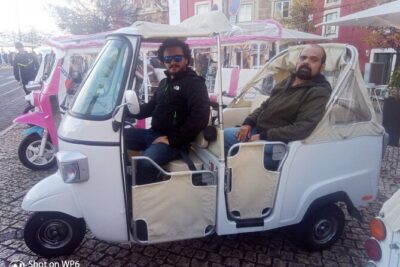
Also watch the design of the tuk-tuk cover. There’s at least one complaint about the cover limiting visibility. If you’re the type who needs a clean view for photos, don’t just accept whatever seat you’re given—ask where you’ll see best before you start moving.
Who should book this Madrid Sightseeing Tuk Tuk Tour
Book it if you:
- Want to cover a wide range fast: Royal Palace, Almudena, Prado area, Retiro, major gates, and modern Madrid
- Like guided stops where you get context, not just movement
- Prefer a private ride over a shared group scramble
- Are okay with some big interiors requiring separate admission tickets
Skip it (or at least rethink your expectations) if:
- You’re very sensitive to limited views from vehicle covers
- Your main goal is to spend lots of time inside major ticket museums or stadium tours
- You can’t guarantee you’ll be at the meeting point on time
Should you book this tour?
My take: if you want a smart first-pass through Madrid highlights without turning your day into a long walking quest, this is a good bet. The route hits the city’s biggest names, and the guide helps you connect them—especially in free admission stops like Almudena Cathedral, Mercado San Miguel, and Parque del Retiro.
If you’re planning to enter the Royal Palace, the Prado, the botanical garden, or Bernabéu, count those extra tickets into your budget. If you just want the sights plus a guided sense of the city, you’ll likely feel you got your money’s worth.
If your top priority is maximum interior time inside ticketed attractions, you might consider a different day structured around museums only. But for an efficient, guide-led “see Madrid” ride, I’d book it.