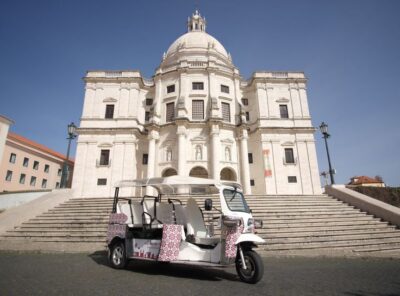
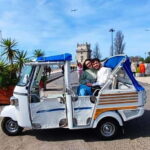
Lisbon looks best when you move through it fast. This private all-electric tuk tuk tour strings together the city’s key historic areas and famous viewpoints in about 2 to 2.5 hours, with English explanations along the way.
I like how the route tackles Lisbon’s “up and down” geography without turning your day into a stair marathon. And I also like that your guide named Sam isn’t just reciting facts—he’s focused on getting you to the best photo spots and sharing practical ideas for what to do next.
One heads-up: this is great for people with moderate fitness, but you’ll still be walking at stops in old neighborhoods like Alfama and around viewpoints, which means good shoes help.
In This Review
- Key things that make this tuk tuk tour worth your time
- Why a tuk tuk is the smart way to do Lisbon’s hills
- Meeting at Hotel Mundial: a straightforward start that saves time
- Baixa de Lisboa and Terreiro do Paço: Lisbon’s grand re-start
- Sé Cathedral: the medieval spine between Alfama and Baixa
- Alfama viewpoint time: Miradouro de Santa Luzia
- Higher and less crowded: Miradouro da Senhora do Monte
- Feira da Ladra at Campo de Santa Clara: shopping with a time machine feel
- National Pantheon (Santa Engrácia): the white dome and the meaning inside
- Casa dos Bicos and the José Saramago connection: Lisbon through art and literature
- Alfama walking segment: narrow lanes, tiles, courtyards, and fado energy
- Chiado: culture, bookstores, cafés, and classic Lisbon pace
- Price and value: $212.93 per group for a full-sight Lisbon day
- Weather, timing, and what to wear for a comfortable ride
- Should you book this Lisbon tuk tuk tour?
- FAQ
- What’s the duration of the tuk tuk tour?
- How much does the tour cost?
- Is the tour private?
- What language is the tour offered in?
- Where does the tour start and end?
- Do I need good weather for the tour?
Key things that make this tuk tuk tour worth your time
- All-electric tuk tuk ride that makes Lisbon’s hills feel easier than on foot
- Sam as the guide, known for fun commentary and pinpointing the best viewpoints
- Photo-friendly stops at Miradouros de Santa Luzia and Senhora do Monte
- Historic centre highlights like Terreiro do Paço and the Santa Justa area
- Real-local texture with Feira da Ladra at Campo de Santa Clara
- Literature-and-architecture stop at Casa dos Bicos and the José Saramago Foundation
Why a tuk tuk is the smart way to do Lisbon’s hills
Lisbon is famous for views—and those views are often perched on slopes. This tour is built for that. Instead of waiting for buses or trying to stitch together neighborhoods by tram, you get a direct, point-to-point route using an electric tuk tuk.
The schedule is tight in a good way: about 2 hours to 2.5 hours, with multiple stops where you get a short walk and then hop back into the tuk tuk. Each viewing block is roughly 20 minutes, so you don’t get stuck in one place too long—ideal if you’re juggling jet lag, heat, or limited time.
It’s also private, up to 4 people per group. That matters. You can ask questions, adjust pacing, and linger for photos without feeling rushed or lost in a crowd. And since it runs in English, you can follow the story clearly as you pass through the city’s changing neighborhoods.
You can also read our reviews of more tours and experiences in Lisbon.



Meeting at Hotel Mundial: a straightforward start that saves time
The tour meets at Hotel Mundial, right by Praça Martim Moniz (Praça Martim Moniz 2, 1100-341). That’s a convenient hub because it’s fairly central and close to public transport.
Starting here is practical for two reasons:
- You can get there easily without planning a complex hop across Lisbon first.
- Your day doesn’t begin with a long “arrival scramble.” You’re straight into the sightseeing momentum.
The end goes back to the same meeting point. So you’re not left trying to figure out your way back up or down after the last viewpoint.
Baixa de Lisboa and Terreiro do Paço: Lisbon’s grand re-start
The first major stop is Baixa de Lisboa, the historic centre where old Lisbon shows its street-grid brain. You’ll spend time around Terreiro do Paço, also called the Place of Commerce.
What I like about this first move is that it gives you orientation fast. From Terreiro do Paço you get a wide open view toward the Tejo River. That river view is a useful mental map for the rest of the day because it helps you understand where Alfama sits relative to the water.
You also get time around the Santa Justa area, including the Elevador de Santa Justa. Even if you’re not riding it, the elevator is a landmark you’ll spot and remember. The idea here is simple: start with the city’s iconic “wow” structure, then transition into older, narrower quarters later.
Possible drawback: Baixa is busy. If you’re hoping for total quiet, plan for a few minutes of city noise while you settle in and take photos.
Sé Cathedral: the medieval spine between Alfama and Baixa
From Baixa you move toward the heart of older Lisbon with the Sé (Lisbon Cathedral). This Romanesque-style cathedral goes way back—built in the 12th century—and it has survived earthquakes and transformations over time.
Why this stop matters: it’s not only a big building. It’s a marker for Lisbon’s identity. When you stand under those robust arches and take in the strong rose window, you get a sense of Lisbon before the city spread out and modernized.
The location is also smart for your route. Sé sits between Alfama and Baixa, so it acts like a hinge point. After this, your day naturally flows toward viewpoints and the steep lanes that make Alfama feel distinct.
If you’re sensitive to church interiors—dark spaces, quiet rules, or cooler air—come prepared to slow down for a few minutes. This stop is about atmosphere, not speed.
Alfama viewpoint time: Miradouro de Santa Luzia
Next comes a viewpoint in Alfama: Miradouro de Santa Luzia. This is one of Lisbon’s classic scenic stops for good reason. You look over the Tejo River with red-tiled rooftops and the folded shape of Alfama down below.
This viewpoint is described as romantic and quieter than you might expect for something so famous. Part of that comes from how the space is built—traditional tiled panels, pergolado shading with bougainvillea, and the natural “frame” effect it creates for photos.
I like that it’s not just about taking a shot. The timing is short—about 20 minutes—so it works even if you’re doing this tour as one part of a bigger Lisbon plan.
Practical tip: bring your phone charger or a fully charged battery. Viewpoints mean longer photo sessions, especially when the light is right.





Higher and less crowded: Miradouro da Senhora do Monte
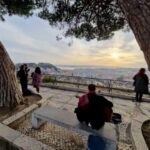
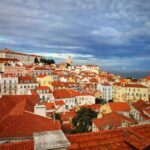
The tour then shifts up again with Miradouro de Nossa Senhora do Monte in the Graça area. This viewpoint offers sweeping panoramas: you can see over toward Castelo de São Jorge, the Tejo River, and much of the city’s surrounding hills.
This is the “zoom out” moment of the day. If Santa Luzia helps you understand Alfama from the edge, Senhora do Monte helps you understand Lisbon as a whole—layer upon layer of neighborhoods and rooftops.
It’s also described as having a quieter, more authentic feel and being a great place for sunset. If your visit timing allows, I’d plan around the light here. If not, it still works during daytime because the sightlines are wide and memorable.
Possible drawback: higher viewpoints can be windy. A light layer can make a difference.
Feira da Ladra at Campo de Santa Clara: shopping with a time machine feel
Then you get a very Lisbon stop: Feira da Ladra, one of the oldest street markets in the city, held in the Alfama and São Vicente area (at Campo de Santa Clara). The vibe is part market, part local tradition, part treasure hunt.
You can browse for antiques, vintage items, crafts, vinyl records, old books, and one-off pieces. This isn’t a clean, curated shopping mall experience. It’s outdoors and lively, with the feel of people actually living their day.
I love market stops on tours like this because they break the “only monuments” pattern. A viewpoint tells you what the city looks like. A market tells you how people live there—and how local culture shows up in objects, not just architecture.
Consideration: marketplaces can mean uneven walking surfaces and lots of foot traffic. If you’re traveling with someone who hates crowds, keep the browsing time light and treat it as a quick culture stop.
National Pantheon (Santa Engrácia): the white dome and the meaning inside
Next is the National Pantheon, linked with the ancient Church of Santa Engrácia. The building is known for its Baroque style and, especially, the majestic white dome that dominates the skyline.
This stop has a different tone than the viewpoints. It’s more reflective. Inside, it houses prominent figures of Portuguese history and culture, so the space feels like a place of memory and respect—not just sightseeing.
From the terrace, you also get another panoramic view over the Tejo River and Alfama. So you get both: a cultural monument and a scenic payoff.
If you like monuments that tell stories through design and symbolism, this will click. If you prefer fast, exterior-only stops, you might need to pace yourself so the interior doesn’t feel like a detour.
Casa dos Bicos and the José Saramago connection: Lisbon through art and literature
One of the most visually distinctive stops is Casa dos Bicos, located by the Tejo River in Alfama. It’s a 16th-century building with a façade made of thousands of raised stone “nozzles,” an architectural feature inspired by Italian design.
That texture is the big reason to stop. From a distance, you might miss why it’s famous. Up close, you see the pattern and suddenly it makes sense.
Today, it hosts the José Saramago Foundation, which connects architecture with literature and Portuguese cultural life. The message here is simple: Lisbon isn’t only old stone and tiled streets. It also builds modern meaning on top of that past.
This is also a good spot if you want something that feels slightly different from the usual cathedral/viewpoint circuit. It adds depth without adding a day-long commitment.
Alfama walking segment: narrow lanes, tiles, courtyards, and fado energy
After the major landmarks and viewpoints, you’ll get time in Alfama itself—its narrow winding streets, traditional tiles, staircases, hidden courtyards, and unexpected viewpoints.
This is where the tour earns its “feel the real Lisbon” goal. Alfama is described as the oldest neighborhood in Lisbon, and it’s tied to fado and everyday local life. You’re not only seeing Lisbon—you’re moving through the physical shape of the neighborhood.
This is also where the “moderate fitness” note matters. Even if the tuk tuk does most of the heavy lifting, old Lisbon streets can be steep and uneven. Plan to enjoy it, not fight it.
Practical advice: if you have limited mobility, wear shoes with grip and expect a few short stretches on foot. If you love wandering, this part will be a highlight.
Chiado: culture, bookstores, cafés, and classic Lisbon pace
Later you shift to Chiado, one of Lisbon’s more sophisticated neighborhoods where tradition meets modern city life. This area is known for historic bookstores, notable cafés, theatres, churches, and classic shopping.
Two things make Chiado a smart contrast to Alfama:
- Alfama is steep, tight, and old-school street life.
- Chiado feels more designed, with cultural institutions and an easy walking flow.
As you stroll, you can spot places like Café A Brasileira, the National Theatre of São Carlos, and the statue of Fernando Pessoa. These references matter because they connect Lisbon to writers, artists, and public life—not just religious or royal power.
If you want a final neighborhood that feels like Lisbon’s modern cultural heartbeat, Chiado does that job well.
Price and value: $212.93 per group for a full-sight Lisbon day
At $212.93 per group (up to 4), this isn’t a “cheap” tour, but it can be good value depending on your travel style.
Here’s why it can pencil out:
- A tuk tuk reduces time spent figuring out routes across hills.
- The itinerary covers multiple major areas in one go: Baixa, Sé, two miradouros, market time, Pantheon, Casa dos Bicos, Alfama, and Chiado.
- You get English-guided explanations and a private group setting, so you’re not paying for the hassle of coordinating a bunch of separate tickets and transport.
To judge if it’s worth it for you, ask: do you want one organized day that hits the most iconic points without stitching together transit? If yes, the price is easier to justify. If you prefer flexible DIY wandering and already have mobility/time to handle hills on your schedule, you might spend less on transport alone.
Weather, timing, and what to wear for a comfortable ride
This experience depends on good weather. That’s important because viewpoints and outdoor market time are central to the route.
For clothing, keep it simple:
- Comfortable shoes for Alfama lanes and any short walks.
- Sun protection in warmer months.
- A light layer for higher viewpoints where wind can cut through.
Also remember: the tour runs daily from 9:00 AM to 7:00 PM, which gives you options. If you’re chasing sunset energy, aim for the Miradouro da Senhora do Monte window.
Should you book this Lisbon tuk tuk tour?
Book it if you want an efficient Lisbon day that mixes big landmarks, classic views, and a market stop—without burning hours on transit. It’s especially a win if you like the idea of a guide who helps you get your bearings, points out the best photo angles, and offers real suggestions for how to continue your trip.
Skip it or plan differently if you’re looking for a fully seated ride with minimal walking. Alfama and some monument areas require you to be on foot, even if only for short segments.
If your group is up to four and you want a guided hit list done with comfort, this is a strong choice.
FAQ
What’s the duration of the tuk tuk tour?
The tour lasts about 2 hours to 2 hours 30 minutes.
How much does the tour cost?
The price is $212.93 per group, up to 4 people.
Is the tour private?
Yes. It’s a private tour/activity, and only your group participates.
What language is the tour offered in?
The experience is offered in English.
Where does the tour start and end?
It starts at Hotel Mundial at Praça Martim Moniz (Praça Martim Moniz 2, Lisboa) and ends back at the same meeting point.
Do I need good weather for the tour?
Yes. The experience requires good weather, and if it’s canceled due to poor weather, you’ll be offered a different date or a full refund.