REVIEW · PARIS
4 Hour Grand Paris Tour by Electric Tuk Tuk See Almost Everything
Book on Viator →Operated by Paris Green Ride · Bookable on Viator
Electric tuk-tuks make big-Paris days easy. This 4-hour Grand Paris loop strings together the classics and quieter neighborhood moments, with an English-speaking driver who helps you see more without getting stuck in transit chaos.
Electric tuk-tuk ride time feels efficient, and you still get room to look, snap photos, and ask questions.
I especially like the guide factor. Drivers like Félix and Jules come across as sharp, warm, and genuinely good at explaining what you’re seeing. I also love how the route mixes major monuments with green pauses like Luxembourg Gardens, plus everyday Paris streets that feel lived-in.
One thing to plan for: many stops are short look-aways or photo stops, and admission tickets are not included for several of the big-ticket sites. If you want to go inside, you’ll need separate tickets and a bit of extra time.
In This Review
- Key things that make this tour work
- Electric tuk-tuk Grand Paris: the fastest way to get oriented
- Meeting at Saint-Germain: where the day starts and how it feels
- Saint Sulpice to Notre-Dame: architecture, restorations, and a quick reality check
- Crossing to Île Saint-Louis and the Roman leftovers
- Rue Mouffetard stroll: where the day turns from monuments to daily Paris
- Saint-Étienne-du-Mont and the Pantheon: two different church styles in minutes
- Luxembourg Gardens and the Observatory: a calm break inside a busy route
- Invalides to Ecole Militaire: history near the Champs de Mars
- Trocadéro for the Eiffel Tower view: the money photo stop
- Arc de Triomphe and the Champs-Élysées approach
- Place de la Concorde and the “big nation” axis
- Grand Palais, Petit Palais, and Pont Alexandre III: the “showroom” stretch
- Louvre perimeter and Place Vendôme: you’re close to the art gravity
- Opera Garnier, Moulin Rouge, Pigalle, and Montmartre streets
- Sacré-Cœur and the Madeleine: the final “taste of contrasts”
- Timing, admissions, and what you should plan if you want more
- Price and value: is $277.99 per person worth it?
- Should you book this electric tuk-tuk Grand Paris tour?
- FAQ
- How long is the 4 Hour Grand Paris Tour?
- What’s the meeting point for the tour?
- What language is the tour offered in?
- Is admission included for major sights like Notre-Dame and the Louvre?
- Does the tour include an Eiffel Tower photo stop?
- Is the tour private?
- Is there a mobile ticket?
- Are service animals allowed?
- Is the meeting point near public transportation?
- What’s the cancellation window for a full refund?
Key things that make this tour work
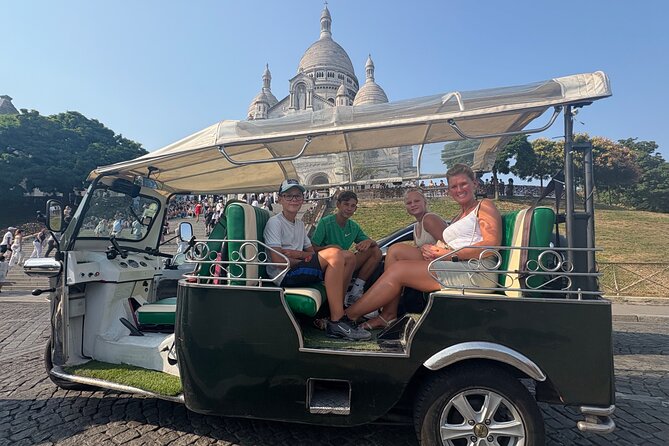
- Electric and quiet: a calmer way to cover serious distance than trying to cram everything into buses and taxis
- Real guide skill: you’re not just getting a list of stops; you get clear explanations and a friendly tone (Félix and Jules stand out)
- Left Bank first, then classic Paris: Saint-Germain, Notre-Dame area, Latin Quarter, and then the Eiffel/Champs-Élysées axis
- Photo planning built in: Trocadéro for the Eiffel view, plus multiple quick photo windows at major monuments
- Neighborhood texture: Rue Mouffetard, Montmartre cobblestones, Pigalle’s energy—this isn’t only marble and museums
- No ticket-stress for many viewpoints: several viewpoints are free to enjoy from outside, even if museum entries aren’t included
Electric tuk-tuk Grand Paris: the fastest way to get oriented
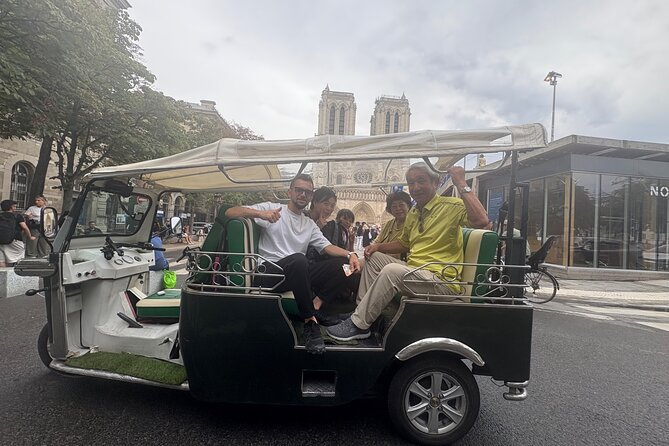
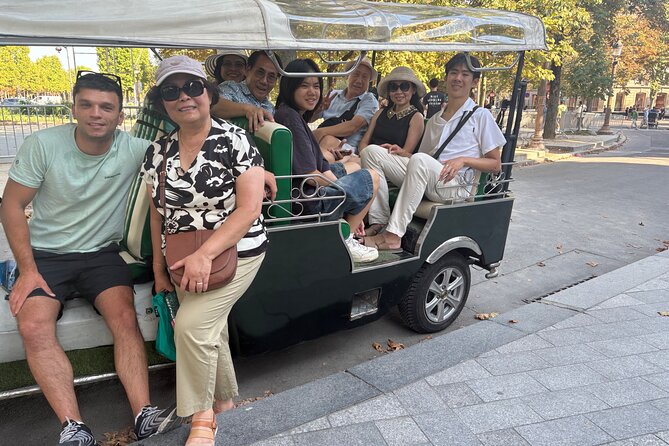
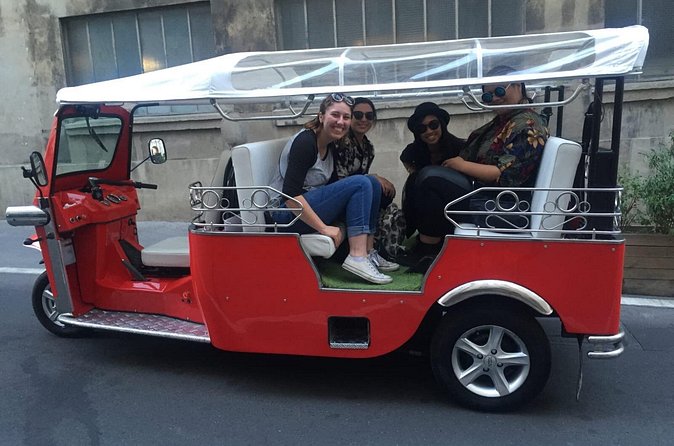
If Paris is your first big trip or your third time and you still want a better way to connect the dots, an electric tuk-tuk is a smart move. The ride is quieter than you’d expect, and it’s built for “stop, look, learn, move on” so you don’t burn your day wrestling with transfers.
This tour is also a great antidote to the usual problem: you know the landmarks, but your brain has no order. Here, the route naturally ties together the Left Bank first, then crosses toward the Eiffel Tower and up through the grand boulevards. You’ll come away with a map in your head, not just photos on your camera roll.
And because it’s a private activity (only your group participates), the guide can keep the pace comfortable. That matters when you’ve got kids, older legs, or just want to linger at the best photo spots.
You can also read our reviews of more tours and experiences in Paris.


Meeting at Saint-Germain: where the day starts and how it feels

You start at 159 Bd Saint-Germain, 75006 Paris. That’s a practical location because you’re already close to some of the most scenic walking zones, and the driver can build the route efficiently from there.
The first stop is Saint Sulpice Church, one of Paris’s larger churches with a big facade and a dramatic interior. Even if you don’t go inside, you get the sense of scale right away. It’s a good warm-up: your eyes adjust to the city’s architectural language before you hit the major monuments.
Once you meet your driver, you head toward Place Saint Germain—the area tied to Café de Flore and the church of Saint Germain. This is one of those parts of Paris where you feel the “thinking person” side of the city: books, cafes, and the kind of streets people actually linger on.
Saint Sulpice to Notre-Dame: architecture, restorations, and a quick reality check
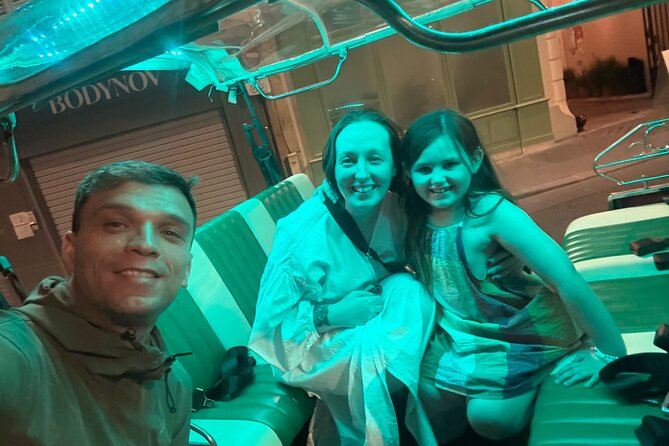
From Saint-Germain, the route takes you to Cathedrale Notre-Dame de Paris. You get about 10 minutes to see this Gothic icon from the outside, and the guide explains it as a 12th-century masterpiece. You also learn about its ongoing restoration after the 2019 events, which helps you understand why the area looks the way it does now.
This is a key tour truth: you’re not here for a long inside visit. The stop notes admission ticket not included, so treat this as a “get the sightline, learn the story, take the photos” moment. If you want the full interior experience, plan a separate visit.
Still, even a short Notre-Dame window can be valuable. It gives you context for later areas too—because once you understand how the city’s older cores are shaped, everything from the Latin Quarter to the river islands makes more sense.
Crossing to Île Saint-Louis and the Roman leftovers
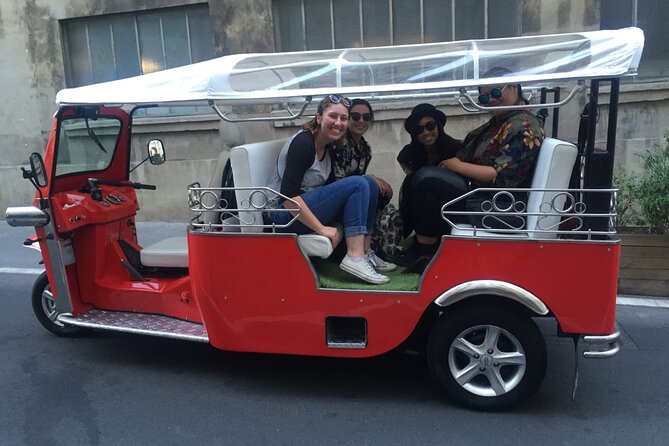
Next you pass by Île Saint Louis, a calm historic island in the center of Paris. You’ll notice the elegant buildings and smaller shops, plus the local classic of Bertillon ice cream. Even if you don’t stop for dessert, it’s an easy moment to picture Paris as everyday life, not only tourist magnets.
Then you reach Arènes de Lutece (about 5 minutes). This ancient Roman amphitheater is one of those things you rarely see unless you’re specifically searching for it. It sits in the middle of a modern neighborhood, which makes it feel even more striking.
Again, tickets aren’t included here, and the stop is brief. But that’s okay. The value is seeing the layering of eras—Roman Paris, medieval churches, then the big classical monuments later. It’s like getting a timeline in motion.
Rue Mouffetard stroll: where the day turns from monuments to daily Paris
After Arènes de Lutece, you pass Place de la Contrescarpe and stroll along Rue Mouffetard, one of Paris’s oldest streets. This is one of my favorite kinds of travel moments: short, sensory, and real.
Rue Mouffard is packed with cafes and market energy, which makes it a good break from sightseeing intensity. Your driver can point out what you’re likely to miss if you only rely on museum time.
Also, this is the kind of street where your photos come out more honest. You’ll get people, textures, storefronts, and that feeling that you’re walking inside a living city.






Saint-Étienne-du-Mont and the Pantheon: two different church styles in minutes
The tour keeps rolling with quick stops and passing views, including Eglise de Saint-etienne-du-mont. You learn it was built on the site of an early church dedicated to St Genevieve, the patron saint of Paris, and you get the description of its Gothic-Renaissance blend.
Then comes the Pantheon, with about 3 minutes. This neoclassical monument is all about France’s major figures, and the guide points out the dome and the views over the Latin Quarter.
If you were hoping for a long Pantheon visit, this isn’t that. Admission is marked as not included, and the stop is short. But the upside is you still get the “why it matters” explanation, and you can decide later if you want a deeper visit at a slower pace.
Luxembourg Gardens and the Observatory: a calm break inside a busy route
One of the smartest parts of the itinerary is that it doesn’t keep you under museum lights the whole day. You pass the Luxembourg Gardens, created by Queen Marie de Medici in 1612. The guide points out the fountains, statues, flowers, and the fact that locals relax there.
You’ll also pass the jardin de l’observatory, with statues and fountains connected to the Paris Observatory area. Even if you only see it from the vehicle or in quick walk space, it shifts your mental gears.
This matters because the rest of the tour moves fast: Eiffel views, arches, grand boulevards, and busy districts. A small green pause keeps the day from feeling like one long line.
Invalides to Ecole Militaire: history near the Champs de Mars
Next you stop at Musee de l’Armee des Invalides for about 5 minutes, mainly for photos and an overview of why the monument is history-heavy. Again, admission isn’t included, so this is about seeing the scale and learning the context.
Then you pass Ecole Militaire, an 18th-century military academy where Napoleon Bonaparte once studied. The stop is brief (about 2 minutes) and marked free for admission, but the big point is the setting: it faces the vast Champ de Mars. Even from a pass-by view, it helps you understand the geography between key Paris landmarks.
Then you go just below the Eiffel Tower. You’re not climbing it here, but you’re close enough to feel the shift from “Left Bank architecture” to “Paris icon in full view.”
Trocadéro for the Eiffel Tower view: the money photo stop
The route pushes into the most photo-ready area: Place du Trocadéro et du-11-Novembre. You get about 5 minutes, and this stop is marked free for admission.
This is the Eiffel Tower view that most people aim for—so having it scheduled and protected by a guide’s timing is worth it. If you’re juggling your own schedule across Paris, it’s easy to miss the best light or the clearest view.
Practical tip: treat this as a take-your-photos-quickly-now-and-then-enjoy-the-street scene kind of stop. The time window is short, and that’s the whole idea—capture the classic angle, then move on without stress.
Arc de Triomphe and the Champs-Élysées approach
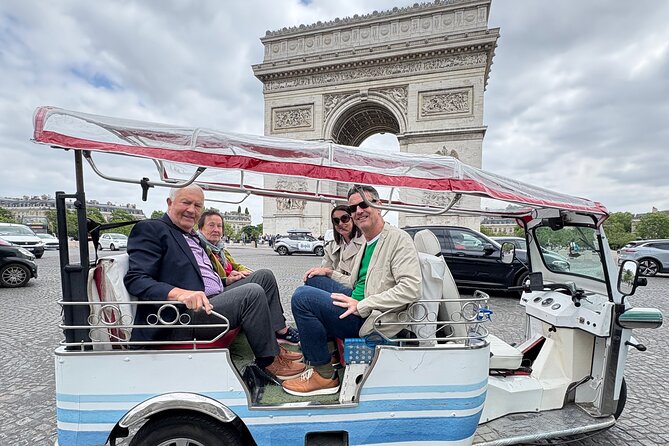
From Trocadéro, you go to Arc de Triomphe with about 5 minutes. The stop includes explanations and time to take photos, and the admission is marked not included. You’ll see why it’s one of the big organizing points in Paris—the star-shaped layout is the reason so many major streets radiate out from here.
Then you head up the Champs-Élysées area to the star roundabout location where the Arc sits. If you’ve only seen the Champs-Élysées as a shopping corridor, you’ll appreciate it more once you understand how it connects the city’s monument geometry.
Place de la Concorde and the “big nation” axis
Next comes Place de la Concorde with about 5 minutes. You pass in front of the national assembly area, and you learn about the obelisk offered by the Egyptians to Napoleon.
This stop feels grand for a reason: it’s built for scale. And since it’s marked free for admission, you can enjoy it without planning an entry ticket.
You then pass Palais de l’Elysée, the historic French President’s residence. You’ll appreciate it more if you remember you’re passing the political and ceremonial center of the country, not just a pretty building.
Grand Palais, Petit Palais, and Pont Alexandre III: the “showroom” stretch
You pass Grand Palais (about 2 minutes). It’s known for its glass and exhibitions, but your experience here is mostly visual—another short stop that adds richness to your mental map rather than requiring long entry time.
Then you pass Petit Palais, famous for its architecture and being an art museum. Even from the outside, the area gives you that “Paris always has a reason to be photogenic” feeling.
After that you get Pont Alexandre III for about 5 minutes, marked free for admission. The guide plans a photo stop on one of the most beautiful bridges in Paris. If you care about composition, this is a good one to use your whole time on.
Louvre perimeter and Place Vendôme: you’re close to the art gravity
Next you pass the Palais Bourbon, tied to French politics, before heading into the heavy-hitter arts zone.
You get Louvre Museum passing time (about 10 minutes), with admission marked not included. The tour also passes Comédie-Française, France’s national theatre. It’s a helpful combo because it reminds you the Louvre area is not only art—it’s culture machinery.
Then you move to Place Vendôme for about 5 minutes. It’s known for luxury boutiques and the column of Napoleon. The stop is marked free, so it’s a good “look around while you’re moving” moment.
Opera Garnier, Moulin Rouge, Pigalle, and Montmartre streets
The route continues with quick pass-bys that still add personality. You see the Opera Garnier area for about 2 minutes (marked not included), then Moulin Rouge for about 2 minutes (not included).
You also pass the Pigalle district, known for nightlife and cabarets, then go through Montmartre, associated with artists and cobblestone streets.
Here’s the value: the tour doesn’t treat these places like just names. The driver’s commentary and the short ride-and-look rhythm helps you understand how Paris nightlife and art history overlap geographically.
Sacré-Cœur and the Madeleine: the final “taste of contrasts”
The last segment includes Sacré-Cœur Basilica with about 10 minutes. The stop is marked not included, so think views and photos rather than an extended interior visit.
Then you pass the Madeleine Church, known for its grand neoclassical architecture. This ending lands on purpose. You go from Montmartre’s artistic/quirky energy to a more formal, classical finale—two Paris moods in one day.
Finally, the tour ends back at the original meeting point. That loop matters because it prevents the common problem of spending your last hour stuck trying to return across town.
Timing, admissions, and what you should plan if you want more
The entire tour is about 4 hours and designed around quick windows. Many of the iconic stops are not included for admission, including Notre-Dame de Paris, Arènes de Lutece, Arc de Triomphe, Louvre Museum, Opera Garnier, and Sacré-Cœur (among others marked not included). Some viewpoints are marked free for admission, like Trocadéro, Place de la Concorde, and Pont Alexandre III.
So here’s the smart way to use this day: treat it as your guided map-building session. If an interior visit calls you, pick one or two top priorities and do those separately after the tour, using the route you just learned.
You’ll also enjoy the day more if you show up with a few goals:
- Get your Eiffel angle photo set early enough to feel relaxed
- Learn what changed at Notre-Dame and why restoration affects what you see
- Decide in advance if you only want exteriors today or if you’ll add one entry later
If your group loves museums, you might feel the “passing” style at Louvre or Invalides. But if you’re more into big-picture orientation, this format is the best bargain in time.
Price and value: is $277.99 per person worth it?
At $277.99 per person for about 4 hours, this isn’t the cheapest way to ride around Paris. The value isn’t in entry tickets—it’s in the combination of private electric transport, a guide who can explain what you’re seeing in real time, and a route that hits the major clusters without you doing the planning math.
In other words, you’re paying for reduced stress. You avoid figuring out the order, you avoid parking and traffic headaches, and you don’t waste time on long transfers between far-apart areas.
This is especially good value if:
- You’re traveling with a small group or family and want everyone together
- You want a first-time overview that also includes neighborhoods like Rue Mouffard and Montmartre
- You care about photo timing more than museum checklists
If you’re solo and already know exactly where you want to go inside, you might prefer to use the cost for a more targeted day of entrances. But if you want the “Grand Paris sampler” that still feels guided and personal, the price makes sense.
Should you book this electric tuk-tuk Grand Paris tour?
Book it if you want a high-impact Paris route with a driver who can talk through what matters, not just where to stand. I’d especially recommend it when you want Eiffel Tower views plus Left Bank landmarks in one day, while still seeing quieter streets and gardens.
Skip it (or pair it with other plans) if your dream day is mostly museum interiors and long ticketed visits. This tour is built for getting bearings fast, taking photos at the right moments, and learning enough to choose what to explore deeper next.
If you can, ask for Félix when you book. The standout theme from guide experience here is not only driving skill—it’s the flexible, friendly way the commentary makes the city click.
FAQ
How long is the 4 Hour Grand Paris Tour?
It’s approximately 4 hours.
What’s the meeting point for the tour?
The tour starts at 159 Bd Saint-Germain, 75006 Paris, France, and ends back at the meeting point.
What language is the tour offered in?
It’s offered in English.
Is admission included for major sights like Notre-Dame and the Louvre?
No. Admission tickets are listed as not included for several stops, including Notre-Dame de Paris and the Louvre Museum. Some areas are marked free for admission, but many others are not.
Does the tour include an Eiffel Tower photo stop?
Yes. The tour includes a stop at Place du Trocadéro et du-11-Novembre for Eiffel Tower views and photos.
Is the tour private?
Yes. It’s a private tour/activity, and only your group will participate.
Is there a mobile ticket?
Yes, a mobile ticket is included.
Are service animals allowed?
Yes, service animals are allowed.
Is the meeting point near public transportation?
Yes, it’s near public transportation.
What’s the cancellation window for a full refund?
You can cancel up to 24 hours in advance for a full refund. If you cancel less than 24 hours before the experience’s start time, the amount paid will not be refunded.