REVIEW · PARIS
Paris Sightseeing by Tuk Tuk Golf Cart 2 hours
Book on Viator →Operated by Paris Green Ride · Bookable on Viator
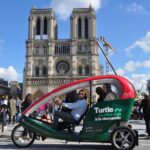
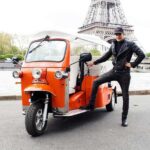
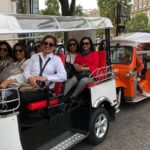
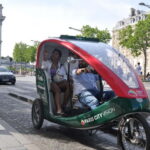
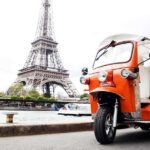
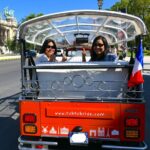
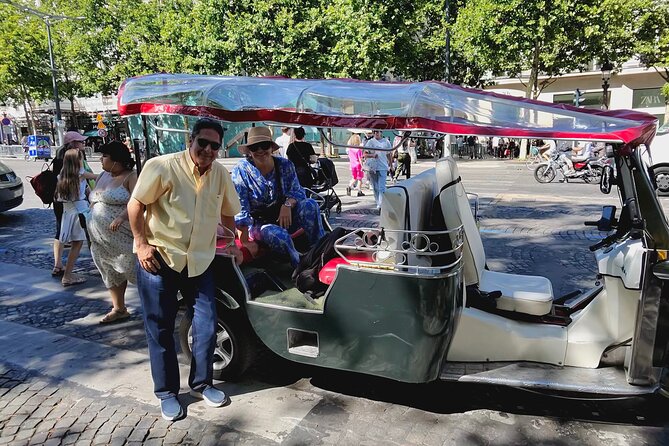
Paris can feel like a lot at once. This two-hour private tuk tuk ride gives you a fast, friendly way to map the city while still seeing major sights up close. You’ll glide past big-name churches, grand squares, and postcard bridges without hunting for tickets or fighting traffic.
What I like most is how efficiently it strings together landmark after landmark—so you get the feel of Paris’s layout early. I also really appreciate the short stop-and-photo format, which works well when you’re jet-lagged or you just want the highlights first, then return later on your own.
One thing to keep in mind: this is a rapid route. Most stops are just a few minutes, so it’s great for orientation and views, but not for deep museum time or long, slow wandering.
In This Review
- Key highlights that make this tour worth your time
- A two-hour loop of Paris that helps you see the whole city
- Price and value: what $150.18 buys you in real terms
- Starting point on the Left Bank: 159 Bd Saint-Germain
- Left Bank churches: Saint-Sulpice and Saint-Germain-des-Prés
- Concorde and the Grand Palais area: big-square Paris meets 1900 World’s Fair architecture
- Pont Alexandre III and the Seine: classic bridge views with golden details
- Champs-Élysées and Arc de Triomphe: the straight-line Paris experience
- Trocadéro to Eiffel Tower: best views, then the sparkle
- École Militaire and Les Invalides: Napoleon’s Paris, seen from the road
- Luxembourg Gardens, the Pantheon, and Notre-Dame from the route
- Ile Saint-Louis and Palais Bourbon: calmer Paris moments before you ride back
- The guide factor: why Jules, Kenny, and Félix can make or break it
- How to make the most of those short stops (without rushing yourself)
- Who this tour suits best
- Should you book this Paris tuk tuk and golf cart tour?
- FAQ
- How long is the Paris Sightseeing tour?
- What does it cost per person?
- Is the tour private?
- Is the tour offered in English?
- What is included in the tour?
- Where do we meet for the tour?
- Is admission included for the stops?
- Are mobile tickets available?
- Are service animals allowed?
- Can I get a full refund if I cancel?
Key highlights that make this tour worth your time
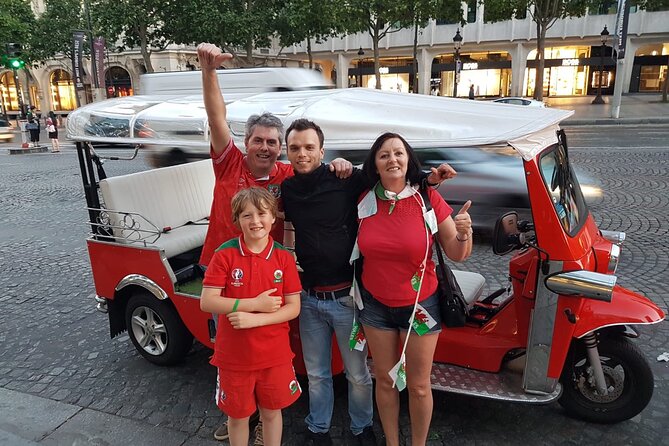
- A private ride through the Left Bank and beyond: your group controls the pace inside the 2-hour window
- Iconic Paris, stitched into one route: Saint-Sulpice, Concorde, Pont Alexandre III, Champs-Élysées, Eiffel Tower
- Photo-friendly stops including Trocadéro for Eiffel Tower pictures
- Napoleon-related landmarks on the same loop, from École Militaire to Les Invalides
- Great for getting oriented fast when it’s your first day in Paris
- Guide energy matters, and the best versions of this tour shine with guides like Jules, Kenny, and Félix
A two-hour loop of Paris that helps you see the whole city
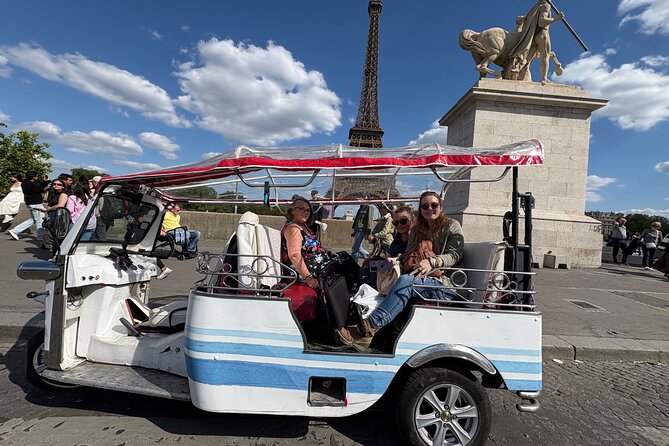
This isn’t a slow, one-neighborhood walking tour. It’s a practical sightseeing loop by tuk tuk and golf cart, designed to help you get your bearings fast. In only about two hours, you’ll cover an impressive stretch of central Paris—enough to understand where everything sits and how neighborhoods connect.
You also get a built-in rhythm. You ride, you stop briefly, you take photos, you move on. That matters in Paris, where waiting for traffic lights and navigating crowded areas can eat up your day. Here, your time gets used for views and context rather than transport stress.
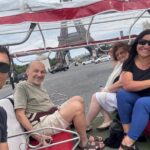
And because it’s private—only your group—you’re not trapped behind a large crowd. If you want extra time for a couple of pictures at a specific stop, you’ll usually have an easier time doing it than on mass group tours.
You can also read our reviews of more tours and experiences in Paris.
Price and value: what $150.18 buys you in real terms
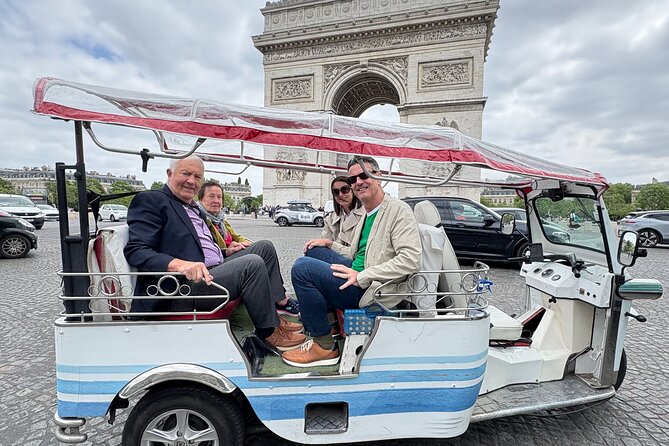
At $150.18 per person for about 2 hours, you’re paying for three things: a guided route, transport by tuk tuk/golf cart, and convenience. The math can feel steep at first, but it starts to make sense when you compare it to piecing together taxis or rides and guiding yourself across multiple districts.
A big value point here is that you’re not paying admission to enjoy the key sights on the route—each stop is listed as free for admission. You’re seeing landmarks from outside or in pass-by views, so your money goes into motion and commentary, not ticket queues.
Also, bottled water is included. It’s small, but it helps on a warm afternoon or after a long flight. The mobile ticket and English offering are also part of the “friction-free” package, especially if you’re trying to get started quickly.
Is it worth it? For first-timers and short-itinerary travelers, I’d say yes—mainly because the route compresses a lot of classic Paris into one simple plan.
Starting point on the Left Bank: 159 Bd Saint-Germain
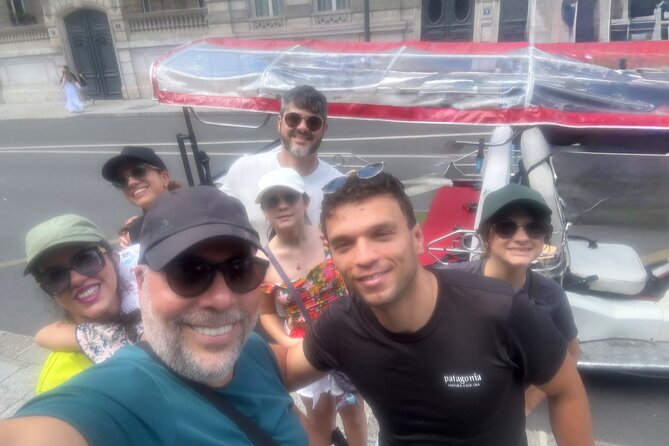
Your tour begins at 159 Bd Saint-Germain, 75006 Paris, and it ends back at the same meeting point. That location is a smart base if you’re staying anywhere along central corridors, because it puts you near a dense cluster of major landmarks.
From there, the route quickly moves you from churches and historic streets into the big spectacle zone of squares and avenues. That’s useful: you’ll learn which directions matter, where the Seine viewpoints come in, and how to connect later days to the areas you liked best.
It’s also listed as near public transportation, which helps if you need a backup plan for getting to the meeting point.
Left Bank churches: Saint-Sulpice and Saint-Germain-des-Prés
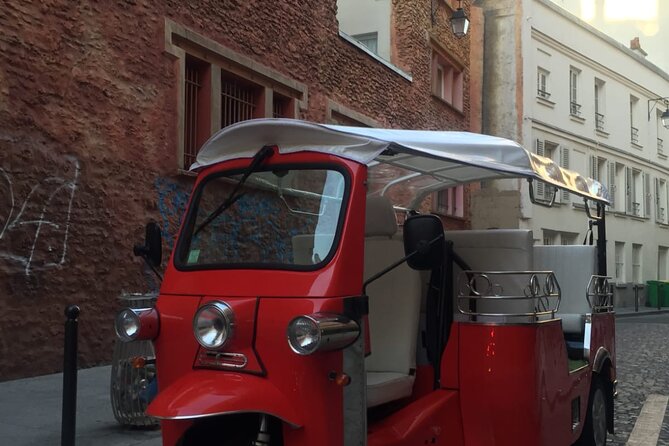
The tour opens with Eglise Saint-Sulpice. This church is famous for its beauty, but it’s not always the first stop for tourists compared with some other grand Paris churches. You get a calm introduction to a more local-feeling Paris landmark—plus an easy early photo opportunity without the day already being chaotic.
Next is Eglise de St. Germain des Pres, connected to Saint-Germain-des-Prés Abbey and its history reaching back to the 6th century. You also get a sense of why this area mattered culturally on the Left Bank. That context is the point: even if you don’t go inside, you’ll understand the “why” behind the buildings you’re seeing.
The practical benefit: starting with two church stops sets a historic tone before the tour accelerates into the monument-heavy parts of town.
Quick timing note: both are short stops, so don’t plan on long interior time here. Treat them as great outside views and orientation moments.
Concorde and the Grand Palais area: big-square Paris meets 1900 World’s Fair architecture
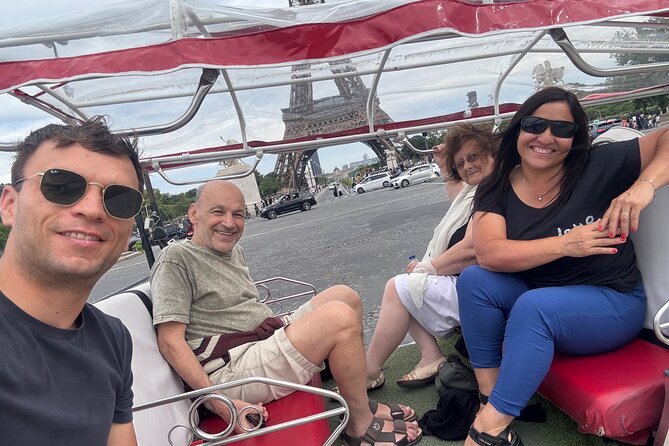
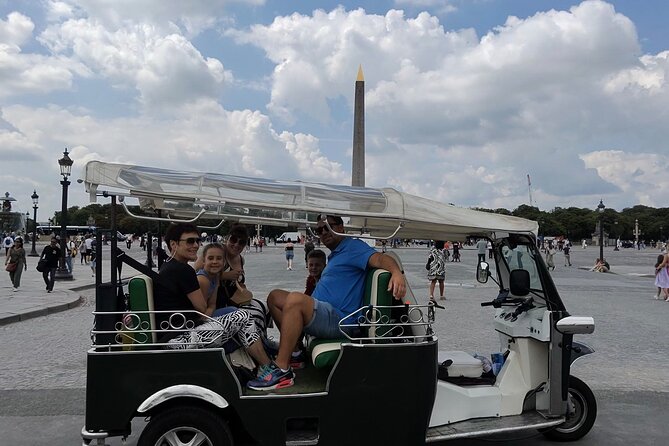
Then you roll into Place de la Concorde. This is one of Paris’s largest squares, and you’ll see it as more than a postcard stop. It has a heavy Revolutionary past tied to public executions, and today it’s defined by the Luxor Obelisk and sweeping sightlines toward the Champs-Élysées and Eiffel Tower area.
From there, you drive by Grand Palais and Petit Palais. These buildings are tied to the 1900 World’s Fair, and they bring a different kind of grandeur than the older churches. The Grand Palais is known for its roof and exhibitions, while the Petit Palais is now home to the Paris Museum of Fine Arts.
Even if you don’t enter, this section helps you read Paris like a map. You start seeing layers: medieval-style religious power, then the turn-of-the-century showpiece era, then the modern landmark string toward the Eiffel Tower.

Pont Alexandre III and the Seine: classic bridge views with golden details
Next up is Pont Alexandre III, one of the most beautiful bridges in Paris, known for its golden statuary and Art nouveau lamps. This stop is about one thing: Seine views that feel cinematic.
From the bridge area, you get a clear sense of sightlines connecting major points: the Seine, the Eiffel Tower area, and Les Invalides in the wider picture. It’s exactly the kind of “move your eyes around” moment that makes the rest of the day easier.
If you’re someone who likes photos, this is one of the best sections to slow your attention down, even if you don’t have extra minutes. Try to catch the tower in the distance while you also frame the bridge details.
Champs-Élysées and Arc de Triomphe: the straight-line Paris experience
You’ll ride along Champs-Élysées, the famous avenue stretching from the Arc de Triomphe toward Place de la Concorde. This is where Paris looks like a movie set—luxury storefronts, classic cafés, and the feel of a wide ceremonial boulevard.
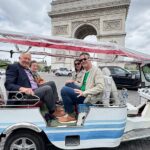
Then comes Arc de Triomphe. The tour stops so you can see it as the monument it is: commissioned by Napoleon to honor his army, and placed at the top of the avenue’s visual line. Even without going up, you’ll appreciate how it anchors the city.
Practical tip: if you’re planning to visit Arc de Triomphe later, this tour helps you understand what you’re walking into. The “distance cues” alone make it easier to plan your next steps.
Trocadéro to Eiffel Tower: best views, then the sparkle
The tour includes Place du Trocadéro-et-du-11-Novembre, described as one of the best viewpoints for Eiffel Tower photos. This is where the Eiffel tends to look tall and centered, and it’s especially popular for photos at sunset or when the tower sparkles at night.
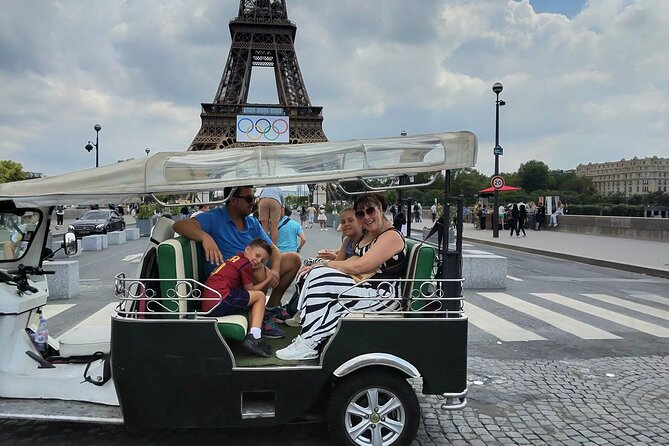
You then stop near the Eiffel Tower. It’s the most iconic symbol of Paris, built for the 1889 World’s Fair, and it sparkles every evening on the hour. Even if you’ve seen it before on screens, the scale hits differently in person.
A key thing to know: your time at each stop is limited. So treat this as a “see it, frame it, enjoy it” segment. If you want a long Eiffel Tower visit (stairs or summit), you’ll still want a separate ticketed experience later.
École Militaire and Les Invalides: Napoleon’s Paris, seen from the road
After the Eiffel area, the tour passes École Militaire, the academy where Napoleon trained. It’s an 18th-century building that still faces the Eiffel Tower area proudly, creating an intentional visual link between past and present.
Then comes Les Invalides, a complex Louis XIV built to care for wounded soldiers. Today it includes military museums, and it’s home to Napoleon’s tomb under the golden dome.
This section adds weight to the trip. You’re not only chasing famous skyline views; you’re picking up the historical thread—Napoleon’s presence in Paris is more than a statue. It’s tied to institutions and architecture.
Timing note: you’ll get a brief stop/pass-by look, so it won’t replace time inside Les Invalides. But it’s a strong “you should come back” teaser.
Luxembourg Gardens, the Pantheon, and Notre-Dame from the route
You’ll pass Luxembourg Gardens, created by Queen Marie de Medici in 1612. You’ll see fountains, statues, and flower areas—and you’ll also notice locals relaxing in one of Paris’s signature parks. This is a good palate cleanser after all the heavy monument scenery.
Next is the Pantheon, built in the 18th century to honor great French figures. It’s where major names are buried, including Voltaire, Rousseau, Victor Hugo, and Marie Curie. Even as a quick pass-by, the Pantheon’s shape helps you feel how Paris organizes its “monument class” buildings.
Then you’ll see Cathedrale Notre-Dame de Paris. The big reality: it’s currently under restoration following damage after 2019. You’ll view it as it is now, outside, which makes this tour a useful way to connect where the cathedral sits in the city—even if you don’t walk the full route to specific restoration viewing areas.
A drawback of quick scenic stops: you can’t absorb every detail. But for building a mental map and deciding what you’ll revisit, it’s still very effective.
Ile Saint-Louis and Palais Bourbon: calmer Paris moments before you ride back
The tour also passes Ile Saint-Louis, a quieter historic island in the center of Paris known for elegant buildings, small shops, and Bertillon ice cream. This is one of those “you feel the character” moments, even if you don’t stop for long.
You’ll also pass Palais Bourbon, home to France’s National Assembly. It’s a different kind of landmark—less about tourism photos and more about what the building represents in the civic life of the country.
Then it’s back to the meeting point at Bd Saint-Germain. In two hours, you’ve covered a huge slice of central Paris without spending your whole day trying to figure out routes.
The guide factor: why Jules, Kenny, and Félix can make or break it
The biggest variable in any sightseeing tour is the person driving it. This one can go from great to memorable depending on how your guide tells the story.
In particular, I’ve seen strong results with guides like Jules, who delivered commentary that hit a good balance between informative and entertaining. I’ve also heard how Kenny can be extremely friendly and fun while still bringing solid knowledge and an easygoing vibe. And Félix stood out for being kind and personable, plus for giving the tour a native feel.
There can be friction, though. One issue to watch for is communication clarity. If your guide’s English is hard to follow, you may spend more time trying to interpret what’s being shown. Also, some versions of the tour may rely on conversation without a microphone, which can make it harder to hear over movement in the vehicle.
My advice: if this is your first trip, prioritize having your guide talk. But if you know your comfort level with French and general landmark vocabulary is limited, consider choosing a time when you can take notes and ask questions as you go.
How to make the most of those short stops (without rushing yourself)
Because many stops are listed at just a few minutes, your success depends on your expectations. Here’s how to get the best out of the ride:
- Plan your photo priorities before you board. Pick 3–4 must-shots (Eiffel, Trocadéro, Pont Alexandre III, maybe Arc de Triomphe).
- Use the ride for orientation. Look down the direction of the route and note what’s where. That helps later when you’re walking independently.
- Ask questions when you’re at a stop, not while driving. Brief stops are when the guide’s story lands best.
- Keep an eye on timing for the Eiffel sparkle. The Eiffel sparkles every evening on the hour, so timing your visit can boost the moment.
One nice touch that can improve the overall feel: one guide, Félix, provided water and croissants. That’s not something you should assume for every tour, but it shows the kinds of small extras that can make the experience feel more personal.
Who this tour suits best
This tour is a great fit if:
- You’re on a short visit and want a high-impact overview fast.
- You’re trying to beat jet lag with something comfortable and not too physically demanding.
- You want a guided route that shows you where the big sights are, so you can decide what to revisit later.
- You prefer a private group experience rather than being swept along in a crowd.
It may be less ideal if you:
- Want museum time or long interior visits.
- Are hoping for a slow, neighborhood-by-neighborhood walk.
- Need super detailed explanations at each stop. The format is quick, by design.
Should you book this Paris tuk tuk and golf cart tour?
I’d book it if you want a smart first-day plan: see the classics, learn the city’s layout, and end the day with clear ideas about what to return to. The combination of major monuments, photo-friendly viewpoints, and a guided loop makes it a practical way to spend your first couple of hours in Paris.
Skip it if your dream trip is long museum time and deep inside-the-building experiences. This is about views, context, and getting oriented, not about lingering.
If you do book, go in with a simple goal: take the best photos, listen for the key stories, and use the rest of your trip to explore at your own pace.
FAQ
How long is the Paris Sightseeing tour?
It’s listed as about 2 hours (approx.).
What does it cost per person?
The price is $150.18 per person.
Is the tour private?
Yes. It’s a private tour/activity, and only your group participates.
Is the tour offered in English?
Yes, it’s offered in English.
What is included in the tour?
Bottled water is included.
Where do we meet for the tour?
The meeting point is 159 Bd Saint-Germain, 75006 Paris, France.
Is admission included for the stops?
Admission tickets are listed as free for the stops mentioned.
Are mobile tickets available?
Yes. A mobile ticket is included.
Are service animals allowed?
Yes, service animals are allowed.
Can I get a full refund if I cancel?
You can cancel for a full refund if you cancel at least 24 hours in advance of the experience start time.