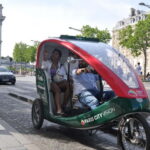
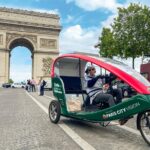
Paris in a tuk-tuk is a smart way to start. This private eco tuk-tuk tour gives you a fast, guided loop of major sights, plus Wi‑Fi on board and bottled water so you stay connected without hunting for signals. The tradeoff is time: it’s about two hours, so you’ll get photo stops and scenic passes more than long museum hangs.
I really like how convenient it is to begin—hotel pickup is available from several central districts—so you spend less time figuring out where to meet. Guides named Sebastian, Tariq, and Kalil show up in people’s accounts, and the best moments are often the quick, story-filled explanations as you glide between landmarks. One thing to consider: because the route is tight, you may need to speak up about what matters most to you.
Before you go, set your expectations around views and perspectives. You’ll see big-name Paris from close-up angles, including the Eiffel Tower area, and you’ll finish back near where you started so it’s easy to keep exploring after.
In This Review
- Key things to know before you ride
- A 2-hour eco tuk-tuk loop: what you’ll feel in the first 10 minutes
- Hotel pickup from central districts (and where you meet otherwise)
- Champs-Élysées: the runway for a first-time Paris orientation
- Arc de Triomphe: quick views, then decide if you want more
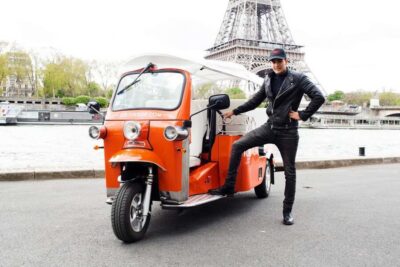
- Trocadéro and the Eiffel Tower: the best angles without long waits
- Invalides, Pont Alexandre III, Petit Palais, and Grand Palais: Paris in detail mode
- Place de la Concorde and the Luxor Obelisk: the square with real history
- Assemblée Nationale, Place Vendôme, and Palais Garnier: power, luxury, and the opera façade
- Louvre glass pyramid and Notre-Dame views: seeing the icons without buying extra time
- When two hours feels tight: how to make the timing work for you
- Longer versions add Montmartre and Sacré-Cœur (if you want the hilltop finish)
- Price and value: what you’re really paying for at $170.98 per person
- Who should book this tour (and who might prefer something else)
- Final call: should you book this private eco tuk-tuk loop?
- FAQ
- How long is the Paris highlights private eco tuk-tuk tour?
- How much does the tour cost per person?
- Is this a private tour?
- Do I get hotel pickup?
- Where is the meeting point?
- Does the tour include Wi‑Fi?
- Is bottled water included?
- Which languages is the tour offered in?
- Are tickets included for places like the Arc de Triomphe, Eiffel Tower, Louvre, and Notre-Dame?
- What is not included in the tour price?
- Can I cancel for a full refund?
Key things to know before you ride
- Hotel pickup in select central districts saves time on day one
- Onboard Wi‑Fi and bottled water keep the experience smooth
- Photo-stop pacing means quick looks, not long admissions
- A guide who tells you what you’re seeing makes the drive feel purposeful
- Two hours can’t cover everything, so choose your priorities
- Language is offered in English, so confirm if you need something else
A 2-hour eco tuk-tuk loop: what you’ll feel in the first 10 minutes
This is the kind of Paris tour that helps your brain map the city fast. In a standard walking day, it’s easy to feel like you’re just moving from one landmark to the next. Here, the ride does the heavy lifting: you zip between sights with enough stops to get that first-Paris wow without losing your whole morning to traffic and lines.
The experience is private, meaning it’s only your group. That matters in Paris, where crowds can turn even a great viewpoint into a frustrating shuffle. A private tuk-tuk also helps you ask a direct question—like what to notice about the architecture—without waiting your turn.
You’ll spend a lot of time “seeing” rather than “entering.” Some places are just passes and photo moments. A few iconic stops come with time limits and tickets not included, so you can decide whether you want to add your own visit later.
You can also read our reviews of more tours and experiences in Paris.
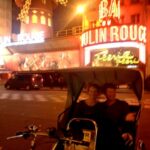
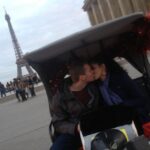
Hotel pickup from central districts (and where you meet otherwise)
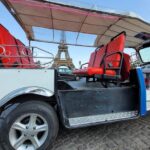
The start is set up for convenience. If your hotel is in the 1st, 4th, 7th, 8th, 9th, 15th, or 16th districts, pickup is free. The driver meets you in the hotel lobby with a signboard showing the lead traveler’s name.
If you’re not staying in those districts, you’ll meet at Place Vauban (75007). From a practical standpoint, this is good: you’re not forced into some far-off rail stop, and you’re also not trying to catch your ride somewhere random.
This matters because day one in Paris is rarely calm. A smooth pickup helps you arrive in the right mood—ready to look up, take photos, and actually pay attention to the guide instead of stressing.
Champs-Élysées: the runway for a first-time Paris orientation
You begin with a scenic drive down the Champs-Élysées, one of the city’s most famous avenues. Expect luxury storefronts, theaters, busy sidewalks, and lots of places where Paris looks like Paris in movies. The guide’s role here is more than trivia. It sets context for what you’re seeing so the street isn’t just a long photo strip.
A nice touch: you’re not locked into a ticketed stop for this part. You’re learning as you go—useful when you don’t yet know which neighborhoods you’ll want to revisit.
If you’re the type who likes to compare what you see in person to what you’ve seen online, this is a strong first move. The Champs-Élysées gives you a baseline for everything that comes after.
Arc de Triomphe: quick views, then decide if you want more
Next comes a photo stop at the Arc de Triomphe. It’s a tribute to French soldiers and a symbol of national pride, and it’s easy to understand why people flock here: the scale is huge, and the surrounding avenues create a “starburst” city feel.
The tour gives you a short window—about five minutes—and admission isn’t included. That’s not a problem if your goal is orientation. It can feel like a tease if your main plan was to go up for the views.
My advice: treat this as a decision point. If you love the monument from street level, you’ll likely want to schedule a longer stop later.
Trocadéro and the Eiffel Tower: the best angles without long waits
For pure Eiffel Tower payoff, the tour hits the Trocadéro area, where you get classic views back toward the tower. It’s one of those moments where you understand why this sight became shorthand for Paris.
Then you move to the Eiffel Tower area for another short stop (again, ticketed entry isn’t included). Here the timing is tight, but you still get that close-up feeling—great for photos from different angles, and great for figuring out where you’ll want to return.
If you’re deciding between Eiffel views at sunset vs. daylight, this tour helps you “see the layout” first. After you’ve mapped where the best angles are, it’s easier to plan your own second visit.






Invalides, Pont Alexandre III, Petit Palais, and Grand Palais: Paris in detail mode
After the big flash of the tower, the tour shifts to a more elegant, architectural side of Paris.
- Hôtel des Invalides gets a pass-by moment. It’s known for Napoleon’s tomb and a military museum, and even without entering, it’s a striking complex.
- Pont Alexandre III is next: an ornate bridge with Art Nouveau styling and symbolism tied to Franco-Russian friendship. Even if you don’t know the details, you’ll feel it in the craftsmanship.
- Petit Palais appears as a beauty of façades and the museum-like presence of the building.
- Grand Palais is included as a viewing segment too, with the guide explaining its role in Paris arts and culture.
These stops are valuable because they teach you how to “read” Paris architecture. A lot of visitors walk right past buildings that are basically storybooks. On a tuk-tuk, you can still slow down with your eyes, and the guide helps connect the visual to the meaning.
The practical catch: because you’re moving, you won’t have time to do deep exploration at each site. Think of this section as a curated sampler. Pick the one building you want to return to later, then plan a focused visit.
Place de la Concorde and the Luxor Obelisk: the square with real history
Place de la Concorde is one of the city’s biggest squares, and the tour frames it with the right details. You’ll see the Luxor Obelisk and learn how it was gifted by Egypt in the 19th century. You’ll also notice the fountains that represent French rivers and seas.
The guide also points out how the square has hosted major historical events, including the French Revolution. That adds weight to what could otherwise be just a scenic stop.
This part is a reminder that Paris landmarks aren’t only about beauty. They’re about layers—politics, symbols, and power—stacked across time.
Assemblée Nationale, Place Vendôme, and Palais Garnier: power, luxury, and the opera façade
This stretch gives you a quick sweep of three different Paris moods.
First, a glimpse of the Assemblée Nationale, the place where French laws are made. It’s a contrast to the tourist-heavy areas you’ve just seen, and it helps you remember this is a living city.
Then you roll by Place Vendôme, known for luxury jewelry stores and historic architecture. Even if you don’t shop, the square teaches you how Paris markets its “taste” as part of its identity.
Finally, you see Opéra Garnier (Palais Garnier) pass-by. The point here isn’t to tour the interior—it’s to recognize the showpiece façade. The guide’s talk helps you connect the building to Paris’s performing arts world.
If you like architecture and city character, this section is one of the best uses of a short tour window.
Louvre glass pyramid and Notre-Dame views: seeing the icons without buying extra time
You’ll get a look at the Louvre Museum, including the famous glass pyramid. The tour pause is short (about five minutes) and admission isn’t included, so you won’t be walking halls this time. What you will do is get a clear, in-person sense of the outside setting—helpful when you later plan which entrance to use and how to approach the museum.
Then the tour ends with a view of Notre-Dame de Paris for a final photo stop (also ticketed entry not included, with about five minutes on-site).
This is a good closing move because it turns the tour into a story arc. You start with grand avenues and monuments, build through bridges and palaces, then end on religious and cultural symbolism. After that, you can decide what to revisit at your own pace.
When two hours feels tight: how to make the timing work for you
The most useful lesson from the way people talk about this tour is simple: the route is loaded. In a two-hour format, you can’t expect everything to be slow and leisurely.
Your best strategy is to have a short list before you arrive:
- one or two must-photo sights (Eiffel Tower area is a common pick)
- one building you want to understand better (Champs-Élysées or Grand Palais-style architecture)
- one emotional stop (Notre-Dame views often land here)
If your guide asks what you want to prioritize, answer fast and clearly. If you’re the quiet type, you’ll still get a narrative, but you’ll get more out of it if you share your “top three” in the first few minutes.
Also, if you care about language nuance, don’t assume. The tour is offered in English, but if you need a specific language or style of explanation, confirm it before you go.
Longer versions add Montmartre and Sacré-Cœur (if you want the hilltop finish)
A key note: Montmartre is marked as included in the 3- and 4-hour tours, along with Basilique du Sacré-Cœur and Place du Tertre. That’s the hilltop, artist-square vibe many people want after the main-center highlights.
If you’re booking the 2-hour version, don’t treat this as a given. But if you’re deciding between durations, Montmartre is the natural next step after the central monuments—different feel, more character, and that famous overlook energy.
If your goal is both city landmarks and a more creative Paris scene, the longer option can be the better match.
Price and value: what you’re really paying for at $170.98 per person
At $170.98 per person, the price can look steep if you compare it only to sightseeing time. But you’re not just buying a seat. You’re buying:
- a private guided ride
- hotel pickup in several central districts
- private transportation rather than walking between dispersed stops
- onboard Wi‑Fi plus bottled water
This value makes the most sense early in a trip, when you want to learn the city and decide what to do next. The tour can reduce your “wasted transit time,” especially if you’re juggling jet lag, limited time, or a packed schedule.
It also helps if you’re trying to avoid crowds for photos. People often like the way you can get in and out without spending ages in the densest pedestrian flows.
Where it might not feel like value: if you already know exactly what you want and you’re mostly interested in inside visits and ticketed sights. This tour keeps things mostly outside, with short photo windows and a few admissions not included.
Who should book this tour (and who might prefer something else)
This is a great fit if:
- you’re in Paris for the first time and want a structured orientation
- you want a low-effort way to see major landmarks quickly
- you care about photos and viewpoints but still want context from a guide
- you’d rather start at your hotel than fight the city’s logistics
It’s less ideal if:
- your priority is long museum time or ticketed monument climbs during this session
- you have very specific interests that require deep time at one site
- you need more flexible, stop-anywhere pacing than a pre-planned route
Final call: should you book this private eco tuk-tuk loop?
If you’re heading to Paris soon and you want an efficient, guided “big picture” start, I’d book this. It’s the kind of tour that helps you get your bearings fast, especially with hotel pickup and Wi‑Fi on board doing the small comforts that matter when you’re on the move.
Just go in with the right mindset: this is built for scenery, viewpoints, and quick orientation. If you treat each stop as a prompt for a later return, you’ll feel like the time was well spent.
FAQ
How long is the Paris highlights private eco tuk-tuk tour?
It lasts about 2 hours.
How much does the tour cost per person?
The price is $170.98 per person.
Is this a private tour?
Yes. It’s private, so only your group participates.
Do I get hotel pickup?
Hotel pickup is offered free for hotels located in the 7th, 8th, 9th, 15th, 16th, 1st, and 4th districts. If you are outside those districts, you meet at Place Vauban.
Where is the meeting point?
The tour starts at Place Vauban, 75007 Paris, France.
Does the tour include Wi‑Fi?
Yes. Wi‑Fi on board is included.
Is bottled water included?
Yes, bottled water is included.
Which languages is the tour offered in?
The tour is offered in English.
Are tickets included for places like the Arc de Triomphe, Eiffel Tower, Louvre, and Notre-Dame?
No. For those stops, admission tickets are not included. Other viewpoint stops are listed as free.
What is not included in the tour price?
Personal expenses and tips are not included.
Can I cancel for a full refund?
You can cancel up to 24 hours in advance for a full refund. If you cancel less than 24 hours before the start time, the amount paid is not refunded.