REVIEW · PORTO
Tours in the Port DE Tuk Tuk
Book on Viator →Operated by LISPORT TRANSFER TOUR · Bookable on Viator
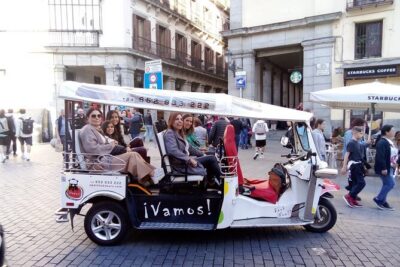
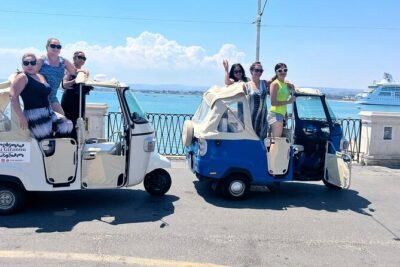
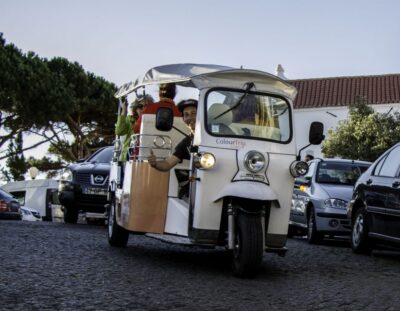
Porto compresses history into one tight ride. In about an hour, I love how the tour mixes São Bento’s tile wall with big Douro bridge views, and keeps the pace easy with a guide like Bruno who tailors the stops. The only real drawback: with so many sights packed in, you’ll mostly get guided time at the highlights, not long museum-style wandering.
You start near Praça da Batalha, roll through the historic center, and end back at the meeting spot. The tour runs with a safety belt and gives you a mobile ticket, and it’s private—just your group—so questions are welcome and the route can flex a bit. Do plan around weather, since it requires good conditions.
In This Review
- Key highlights you’ll feel right away
- Why Porto’s hills are perfect for a tuk tuk
- Starting at Praça da Batalha: your easiest orientation in town
- Royal Theatre of São João: a classic façade with a dramatic past
- São Bento Railway Station: the tile wall you have to see in person
- Porto Cathedral and the spiritual heart of the city
- Dom Luís I Bridge: the Douro view that frames everything
- Fernandina Wall remnants: medieval defense lines, still photo-friendly
- Igreja de Santo Ildefonso: the staircase and the 11,000-tile façade
- Rua de Santa Catarina and the center shopping pulse
- Avenida dos Aliados and Porto City Hall: official grandeur in granite
- Praça dos Leões (Lion Square): students, lions, and Lello next door
- Carmo vs. Carmelites: two convent stories and the one-meter house
- Hospital building by John Carr: rare Neoclassical England in Porto
- Garden of Cordoaria: from rope-making to quiet shade
- Cadeia da Relação: a free photography center in an old prison
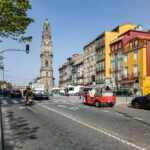
- Clérigos Tower: the 360° moment, with a paid climb
- Price and value: $42.05 for a private, high-impact loop
- Who this tuk tuk tour suits best (and who might not)
- Should you book this Port DE Tuk Tuk tour?
- FAQ
- How long is the Port DE Tuk Tuk tour?
- What is the price for this tour?
- Is the tour private?
- What language is the tour offered in?
- Do I get a mobile ticket?
- Where does the tour start and where does it end?
- Does the tour run in any weather?
- Are service animals allowed?
- Can I climb Clérigos Tower during the tour?
- What is the cancellation window for a full refund?
Key highlights you’ll feel right away
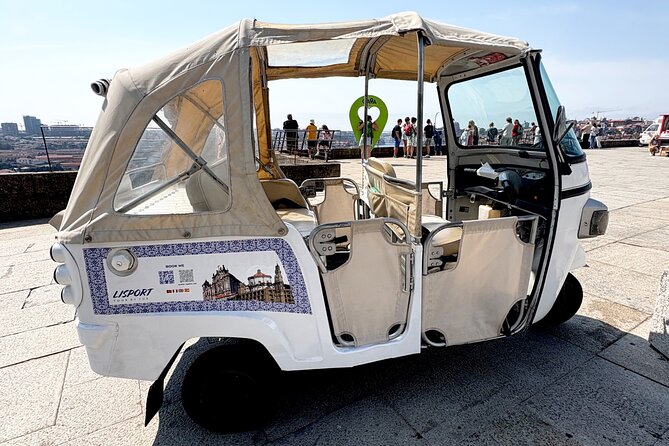
- A small, private ride that can adapt to what you care about most
- São Bento Station tiles: over 20,000 historic panels filling the interior
- Dom Luís I Bridge: an Eiffel-era metal bridge linking Porto to Gaia with classic panoramic angles
- Medieval Porto photos at the Fernandina Wall remnants and the Postigo do Carvão door
- Blue-and-white tile drama at the Igreja de Santo Ildefonso façade and staircase
- A 360° finish at Clérigos Tower (tower climb is paid, church access is included)
Why Porto’s hills are perfect for a tuk tuk
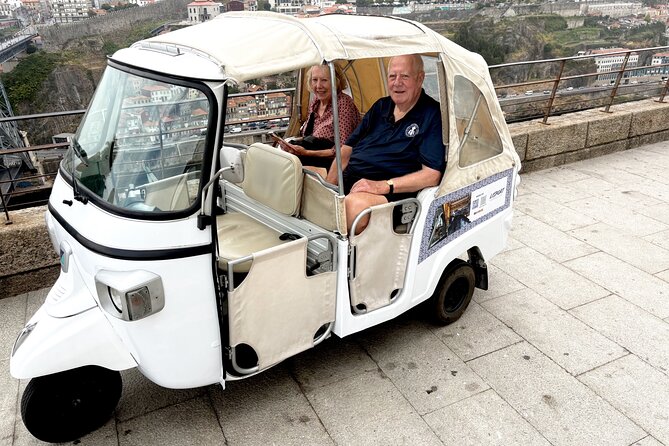
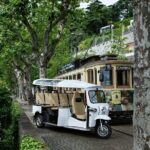
Porto is not built for slow, flat strolling. That’s exactly why a tuk tuk makes sense here: you can cover more ground without burning your whole day climbing the steep bits.
You still get to enjoy the best parts of the city at human speed. You’re seeing major architecture and viewpoints from practical angles—then hopping off for the photo stops that matter, like the tiled façades and the river crossings.
You can also read our reviews of more tours and experiences in Porto.


Starting at Praça da Batalha: your easiest orientation in town
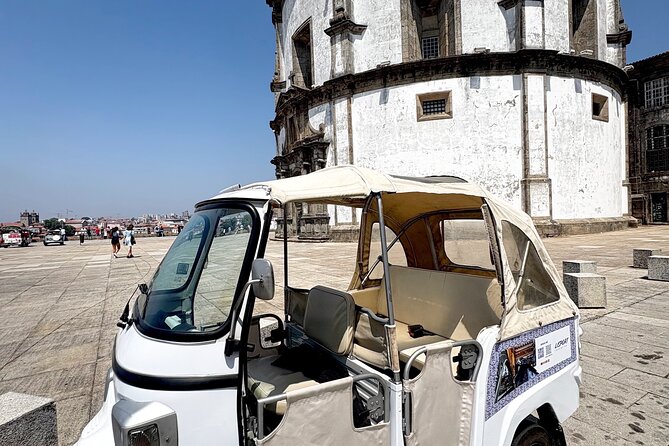
The tour starts at the Monumento ao Rei D. Pedro on Praça da Batalha 66 and ends back there. That matters because it’s right in the historic center—so after the ride, you’re already positioned for the next steps of your day.
You’ll also hit a cluster of landmarks near São Bento Station and the National Theatre of São João area, which is a smart way to learn Porto’s layout quickly. If you like to feel oriented before you start choosing dinner spots, this kind of route helps.
Royal Theatre of São João: a classic façade with a dramatic past
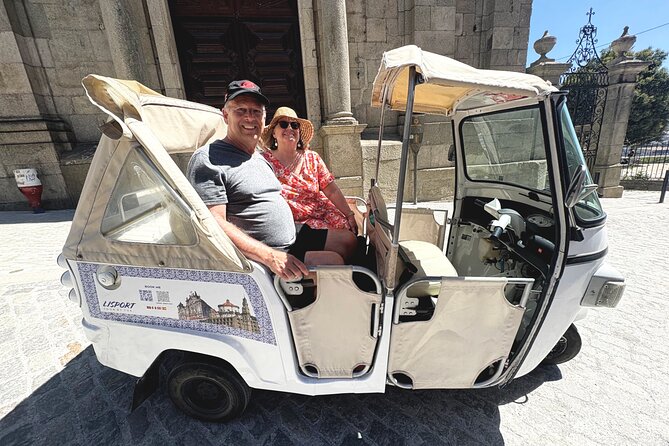
One of the first big stops is the Plaza da Batalha area with the Royal Theatre of São João (Teatro Nacional de São João). It began in 1798 as the Royal Theatre of São João, took a detour through a 1908 fire, then reopened in 1920.
What I like is how the style signals its importance right away. The building is Neoclassical with Beaux-Arts influence—think imposing columns, sculptures, inscriptions—and inside you get golden frescoes and painted ceilings, not just a pretty front.
A practical note: guided visits and show visits happen on schedule, so timing can affect what you get. If you’re visiting during a quiet window, it’s still a great visual stop for the architecture.
São Bento Railway Station: the tile wall you have to see in person
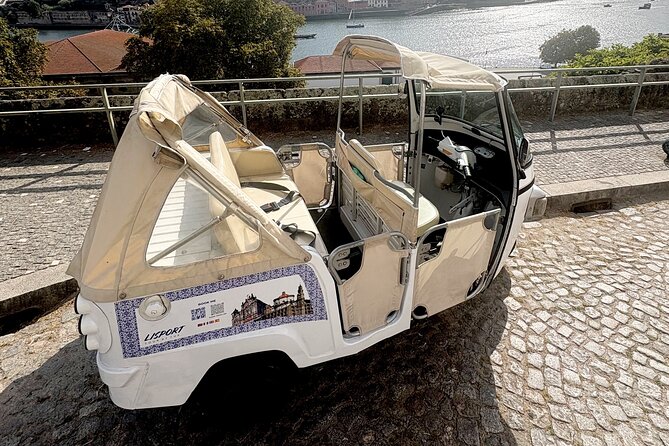
Then you go to São Bento Railway Station, inaugurated on 5 October 1916. The station replaced the older Convent of Saint Benedict of Ave-Maria, and the building design connects directly into the rail network.
The star is the interior: more than 20,000 historic tiles painted between 1905 and 1908 by Jorge Colaço. They show scenes from Portuguese history—rural life, transport, and key moments—plus inscriptions like Douro and Minho in the upper atrium.
Good news for your time: the stop is listed with ticket free admission. Even if you only have a short window, the station is one of those places where a quick look is still rewarding because the details are everywhere.
Porto Cathedral and the spiritual heart of the city
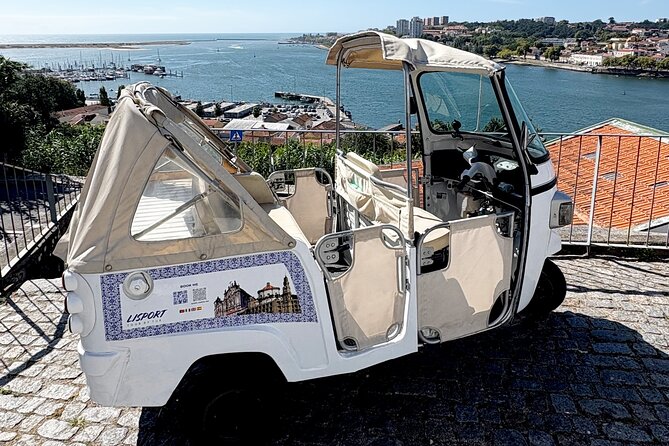
From there, the tour heads into the older religious core with Porto Cathedral (Sé do Porto). It’s a layered building: Romanesque roots starting in the 12th century, then major changes in the 14th and 17th centuries with Gothic and Baroque additions.
This is where the city’s power story comes through clearly. The cathedral played a role during the Christian Reconquest and the consolidation of the Kingdom of Portugal.
Two details worth noticing: the Romanesque rosacea on the façade, and the contrast between styles as you look around. It’s also tied to big political moments—like Dom Pedro IV (Dom Pedro I of Brazil) celebrating mass before the siege of Porto during the Liberal Wars. That’s the kind of context that turns a stone building into a timeline you can feel.



Dom Luís I Bridge: the Douro view that frames everything
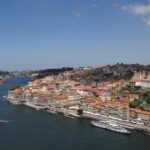
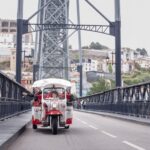
Next you cross into the real postcard zone: the Dom Luís I Bridge over the Douro. It connects Porto and Vila Nova de Gaia and sits between the Ribeira do Porto and the Cais de Gaia, with views toward wine warehouses.
It opened in 1886 and was designed by engineer Théophile Seyrig, a partner of Gustave Eiffel. At the time, it was among the largest metal-bound bridges in the world, and it still has that bold iron look.
Here’s the practical value: this bridge is both a crossing and a viewpoint. The tour points you to the best ways to see it, especially from angles where you can take in the river and the industrial-to-historic blend of the waterfront.
Fernandina Wall remnants: medieval defense lines, still photo-friendly
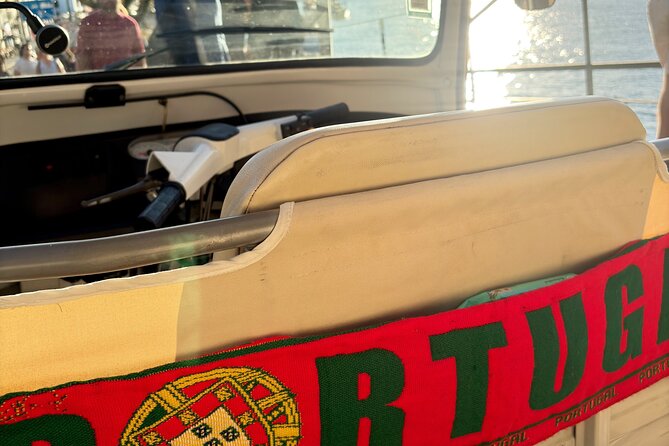
You also get time around the Fernandina Wall, built in the 14th century during D. Fernando I’s reign (hence the name). It replaced earlier Romanesque walls that couldn’t keep up with Porto’s growth and helped control access to the city.
Even though much of it was demolished in the 19th century as the city expanded, pieces remain. The tour highlights restored sections and photo-worthy fragments, including:
- the segment near Porto’s riverside
- the section between Largo do Muro dos Bacalhoeiros and Ribeira
- Postigo do Carvão, described as the only medieval door still existing
If you like photos that feel “real old city” rather than just modern streets, this stop delivers.
Igreja de Santo Ildefonso: the staircase and the 11,000-tile façade
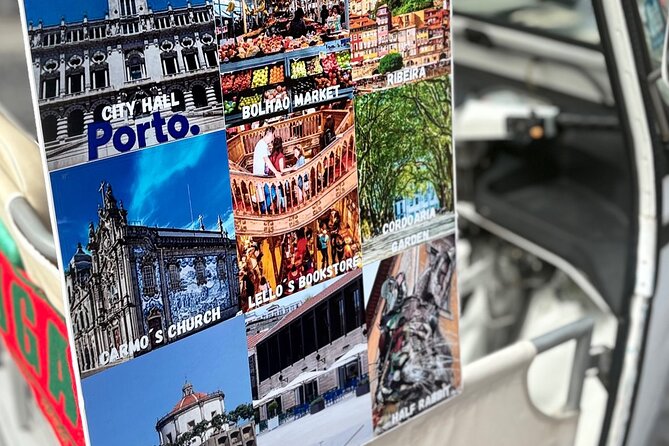
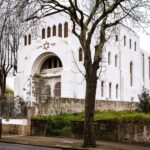
One of the most memorable visual moments is the Igreja de Santo Ildefonso, right by Praça da Batalha. Built between 1709 and 1739 and influenced by Baroque with proto-rococo, it has a granite structure with two towers and a curved fronton.
Then come the tiles: the façade is covered with about 11,000 blue and white tiles created in 1932 by Jorge Colaço. The scenes show moments from Santo Ildefonso’s life and parts of the Gospel.
I like this stop because it gives you both drama and structure. The staircase, the tile-and-granite contrast, and the way the façade lighting can pop at night all make it one of Porto’s easiest places to photograph well.
Rua de Santa Catarina and the center shopping pulse
From there, you head along Rua de Santa Catarina, Porto’s main shopping street. It’s mostly pedestrian and frequented by locals and tourists.
The value here isn’t shopping—it’s energy and variety. You’ll see international chains alongside traditional storefronts, and you’re in range of big food-and-culture anchors like Café Majestic and the Chapel of Souls (with its blue tile façade).
Also close by is Bolhão Market, one of the city’s iconic traditional markets. It’s always active, with live music and street life, which makes it a good place to pause and people-watch between monuments.
Avenida dos Aliados and Porto City Hall: official grandeur in granite
The tour then climbs toward Avenida dos Aliados, with the imposing building facing Praça da Liberdade. Construction started in 1920 and finished in 1957, designed by Correia da Silva.
The building’s central tower with a clock rises to 70 meters, and the granite façade is decorated with sculptures. It also functions as the headquarters of Porto’s municipal executive, so it’s part administrative hub, part landmark.
You can sometimes visit the interior chamber on guided visits, depending on what’s scheduled. If your trip lines up with a special public event, you may get more access—but for most visitors, the exterior alone is a strong stop.
Praça dos Leões (Lion Square): students, lions, and Lello next door
This is the square that instantly feels “Porto.” The Fountain of the Lions sits in neobarroco style with four bronze-winged lions running water through their mouths.
The surroundings matter too: it’s near the Rectorate of the University of Porto, plus the Church of Carmo, the Church of the Carmelites, and the nearby famous Lello Bookstore.
If you’re traveling at a time when students are out, the square has that lively mix of conversations and quick photos. At night, movement ramps up too, helped by nearby bars and cafés.
Carmo vs. Carmelites: two convent stories and the one-meter house
The tour covers both churches in the same area, which makes comparisons easy.
- The Church of the Carmelites (1616–1628) is Classical Baroque, part of a female convent. Its interior features golden retables, a typical Portuguese Baroque look.
- The Church of Carmo (1756–1768) is Baroque and Rococo, part of a male convent, and its façade is richly decorated with rococo elements. It also has a tile panel added in 1912 showing the Imposition of the Escapulario to St. Simon Stock.
Then there’s the standout detail: a tiny narrow building described as the narrowest house in Porto, about 1 meter wide. It’s between the convent spaces, linked to an old rule that prohibited direct contact between nuns and monks.
This is one of those stops where even if you don’t go deep into religious architecture, you still leave with a memorable story.
Hospital building by John Carr: rare Neoclassical England in Porto
Another surprising highlight is the hospital founded in 1799 by the Misericordia do Porto and designed by English architect John Carr. It’s described as Neoclassical English, noted as rare in Portugal.
The building structure is in a U shape with inner courtyards, and it’s recognized as one of the country’s important hospital buildings both historically and architecturally. It’s still operating as a public and university hospital connected to medical education.
So what do you actually take in on a tour like this? Big, austere granite forms, long institutional architecture, and the feeling that Porto’s identity includes health, education, and civic systems—not just views and tiles.
Garden of Cordoaria: from rope-making to quiet shade
Near the Torre dos Clérigos and other university area landmarks, you’ll see Garden of Cordoaria. The garden comes from the former rope-making zone where corders stretched and twisted ropes.
In the 19th century, it became a garden and was reformulated by landscape architect Émile David, the same linked to the Crystal Palace. Today it’s a calm green space with walking routes and lots of shade.
What I like about including this park stop is the contrast. After intense façades and crowded streets, you get a quieter break, plus a photo-worthy sculpture element: a display of bronze human figures by Juan Muñoz, placed across the garden in mysterious positions. There’s also a sculpture of Portuguese writer Ramalho Ortigão.
Cadeia da Relação: a free photography center in an old prison
In the Baixa area, near Torre dos Clérigos and close to Garden of Cordoaria, the tour stops at the Cadeia da Relação area—originally a prison and courthouse, built in 1767.
Later, it served as a prison starting in 1974 and was rehabilitated in the 1990s. Now it hosts a photography center devoted to preserving and sharing Portugal’s photographic heritage, founded in 1997.
The practical win: the stop notes free entry. It’s also designed as a historic building visit, with rooms that include prison grids and cells, plus temporary and permanent photography exhibitions. Even if you don’t plan a full browsing session, it’s a meaningful cultural pause.
Clérigos Tower: the 360° moment, with a paid climb
You end with Clérigos Church and Clérigos Tower on Rua dos Clérigos, near Lello Bookstore and Jardim da Cordoaria.
The church dates to 1732–1750, and the tower was completed in 1763. It’s a masterpiece by Italian architect Nicolau Nasoni, a key figure of Baroque in northern Portugal.
The tower is 76 meters high, and the climb involves 225 steps. The payoff is a 360° panoramic view over Porto and the Douro, and it’s also lit at night in many cases.
Here’s the deal to plan around: entry is paid to climb the tower and visit the museum, and the description notes that it includes access to the church. So if you want the full tower view, build that cost into your day and expect lines of people heading upward.
Price and value: $42.05 for a private, high-impact loop
At $42.05 per group (and the booking shows up to 1), the big question is whether it’s worth it versus spending those euros on individual entries and longer walks.
For me, it works because the value isn’t just the vehicle. It’s the time-efficient route that layers together major landmarks across Porto and Gaia in roughly 1 hour to 1 hour 10 minutes.
You’re also getting a guided approach in English, plus the ability to ask questions on the fly. And the private format is key: you’re not fighting for attention while the guide tries to manage a big bus crowd.
The strongest “value signal” in the experience is how guides like Bruno adjust to your interests and pace. If you’re the type who wants a quick hit of orientation and then free time afterward, this matches that style well.
Who this tuk tuk tour suits best (and who might not)
This tour fits people who want:
- a fast orientation to Porto’s top sights
- a guided route that still leaves room to choose what to linger on
- strong stops for architecture and photo moments
It may not be ideal if you want slow, stop-by-stop museum time at every single site. The tour compresses a lot of iconic places into a short window, so some sights are meant for seeing and learning, not for deep independent exploring at length.
It’s also a good match for mixed interest groups—people who care about history and people who care about arts and design both get plenty to look at.
Should you book this Port DE Tuk Tuk tour?
If your goal is to get your bearings and hit Porto’s headline sights in a short, guided, low-stress way, I’d book it. The mix of São Bento tiles, Dom Luís I Bridge, and the Clérigos Tower view is exactly the kind of payoff that makes an hour feel like it lasts longer.
I’d only hesitate if you’re planning to rely on slow, long entry visits at multiple museums during the same day. This works best as a first-day intro, or as a reset between other plans, especially when the weather is cooperating.
FAQ
How long is the Port DE Tuk Tuk tour?
The tour lasts about 1 hour to 1 hour 10 minutes.
What is the price for this tour?
The price is listed as $42.05 per group.
Is the tour private?
Yes. It’s described as a private tour/activity, with only your group participating.
What language is the tour offered in?
The tour is offered in English.
Do I get a mobile ticket?
Yes, the tour includes a mobile ticket.
Where does the tour start and where does it end?
It starts at Monumento ao Rei D. Pedro VPraça da Batalha 66, 4000-101 Porto, Portugal and ends back at the meeting point.
Does the tour run in any weather?
No. The experience requires good weather. If it’s canceled due to poor weather, you’ll be offered a different date or a full refund.
Are service animals allowed?
Yes, service animals are allowed.
Can I climb Clérigos Tower during the tour?
Clérigos Tower entry is paid to climb the tower and visit the museum, and it includes access to the church.
What is the cancellation window for a full refund?
You can cancel up to 24 hours in advance for a full refund. Canceling within 24 hours won’t be refunded.