REVIEW · PORTO
Full-Day Private Tuk Tuk All Around Porto
Book on Viator →Operated by Portuk · Bookable on Viator
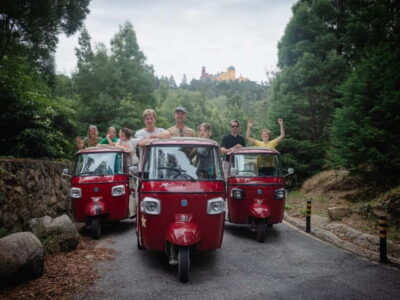
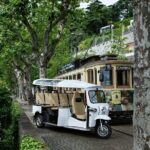
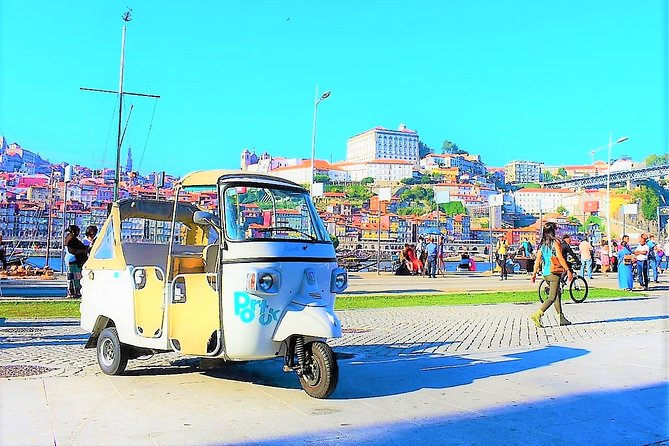
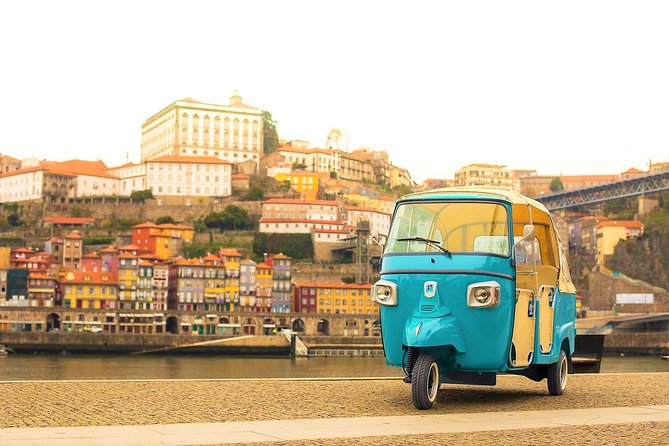
Porto feels different from a tuk-tuk. This full-day private ride lets you glide between major sights without the grind of crowded buses, and you can keep the pace friendly for your group. You’ll be guided right through Porto’s changing neighborhoods, with live commentary that helps you connect the dots fast, starting near the big cultural anchors and working outward.
I especially like the included lunch and wine tasting. You’re not just “walking and looking” all day—you stop for regional flavors like cheeses, sausages, and canned fish, paired with wines from small local producers. After that, the city keeps making sense because you’ve had a real Porto break.
One thing to think about: a tuk-tuk is small. Even with a private setup, you may feel it on cobblestones and in rain, and some monument entrances are not included. If the weather is rough, you’ll want to plan for a wetter, slower day.
In This Review
- Key Things You’ll Notice on This Porto Tuk-Tuk Day
- Starting Point Near São Bento: Where the Day Gets Moving
- Teatro Nacional São João: Porto’s 1910 Theater Big-Ticket Facade
- Cathedral and Cloisters: Romanesque Roots and 20th-Century Rebuild
- São Bento Railway Station: The 20,000-Tile Lobby Moment
- Igreja do Carmo: Rococo Porto and Tile-Front Drama
- Antiga Cadeia da Relação: A Granite Prison Turned Photo Center
- Fonte dos Leões and the Lello Factor: Quick Wins for Photos and Atmosphere
- Cordoaria Garden (Jardim de João Chagas): A Breathing Space Between Landmarks
- São Francisco Church and Its Gilded Interior: Gothic Meets Baroque Drama
- Palacio de Cristal Gardens: Porto’s “Walkable View Deck”
- Torre dos Clérigos and the Bridges: Icon Views Without Overthinking the Route
- Palacio da Bolsa, Ferreira Borges, and Alfândega: Porto’s City-Commercial Side
- Igreja dos Carmelitas and the Final River-Facing Note
- Lunch and Wine Tasting: A Real Break, Not a Token Stop
- Price: Does $166.99 Hold Up for an 8-Hour Private Tuk-Tuk?
- Practical Tips for a Comfy Tuk-Tuk Day in Porto
- Should You Book This Private Tuk-Tuk Around Porto?
Key Things You’ll Notice on This Porto Tuk-Tuk Day
- Private feel without bus hassle: you avoid long waits and squeeze-through crowds.
- Small-group pace: your guide can adjust the flow based on your interests.
- Wine tasting plus a tasting-style lunch: you’re fed, not just chauffeured.
- A mix of architectural styles: Romanesque, Rococo, Gothic, Baroque, and Art Nouveau show up in one loop.
- Big views with minimal effort: bridges and viewpoints come in naturally, not as a separate side quest.
Starting Point Near São Bento: Where the Day Gets Moving
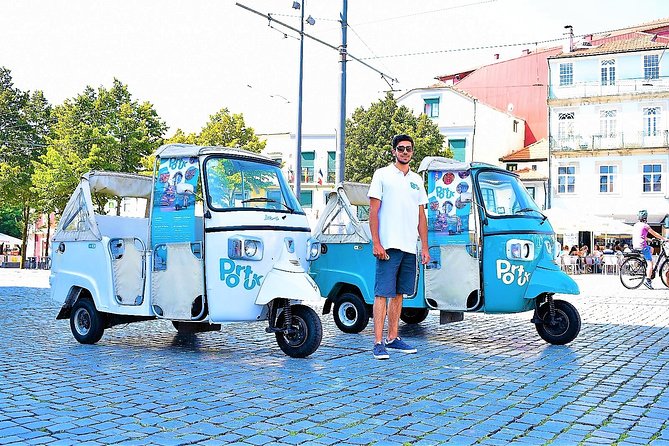
Your day begins at R. de Augusto Rosa 180, with a start time of 9:30 am. That early timing matters in Porto. Streets can get busy fast, and the best photo angles at major landmarks tend to be easier before the midday rush.
From the jump, the tuk-tuk format is what makes this day work. Porto’s center is a maze of tight turns and short streets, which is exactly where a car or a bus feels clumsy. With a tuk-tuk, you can get close to the action, then hop out for quick walks where it counts—church fronts, station lobbies, terraces, and garden paths.
You’ll also get live commentary on board, so even the short ride segments feel like part of the experience, not just transport. And because the tour is private, the conversations aren’t stuck at group-speed.
You can also read our reviews of more tours and experiences in Porto.



Teatro Nacional São João: Porto’s 1910 Theater Big-Ticket Facade
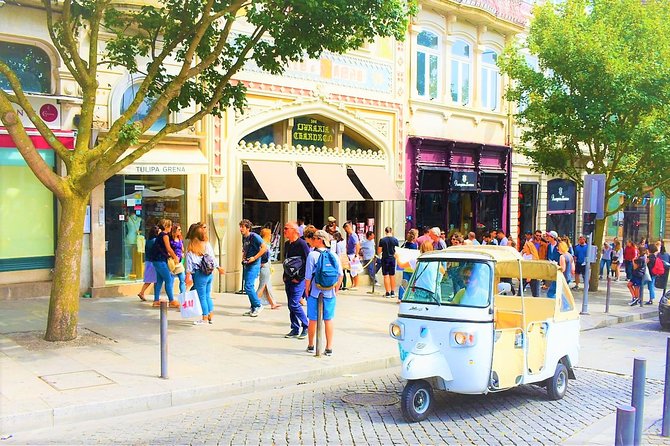
A classic start is Teatro Nacional São João. The building story alone gives you something to watch for: it was built in 1910 over the ruins of an earlier theatre that burned in 1908. On the outside, the façade nods to styles from the early 1900s, including a renovation inspired by Luís XVI design language from France.
What I like about this first stop is how it sets Porto’s tone. This isn’t just an “old city walk.” It’s a city that rebuilds, layer by layer—sometimes literally on top of what came before. The theatre’s mission also matters here: it’s tied to performances across national and international repertoire, and the building connects with nearby cultural spaces like the Carlos Alberto Theatre and the São Bento da Vitória monastery.
Admission is free for this stop, so you can take your time at the exterior and focus on details without paying extra.
Cathedral and Cloisters: Romanesque Roots and 20th-Century Rebuild
Next comes Catedral do Porto, with construction dating to the 12th/13th century and a Romanesque base. But the cathedral you see today reflects centuries of expansion and renewal, and the final result includes an idealized reconstitution of the medieval cathedral through later work.
This is the kind of place where your eyes benefit from the guide’s pacing. The standout named features include the Gothic São João Evangelista Chapel, the 14th-century cloister, and the way later eras leave fingerprints—like the 18th-century Santíssimo Sacramento Chapel and its silver altar (mannerist). There are also Baroque frescos by Nicolau Nasoni and traditional tilework by Vital Rifarto.
One note: admission at this stop is not included. That means you’ll want to decide on the fly if you want the inside experience, especially if you’re time-tight or if you’re trying to keep total spending down.
São Bento Railway Station: The 20,000-Tile Lobby Moment
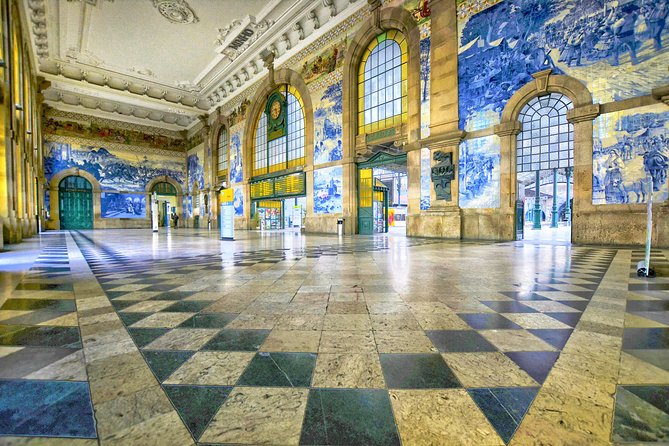
Then you hit a Porto icon that’s more like a museum lobby than a transit hall: São Bento Railway Station. The building is early 20th century, with a glass-and-cast-iron roof designed by Marques da Silva.
The real star is the lobby covering: around 20,000 narrative tiles painted by Jorge Colaço. This is where a tuk-tuk tour earns its keep. You can arrive quickly, park in the right spot, and spend a focused 10 minutes absorbing scenes that would otherwise pull you into a longer detour.
Admission is free here, so it’s a high-value stop. If you like art and storytelling, don’t rush. Look for how the tile narratives repeat themes across Portuguese life—transport, history, and daily character.
Igreja do Carmo: Rococo Porto and Tile-Front Drama
In the second half of the 1700s you’ll find Igreja do Carmo, known as one of Porto’s most remarkable Rococo buildings. Its interior carvings are the headline, but the exterior has a second layer: a lateral façade covered with tiles in 1912, with drawings designed by Silvestre Silvestri.
This stop is short by design (about 5 minutes), so treat it as a quick appreciation moment. In a full-day loop, every minute matters, and this is one of those churches you should either enjoy for the façade and feel, or decide to pay to go deeper if you’re a serious architecture fan.
Admission is not included, so plan accordingly.





Antiga Cadeia da Relação: A Granite Prison Turned Photo Center
One of my favorite contrasts is Antiga Cadeia da Relação. It’s a granite building dating to 1582, rebuilt in 1767 in a neo-classical style. The façade rhythm is specific and measurable—103 windows—and it has four façades with different functions.
The most interesting detail here is how the building used to move people: one façade supported Court access, while another allowed passage of prisoners and now serves as the main entrance. It also ties to stories of people held there, including writer Camilo Castelo Branco and the famous outlaw Zé do Telhado.
Today, after restoration (1999–2002 under Eduardo Souto de Moura and Humberto Vieira), the building houses the Portuguese Centre for Photography, plus an exhibition center. Admission is free, so it’s a “drop-in and learn” stop.
Fonte dos Leões and the Lello Factor: Quick Wins for Photos and Atmosphere
After the prison-turned-photo landmark, you get a brief palette cleanser: Fonte dos Leoes, the 19th-century Fountain of the Lions. It was built by a French company and cast at Val d’Osne foundry in France, and it’s a copy of the fountain in Leicester, England (Town Hall Square).
It’s only about 5 minutes, but it’s a nice reminder that Porto’s taste has always been international.
Then you may get your Art Nouveau brain fully awake at Livraria Lello. The façade (in Art Nouveau with neo-Gothic details) is the big visual hit, and inside you’ll find painted plaster imitating wood, plus a famous staircase and a large stained-glass skylight with the monogram and motto Decus in Labore.
This is one stop where time matters. The tour gives you about 20 minutes. Admission is not included, so you’ll likely need to pay separately if you want the interior.
Cordoaria Garden (Jardim de João Chagas): A Breathing Space Between Landmarks
Next: Jardim de João Chagas, better known as Cordoaria Garden. It’s a public park created when the Praça da Cordoaria was transformed for city use (mid-1800s). The rope-maker connection is a good Porto detail: the name ties back to rope makers who stayed in the area for about 200 years.
You’ll pass statues of writers Ramalho Ortigão and António Nobre, plus more modern sculptures by Juan Muñoz from 2001, including O rapto de Ganímedes.
Admission is free, and the vibe is different from the church-heavy stretch before it. It’s a good place to slow down, check your photos, and let your feet recover.
São Francisco Church and Its Gilded Interior: Gothic Meets Baroque Drama
Porto’s “wow” moment comes next at Igreja de San Francisco. It’s the city’s most important Gothic temple, with construction beginning in the 14th century, but the interior reputation is Baroque—especially its gilded woodwork.
People describe it with a reason. Count Raczinsky famously called it the Church of Gold, and the point is clear once you see the interior carving density. The Tree of Jesse is also highlighted, and there are catacombs.
Admission is listed as free for this stop, which is a big reason this part of the day feels like value. If you love ornate interiors, this is where you’ll feel glad you booked a guided route instead of trying to stitch together everything on your own.
Palacio de Cristal Gardens: Porto’s “Walkable View Deck”
After the church focus, you shift to scenery at Jardins do Palacio de Cristal. This botanical garden is one of Porto’s most loved escapes, built like a mosaic of smaller gardens that open up as you wander.
Expect lawns, sun-dappled paths, fountains, sculptures, and major plantings like giant magnolias, camellias, cypress, and olive trees. And the payoff is visual: city and Rio Douro views show up as you move.
You get around 30 minutes, which is enough for a slow loop without turning the day into a hiking project. Admission is free, so it’s another strong “included value” stop.
Torre dos Clérigos and the Bridges: Icon Views Without Overthinking the Route
Then you head into the landmark triangle.
You’ll visit Jardim do Infante Dom Henrique near Mercado Ferreira Borges and Palácio da Bolsa. The square includes a Monument to Infante D. Henrique, built to celebrate the 5th centenary of his death, with construction started in 1894 and completed in 1900. An underground car park sits below the garden, which is a fun detail if you like city engineering.
Next up: Torre dos Clerigos, a Baroque bell tower that you’ll spot from multiple points in Porto. The tower’s entrance is not included, but the exterior presence is enough to set your orientation for photos.
Then it’s straight to Dom Luis I Bridge. This iron bridge opened in 1886 and has two overlapping iron decks—engineered length 395 meters, width 8 meters, and an arch still considered the world’s biggest forged iron arch. Even if you don’t go inside anything, it’s a full-sight stop. The upper deck is used by the Porto Metro, connecting the Cathedral area to Jardim do Morro and onward.
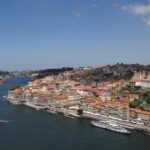
From here, the tour also connects you to Mosteiro da Serra do Pilar, a UNESCO-listed site. This church started in 1538 and finished around 1670, originally for Augustinian friars, later involved with the liberal army during the Civil War of 1832–1834. What you’ll feel at Serra do Pilar is the terrace viewpoint: from the grand terrace you can see the entire riverside of Porto and Vila Nova de Gaia, including the Cathedral area and D. Luís I Bridge.
Admission at this stop is free, and the circular church plan plus the 36 Ionic columns in the cloister makes it especially interesting if you’re into architectural “math.”
Palacio da Bolsa, Ferreira Borges, and Alfândega: Porto’s City-Commercial Side
The tour continues with major urban landmarks near the riverfront and center.
At Palácio da Bolsa, you get a neoclassical National Monument connected to the Commercial Association of Porto, designed in 1842. The star inside is the Arabian Room. It’s also on the Urban Wine Route, which ties nicely back to the included tastings idea.
Next: Mercado Ferreira Borges, built in 1885 to replace the old Ribeira Market. It’s an example of iron architecture, later renovated and turned into an entertainment venue where Hard Club operates now. It’s a short stop, but it’s the kind of place you remember because you can feel how Porto repurposes spaces.
Then you reach Alfândega Porto Congress Centre, a 19th-century neoclassical building with two facades—one toward the Douro and one toward the city. It’s known for engineering that mixes iron with stone, brick, and wood depending on space function. Restoration adapted it for transport-related collections, and it now also hosts congress events.
Admission is listed as free for these stops, so again: you’re getting access to Porto’s “bigger picture” without added museum tickets.
Igreja dos Carmelitas and the Final River-Facing Note
The day wraps with Igreja dos Carmelitas. This 17th-century church has a classical façade from the 1850s, attributed to Nicolau Nasoni. Its Porto Rococo altarpiece is described as stylistically revolutionary, and the church is a National Monument.
After this, the tour returns you back to the meeting point at R. de Augusto Rosa 180. You’ll likely end the day with a clearer mental map of Porto—bridge to bridge, hill to river, and church to garden—because you didn’t have to chase each stop alone.
Lunch and Wine Tasting: A Real Break, Not a Token Stop
Lunch is included and framed as a tasting lunch of regional products. You’ll see items like cheeses, sausages, and canned fish, paired with wines from small local producers. That’s a very Porto kind of meal: straightforward food, good alcohol, and flavors built on what’s local rather than what’s trendy.
The most practical benefit is timing. After a long run of churches and viewpoints, you’re less likely to feel worn out or cranky. And if you’re the type who likes learning through taste, this lunch helps the rest of the day land better.
If you’re the “I need to snack every 45 minutes” type, you should still plan to carry a small water bottle or easy snack, because not every stop gives long “sit time.” The tour does keep moving, even when you stop for photos.
Price: Does $166.99 Hold Up for an 8-Hour Private Tuk-Tuk?
At $166.99 per person for about 8 hours, you’re paying for three things: a private tuk-tuk experience, on-the-ground guidance, and included food and drink.
Here’s how I’d judge value:
- Transport you don’t have to organize: you’re not budgeting for multiple taxis or rides between dispersed sights.
- Time-saving access: you get to major sights with less hassle and less backtracking.
- Included tasting elements: wine tasting plus lunch is not trivial cost.
- Your tickets are separate for some interiors: monuments with “not included” entrances can add up if you want every inside visit.
So yes, it can be a good deal—especially if you’re traveling in a pair and you care about seeing more than just one neighborhood. If you’re traveling solo or you strongly prefer to pay only for a few paid entrances, compare it against a mix of walking plus a cheaper private driver time block.
Practical Tips for a Comfy Tuk-Tuk Day in Porto
Porto is hilly, and the streets can be bumpy, so keep expectations realistic.
- Wear shoes you trust on cobblestones. A tuk-tuk day adds more short walks than you might think.
- If rain shows up, expect wet roads and misty air. Ponchos help.
- Ask your guide about the best photo sides for bridges when the light is working. It’s a small request that makes a big difference.
- If you care about interiors—especially Livraria Lello and Torre dos Clérigos—budget for the separate entrance fees since they’re listed as not included.
- If you’re traveling with more people, think about comfort first. These vehicles can feel tight depending on the exact number in the group.
One extra tip from how guides have run the day: the best guides make time for your pace, not just the calendar. Names you might hear include Gabby, Bernardo, Fabio, Gonçalo, Leonardo, Leandro, and Anna—and people who rated the experience highest often singled out their friendliness and flexibility.
Should You Book This Private Tuk-Tuk Around Porto?
I’d book this if you want a guided Porto highlight loop that moves efficiently but still lets you stop for real views and meaningful landmarks. It’s a strong fit for first-time visitors, couples, and small groups who want a fun ride while also learning what they’re seeing.
Skip it (or at least reconsider) if you hate tight seating, don’t like bumpy rides, or you’re primarily shopping for a low-cost day with only free stops. Also, Porto weather can change quickly, and the experience is set for good conditions.
If you want Porto with less waiting, fewer crowds, and more “how did they build that” moments, this is a solid choice.