REVIEW · LISBON
Tuk Tuk Lisbon: Exploring Urban Art
Book on Viator →Operated by TukGuide Portugal · Bookable on Viator
Street art by tuk tuk beats walking. I love how this tour turns Lisbon’s neighborhoods into a real-world gallery, not a list of names. I also like that you get a private guide and private transportation, so you can move efficiently between murals and look closely without racing a crowd. If you’re expecting a gentle, fully accessible ride, there’s one catch: it’s not recommended for people with reduced mobility or for pregnant travelers, and children under 7 aren’t allowed.
You’ll get a tight 2–3 hour route (usually booked well ahead) and plenty of chances to stop for photos, especially around viewpoints. The one possible drawback is that the experience is very focused on street art, so if you mainly want classic monuments, you’ll want a different day plan. Still, if you like color, style, and the stories behind city walls, this is a strong fit.
In This Review
- Key things to know before you go
- A Tuk Tuk Route Built for Murals and Lisbon’s Slopes
- Santa Apolónia: Pichi & Avo’s sculptural tag storm
- Santa Clara Field: André Saraiva’s 53,000-tile wall
- Travessa das Merceeiras: Vhils (Alexandre Farto) in hidden faces
- Graça district portraits: Sophia, Natália Correia, and Florbela Espanca
- Avenida Fontes Pereira de Melo: Os Gémeos, Blu, Eric Il Cane, Sam3 in three buildings
- Lx Factory: Bordalo II and Lisbon’s creative workshop feel
- Price and logistics: what $93.73 buys you
- Who this tour is best for (and who should skip it)
- Should you book this Tuk Tuk Lisbon urban art tour?
- FAQ
- How long is the Tuk Tuk Lisbon urban art tour?
- What does the tour cost per person?
- Is hotel pickup included?
- Where can we meet if we are not picked up at our hotel?
- What is included in the price?
- Is food or drinks included?
- Is the tour only for English speakers?
- Is it suitable for children and people with mobility needs?
Key things to know before you go
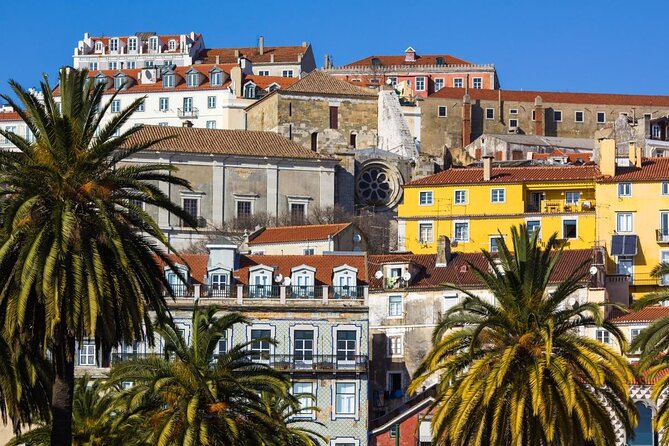
- Private tuk tuk setup: your group goes together with private transportation and guide time.
- Hotel/cruise-terminal pickup: you can start from many spots near the historic center, plus cruise terminals.
- Murals across several famous walls: from tile work to stenciled portraits to carved faces.
- Designed for photo stops: the pace often allows quick stops when traffic and timing cooperate.
- English guided tour: built for clarity, not guesswork.
- Ends back where you start: so you’re not stuck figuring out the rest of your evening.
A Tuk Tuk Route Built for Murals and Lisbon’s Slopes
Lisbon is full of walls that tell stories, but the city’s hills can turn a simple photo walk into a long slog. That’s where the tuk tuk format helps. In roughly 2 to 3 hours, you can cover several mural-heavy areas with far less back-and-forth than you’d get on foot or with multiple rides.
This is also a private tour, which changes the vibe. You’re not shoehorned into a fixed “follow-the-leader” flow. A good guide can tailor the timing around what you care about most—how closely you want to look at technique, or how long you want at viewpoint angles. In past tours, guides like Filipe have been especially flexible about pausing for photos when traffic allowed, and that makes a difference if you’re trying to get clean, straight-on shots of street art.
One practical note: the tour is for people who can handle uneven sidewalks and small curb moments. Even though it’s not an all-day trekking plan, it’s not marketed as an accessible sightseeing loop. If reduced mobility is a concern, you may want to choose a different style of tour that’s explicitly set up for your needs.
You can also read our reviews of more tours and experiences in Lisbon.



Santa Apolónia: Pichi & Avo’s sculptural tag storm
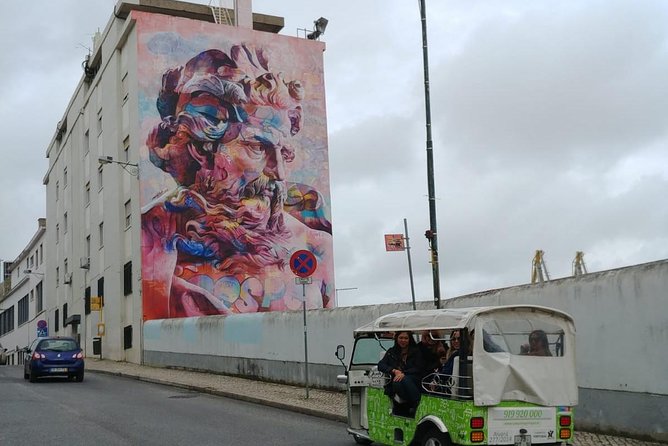
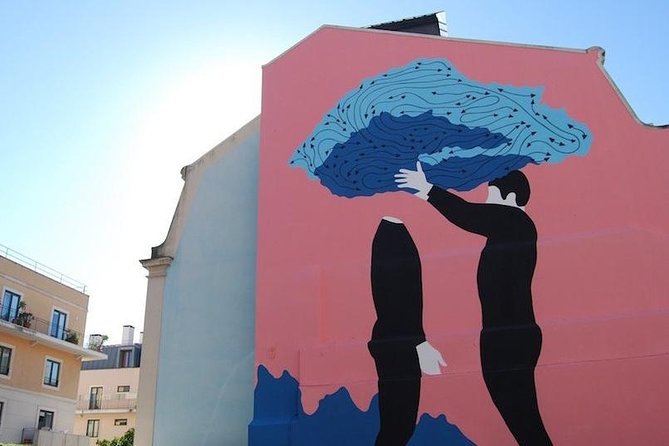
One of the first hits is at the Sidewalk of Santa Apolónia, on Calçada de Santa Apolónia. Here you’re looking at work by Pichi & Avo, a Spanish duo known for blending classic art methods with graffiti energy. The mural includes a large sculptural figure layered over what feels like endless tagging across the building’s side.
What makes this stop satisfying is the contrast. The figure reads almost as a carefully drawn form, while the wall around it celebrates rougher, freer marks. If you’ve ever wondered how artists can bring “museum-like” skill to a street setting without washing out the rebellion, this is a clear example.
Why I like starting here: it sets your eyes for the rest of the route. By the time you move on, you’ll spot technique differences faster—what’s been drafted carefully, what’s been thrown down fast, and what’s meant to look chaotic while still being composed.
A small drawback: like many street murals, this kind of work depends on your viewing angle. The best photos often come when you’re close and slightly angled, so give yourself a minute to reposition rather than snapping from the first spot you stop.
Santa Clara Field: André Saraiva’s 53,000-tile wall
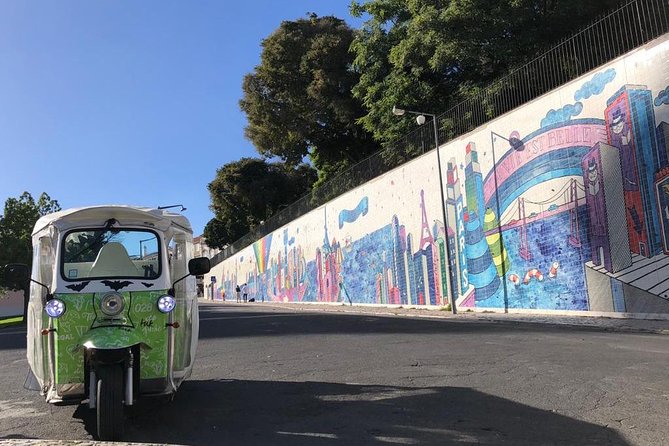
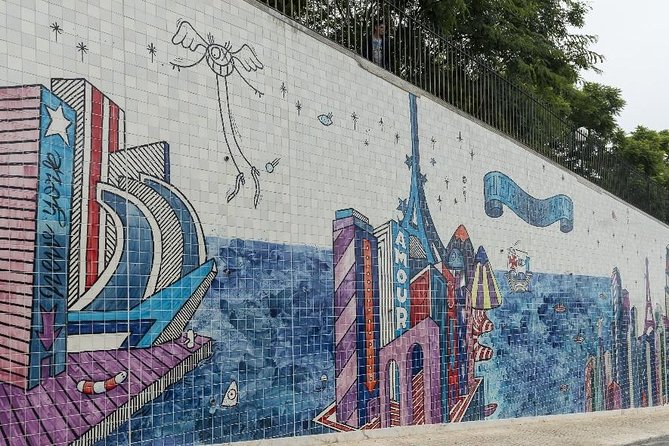
Next comes the Santa Clara Field area, tied to the old wall of Jardim Botto Machado in the Campo de Santa Clara / Feira da Ladra area. This is where André Saraiva turns a long stretch of wall into a tiled world.
The scale here is the point. The mural covers about 170 meters of wall, roughly 1,000 m², using around 53,000 tiles. That’s not “a mural.” That’s a full-on surface transformation—like someone built a second city out of ceramics.
For you, the practical value is twofold. First, you get a break from the heavy street-paint look and see how tiles change texture and light. Second, long murals help your brain relax: you can scan slowly, and the eye has time to follow the story rather than just hit a single focal point.
The only caution: because the art is so large, you might feel tempted to rush. Don’t. Walk your gaze from one section to another. Look for patterns and repeats—tile murals often work like puzzles, and the real payoff is how details connect across the whole wall.
Travessa das Merceeiras: Vhils (Alexandre Farto) in hidden faces
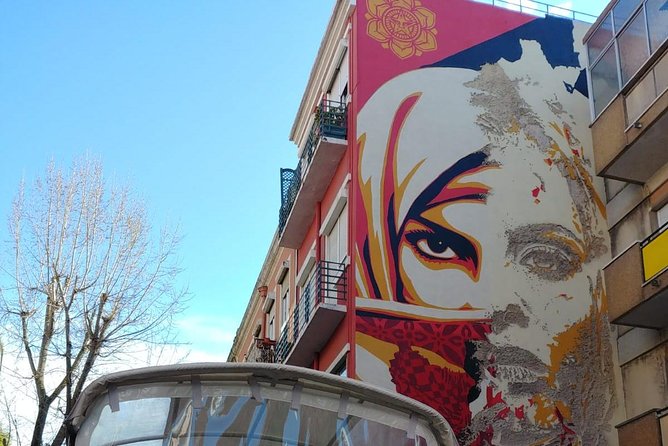
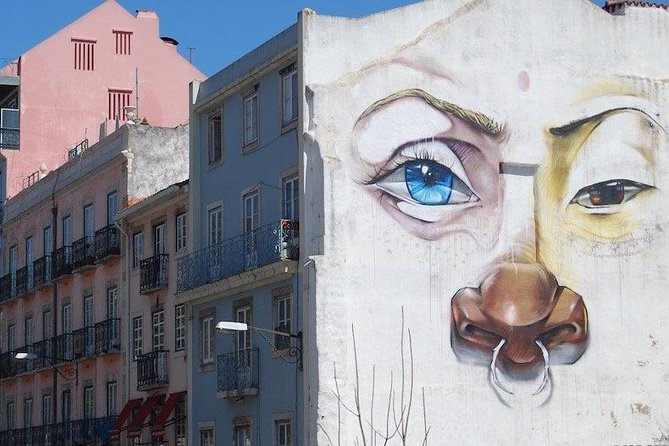
Then the route shifts into carving and excavation style with Vhils, the stage name of Alexandre Farto. In Travessa das Merceeiras, there’s a face carved into the city’s texture—an approach that feels both brutal and delicate at the same time.
This stop is for you if you like street art that doesn’t just sit on top. Carved work changes how you read the wall: light becomes part of the art. As you move a few steps, shadows shift, and the face emerges or fades depending on the angle.
In Lisbon terms, Vhils has been one of the early names that helped bring street art carving into the mainstream conversation. And that makes this a useful stop: you’re not only seeing a mural, you’re seeing a piece of how urban art gained cultural weight in the city.
The drawback is simple: carved pieces can be easier to miss than flat, colorful murals. Give yourself time to locate the face and check from more than one angle. If you’re in a rush, you’ll likely get a decent shot—but you’ll miss the subtle effect.
Graça district portraits: Sophia, Natália Correia, and Florbela Espanca
Now you get something different: street art that acts like public portraiture, tied to Lisbon’s literary legacy. In the Graça area, a group of artists created works honoring national literature figures connected to the neighborhood.
On Rua Josefa de Óbidos, look for Sophia de Mello Breyner, made by Eime. Then in Travessa do Monte, you’ll find portraits of Natália Correia and Florbela Espanca, created by Mariana Dias Coutinho. What’s smart here is the location: this isn’t street art hidden in an alley. It sits near the neighborhood’s viewpoints, so art and scenery work together.
This is one of those stops where the timing matters. If you arrive when the light is good, you’ll see the portraits with stronger contrast. If it’s flat light, you might feel the colors fade, but you’ll still get the “why here” of the choice: these portraits belong in a place known for outlooks and character.
Also, since these spots sit near viewpoints of Graça and Senhora do Monte, you can think of this moment as two stops in one: literary faces for the art lover, plus the city’s angles for the view chaser.
Potential drawback: because viewpoints are popular, you might share the space with other people. That doesn’t ruin it, but it can slow down your photo time if you want quiet.





Avenida Fontes Pereira de Melo: Os Gémeos, Blu, Eric Il Cane, Sam3 in three buildings
From Graça, the route heads to a busier avenue: Avenida Fontes Pereira de Melo. Here, several international artists worked on murals in three vacant buildings—including Brazilians Os Gémeos, Italians Blu and Eric Il Cane, and Spanish artist Sam3.
This is where the tour proves it’s not just local color. It gives you a snapshot of the international street art language—different letter styles, different character types, different ways of turning empty structures into statement walls.
One reason this stop is worth your attention is its reputation. The artwork was considered among the 10 best worldwide by The Guardian. Even if you don’t chase rankings, that kind of recognition signals that you’re looking at work that’s been seen, debated, and noticed beyond Lisbon.
A practical consideration: works across multiple buildings can feel harder to “read” if you’re only catching it from one side. Take a moment to look, then reposition if you can. With a private tuk tuk setup, you’re not locked into a single pedestrian route, so use that advantage.
Lx Factory: Bordalo II and Lisbon’s creative workshop feel
The tour often ends with a shift into Lx Factory, a creative space where you’ll find more than a dozen works in one area. This is where you can slow down and treat the outing less like a sprint and more like browsing.
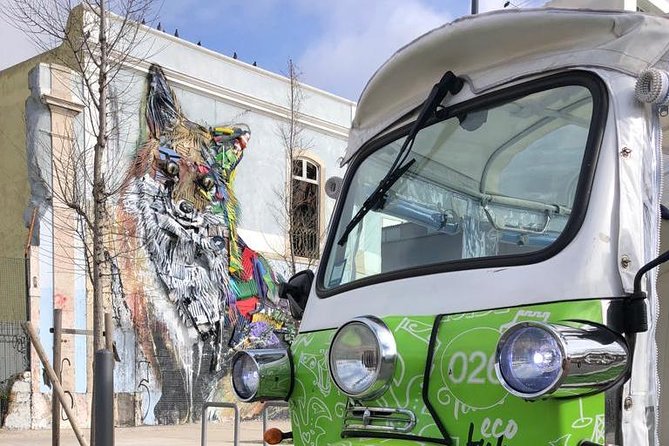
The standout name here is Bordalo II, known for turning trash and everyday waste into huge animal sculptures. A famous example in the Lx Factory creative zone is a massive bee made from garbage. It’s funny, clever, and a little disturbing in the best way: it makes you think while you laugh at the scale.
Why I like finishing here: it breaks the mural-only rhythm. By the time you arrive at Lx Factory, you’ve already absorbed multiple styles. Now you get a chance to wander and compare—how street art looks when it’s part of a creative district instead of solely an outside wall.
One possible drawback: if you only have a short attention span, Lx Factory can tempt you to look at too much at once. Keep your priorities in mind—maybe pick one or two works to get the best photos, then move on.
Price and logistics: what $93.73 buys you
At about $93.73 per person, this tour sits in the range where you should ask one question: is it covering enough ground and value to justify the cost? For me, it can make sense because you’re buying three things at once:
1) A private guide who knows what you’re seeing. When a guide can explain technique and context—why a mural was placed where it is, and what makes a style distinct—you get more than pictures.
2) Private transportation that reduces the hassle factor. Lisbon’s hills and uneven streets are real. The tuk tuk format helps you spend your energy on looking, not on getting there.
3) A compact time window with multiple major mural moments. In around 2 to 3 hours, you hit several of the city’s most recognizable urban art stops, from tile-scale projects to carved portraits to international building murals.
A useful detail: this experience includes guided tour, a private guide, and private transportation, and you’ll get a mobile ticket. It’s also sold as a private tour/activity, meaning only your group participates, not random strangers mixing into your time.
If you’re traveling as a pair or small group, private tours can feel like less of a “deal” than group discounts, but the payoff is pace. And with group discounts offered, it can also get more reasonable if you’re coordinating with others.
One more “don’t forget” tip: this is typically booked about 45 days in advance on average. If your dates are firm, booking earlier usually helps you lock in your preferred time slot.
Who this tour is best for (and who should skip it)
This is ideal if you enjoy street art as art, not just as decoration. You’ll like the mix of styles: tagging energy paired with sculptural imagery, a huge tile installation with massive scale, carved faces by Vhils, and literary portraiture that connects murals to Lisbon’s identity.
It’s also a good choice for people who want a guided plan but don’t want a “museum-only” day. If you like walking through neighborhoods and reading the city’s visual language, you’ll get more out of this than a generic sightseeing loop.
It’s not the best option if you need an accessible route. The tour isn’t recommended for people with reduced mobility, and it’s not suggested for pregnant travelers. It also has a clear rule: children under 7 aren’t allowed.
Should you book this Tuk Tuk Lisbon urban art tour?
Book it if you want Lisbon to feel current and creative—murals, portraits, carvings, and big-scale work—without spending half your day fighting logistics. The private setup and hotel/near-historic-center pickup help you get started smoothly, and the route hits a solid variety of street art styles rather than repeating one look.
Skip it (or switch to a different plan) if your priority is classic monuments and indoor sights. This tour focuses on urban art, so you’ll want to pair it with other parts of Lisbon if you’re building a mixed itinerary.
If you’re comfortable walking a bit and you’re excited to see what artists have done to real walls in real neighborhoods, this is a smart, high-value way to spend a morning or afternoon—especially when you can get a guide who makes photo stops and street-level viewing work.
FAQ
How long is the Tuk Tuk Lisbon urban art tour?
It runs about 2 to 3 hours.
What does the tour cost per person?
The price is $93.73 per person.
Is hotel pickup included?
Pickup is offered. The provider picks up from Lisbon hotels and Airbnbs near the historic center, from the three cruise terminals of Lisbon, and from nearby restaurants/meeting spots near the historic center.
Where can we meet if we are not picked up at our hotel?
They suggest functional meeting points like Time Out Market and the Alto do Parque Eduardo VII.
What is included in the price?
The tour includes a guided tour, a private guide, and private transportation.
Is food or drinks included?
No. Food and drinks are not included, and monuments tickets are also not included.
Is the tour only for English speakers?
The tour is offered in English.
Is it suitable for children and people with mobility needs?
Children under 7 are not allowed, and it is not recommended for pregnant women or people with reduced mobility. Service animals are allowed.