REVIEW · LISBON
3 Hours Private Tour of Lisbon’s Historic Center by Tuk Tuk
Book on Viator →Operated by Lisbon Vibes by Tuk Tuk · Bookable on Viator
Lisbon’s hills are easier in a tuk tuk. This 3-hour private ride strings together classic sights and photo-stops with live guide commentary, so you get orientation fast without spending half the day in transit. You’ll roll past Rossio Square, curve through viewpoint stops, and end up in areas like Alfama and Chiado with a guide who explains what you’re actually seeing.
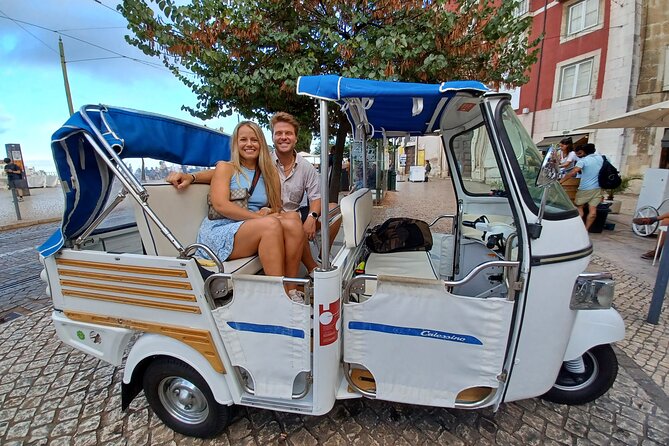
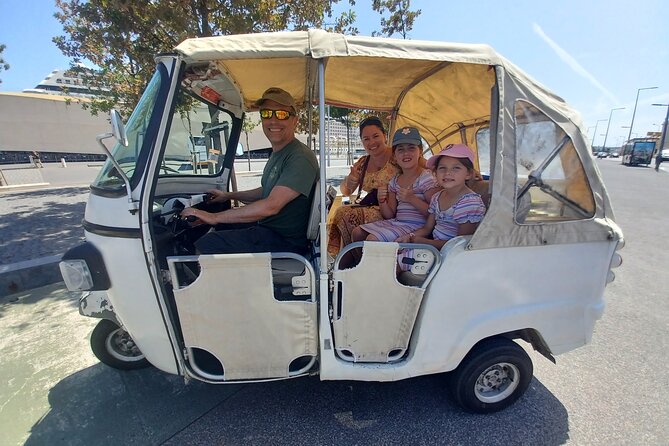
What I like most is the private group setup for up to 3 and the way the route focuses on viewpoints and major landmarks without making you queue for hours. The tuk tuk rain cover and warm blanket are also a practical touch, because Lisbon weather loves changing its mind.
One consideration: this tour is short, so you’ll pass by several famous places rather than doing long inside visits at every stop, and the viewpoints are where the time goes.
In This Review
- Key highlights you’ll feel during the ride
- 3 Hours by Tuk Tuk: when Lisbon’s hills trump long walking
- Starting at Hard Rock Cafe and rolling into Rossio Square
- Rossio to Bairro Alto via the Santa Justa Elevator
- Lisbon Cathedral and the first viewpoints you’ll actually remember
- Portas do Sol and Senhora do Monte: best “photos with context” time
- São Vicente de Fora and the National Pantheon: culture stops that fit
- Alfama’s lanes: optional walking + a ginjinha moment
- Chafariz de El-Rei to Praça do Comércio: water, power, and river views
- Chiado and Rua Garrett: books, cafés, and everyday Lisbon life
- Largo do Carmo: the Carnation Revolution square you can feel
- São Pedro de Alcântara to Parliament, Estrela, and Parque Eduardo VII
- Price and Value for a private group (up to 3)
- Should you book this Lisbon Historic Center Tuk Tuk tour?
- FAQ
- How long is the Lisbon historic center tuk tuk tour?
- How big is the group for this private tour?
- Where do we meet, and does the tour return to the same place?
- What’s included in the tour price?
- Is the tour offered in English, and do I get a mobile ticket?
- Are tickets included for the major sights on the route?
- What happens if it rains?
- Can I cancel for a full refund?
Key highlights you’ll feel during the ride

- Private tuk tuk for up to 3 means your guide can tailor pacing and photo stops to your group
- Big viewpoint time at Santa Luzia, Portas do Sol, Senhora do Monte, and São Pedro de Alcântara
- Lisbon Cathedral + São Vicente de Fora give you real interior moments, not just street photos
- Alfama includes an optional walking stretch with the chance to taste ginjinha from the chocolate cup tradition
- Rain-ready comfort with a tuk tuk cover and warm blanket included
- Stops that connect the city’s story from Moor-era Lisbon Cathedral to the Carnation Revolution at Largo do Carmo
3 Hours by Tuk Tuk: when Lisbon’s hills trump long walking

Lisbon is gorgeous, but it’s not shy about slopes. A tuk tuk is a sensible way to cover ground while still feeling like you’re moving through real neighborhoods, not just checking boxes.
In just about three hours, you’re set up to see multiple “Miradouro” moments (viewpoints) that most people can’t stitch together efficiently on their own. And because the tour is private, you’re not stuck waiting for strangers to finish taking photos or to read signs slowly at every stop.
You also get live commentary from a guide, and that matters. Lisbon’s streets can look random until someone connects the dots: where you are, why it matters, and what to look for in the city’s layout.
You can also read our reviews of more tours and experiences in Lisbon.



Starting at Hard Rock Cafe and rolling into Rossio Square
You meet at Hard Rock Cafe Lisboa on Av. da Liberdade, then you ride out from there back toward the historic center loop. It’s a convenient starting point because it’s easy to reach, and the tour ends back at the same place.
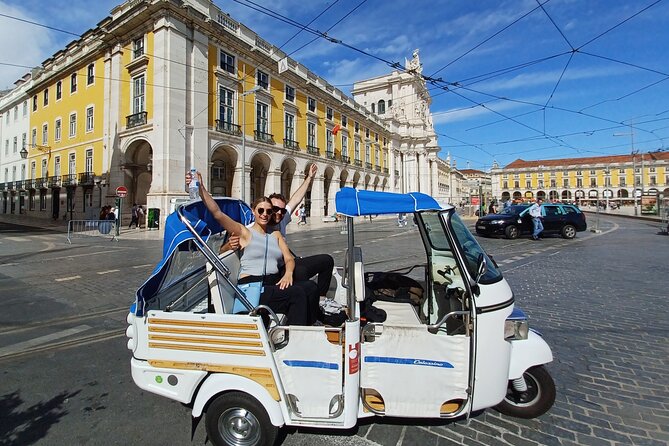
The first major visual hit is Rossio Square (Praça Dom Pedro IV). You don’t just see it from one angle—you pass through as a moving “orientation marker,” with the mosaic pavement and historic buildings giving you a sense of where Lisbon’s old core starts to reveal itself.
Rossio is also a good mental warm-up. After you’ve watched traffic flow around it for a moment, the rest of the day clicks into place: you’re traveling from the heart of the city toward viewpoints and older districts built on different elevations.
Rossio to Bairro Alto via the Santa Justa Elevator
One of the strongest “wait, that’s Lisbon” moments is the Santa Justa Elevator. Even when you’re only passing by, it’s hard to miss the elegant 19th-century metalwork that links the Baixa district to the Bairro Alto.
This stop is valuable because it explains Lisbon’s vertical logic. You’ll start to understand why residents and visitors keep bouncing between lower streets and higher neighborhoods. Lisbon isn’t flat, and that affects everything: sightlines, architecture, and how people move through the city.
Even without a full elevator visit on this tour, the guide’s explanation helps you see it as an engineering answer to a geography problem—not just a pretty structure.
Lisbon Cathedral and the first viewpoints you’ll actually remember
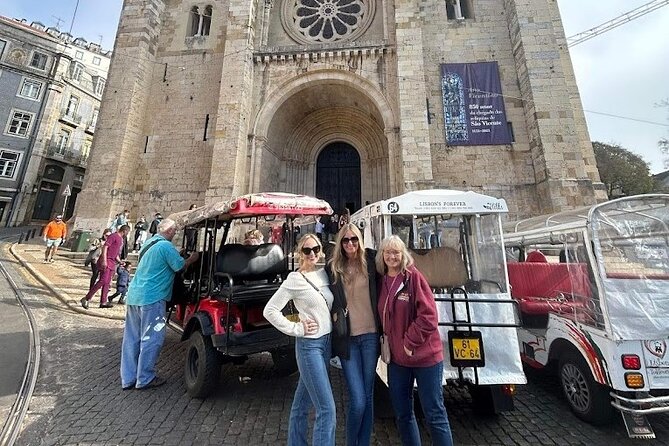
A highlight moment comes at Lisbon Cathedral (Basilica of Santa Maria Maior). You get a proper stop with about 15 minutes and free admission. This is the kind of indoor time that balances the outdoor miradouros.
The big payoff here is the story. Lisbon Cathedral dates back to the 12th century after the reconquest from the Moors, which gives your day a historical spine. When you look at the interior, you’re not just seeing a church—you’re seeing a layer of Lisbon that predates much of the surrounding city.
Then the tour shifts toward viewpoint mode with Santa Luzia. At Miradouro de Santa Luzia, you get about 10 minutes, and this is mainly a pass-through photo stop. The gardens, traditional Portuguese tiles, and bougainvillea-covered pergolas create an instantly charming scene, and it’s one of those places where a quick stop still feels meaningful because the design is so intentional.
Practical tip: if you care about photos, treat these viewpoint stops like mini photo assignments. The guide will help you time them, but you still want your camera ready before the tuk tuk rolls into position.
Portas do Sol and Senhora do Monte: best “photos with context” time

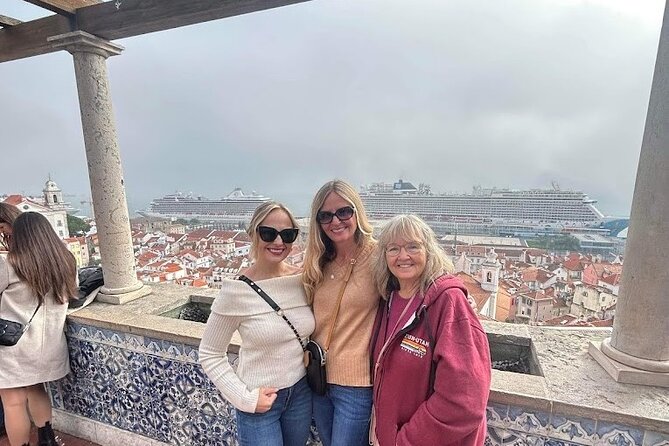
Miradouro das Portas do Sol is the next step up, with about 20 minutes and free admission. The payoff here is that you’re looking outward—toward the River Tagus and the surrounding hills—so you can map the city’s shape in your mind. It’s one of the fastest ways to understand why Lisbon looks the way it does from above.
Then you move to Senhora do Monte, the highest of the stops on this route, with about 20 minutes. The view is built for photos: São Jorge Castle and the historic center sit in the foreground, and you can see the Tagus farther out. The guide’s commentary helps you identify what you’re looking at, so the photos aren’t just pretty—they’re useful.
This section is where the tuk tuk choice really pays off. You’re getting the big viewpoints without turning the day into a workout. And because the tour is private, the pace tends to match your group’s energy instead of a fixed crowd schedule.






São Vicente de Fora and the National Pantheon: culture stops that fit
Next up is Igreja de São Vicente de Fora, with about 15 minutes and free admission. This church is known for Renaissance architecture, its impressive dome, and the fact that it has one of the most remarkable organs in Europe.
Even if you only have a short window, a stop like this changes the day. After viewpoints, you get structure and interior detail again. You’ll start noticing how Lisbon mixes eras rather than switching to one style and sticking with it.
Then comes a more “explanation-first” moment at the National Pantheon (Church of Santa Engrácia). You’ll stop for about 10 minutes for storytelling, but a full visit is not included (ticket not included). This is still worthwhile because the guide points out the significance and mentions famous figures buried there, including fado singer Amália Rodrigues and football legend Eusébio.
If your goal is to see the biggest famous faces and symbols without spending money at every door, this format works well: you get the context, and you decide on your own if you want a deeper visit later.
Alfama’s lanes: optional walking + a ginjinha moment
Alfama is the neighborhood that makes Lisbon feel like Lisbon. It’s a maze of narrow streets, winding stairs, and colorful buildings—and the tour builds in time for that vibe.
At Alfama, you get an optional walking tour stretch (about 20 minutes, free admission). It’s the part where you can step out of the tuk tuk and actually feel the neighborhood’s scale. The streets here are tight enough that walking can help you experience what a drive can’t.
There’s also a very Lisbon-style stop: tasting ginjinha, the cherry liquor served in a chocolate cup. The cup itself is half the fun, and it gives you a quick edible souvenir that fits the neighborhood’s old-school identity.
Consideration to keep in mind: if your group prefers staying seated, you can treat this as a shorter optional moment and focus on the photos and passing views instead.
Chafariz de El-Rei to Praça do Comércio: water, power, and river views
As the tour moves along, you’ll pass by Chafariz de El-Rei, described as the first public fountain in Lisbon, built in the 13th century by D. Dinis. Even when you only stop briefly, it’s a great anchor point because you’re seeing how everyday city systems (like water) were part of Lisbon’s growth.
Then you reach Praça do Comércio, right by the Tagus River estuary. This is one of the largest squares in Europe, and it used to be the site of the royal palace. Even from outside, the scale hits you—plus the view includes the iconic Rua Augusta Arch.
This stop is best for perspective. After years of seeing Lisbon photos online, Praça do Comércio is where you realize the city’s power axis was always tied to the river. The guide’s commentary helps you connect the square’s grandeur to the city’s trading and governance role.
Chiado and Rua Garrett: books, cafés, and everyday Lisbon life
You then glide through Chiado, the heart of Lisbon’s commerce and theatre scene. It’s a district where older traditions meet modern life, and the drive-through works because you’re sampling the area from the street level.
Rua Garrett is part of this experience, and you also pass Bertrand Bookstore. It’s described as the oldest bookstore in the world still in operation, dating back to the 18th century. That’s the kind of detail you don’t want to miss, because it turns a normal street stop into a “wait, seriously?” moment.
This segment is also a good time to slow down mentally. You’re not at a viewpoint now. You’re in a place where Lisbon shops, street rhythm, and daily life mix together.
If you’re the type who likes to browse, you might use this as a cue for later—come back on your own time when you can linger inside.
Largo do Carmo: the Carnation Revolution square you can feel
Largo do Carmo is a short pass-by stop, but the story lands. This square was the setting for events that changed Portuguese history on April 25, 1974, during the peaceful Carnation Revolution.
Why this matters on a tuk tuk tour: you’ll feel the city as more than scenery. Lisbon has political and social layers, and this stop reminds you that the streets around you were witnesses, not just backdrops.
It’s also a reminder to watch for details. A square can look pretty on the surface, but with the right context you start noticing why it was chosen and why it’s remembered.
São Pedro de Alcântara to Parliament, Estrela, and Parque Eduardo VII
Next comes Miradouro São Pedro de Alcântara, where you get about 20 minutes for photos. This viewpoint is described as giving one of the most breathtaking and complete views over Lisbon, stretching toward São Jorge Castle, Baixa, and the shimmering Tagus River.
Then the tour continues with passing stops connected to Lisbon’s public life. You’ll see a neoclassical palace built in the late 16th century that has been the seat of the Portuguese Parliament since 1834. It’s a strong “architecture meets government” moment, and it also ties back to the idea that Lisbon’s geography shaped who ruled from where.
You’ll also stop at Basilica da Estrela, about 10 minutes, located in front of Estrela Garden. It’s an 18th-century royal basilica and convent connected to the Most Sacred Heart of Jesus. Even a short stop gives you something calmer after viewpoint time: a big church space and a sense of serenity.
Finally, you reach Parque Eduardo VII with about 20 minutes. This is Lisbon’s largest green space in the city center. It was originally called Liberty Park and was renamed in honor of King Edward VII after his visit in 1903. The stop includes an additional panoramic viewpoint framed by gardens and tree-lined paths.
This closing sequence is smart. After a day of slopes and sights, a park with a viewpoint lets you land the plane and get one last set of city photos without rushing to the next door.
Price and Value for a private group (up to 3)
At $211.47 per group (up to 3) for about 3 hours, this isn’t a cheap add-on if you’re traveling solo. But it can be good value when you share it, because you’re effectively paying for guided transport plus a route designed around Lisbon’s hills and viewpoints.
Think of what you’d otherwise spend time on:
- you’d need transportation across multiple elevations
- you’d need a plan to hit several miradouros efficiently
- you’d still benefit from guide context, not just maps
Also, the tour includes the tuk tuk cover in rain and a warm blanket. That small comfort can save your day if weather turns. And because it’s private, your group’s time doesn’t get dragged down by someone else’s pace.
One more value point: the tour is English and uses a mobile ticket, which helps you stay flexible if your schedule shifts a little.
Food and drinks aren’t included, so you’ll want your own plan for snacks or a drink break if you get hungry mid-day. Tips are also not included, so budget a little for that if you feel the guide earned it.
Should you book this Lisbon Historic Center Tuk Tuk tour?
You should book if you want the fastest way to connect Lisbon’s major historic areas with viewpoint photos in a short window. It’s especially worth it when:
- you’re short on time and want structure
- you’d rather avoid big transport hassles on hilly streets
- your group includes people who prefer seated sightseeing with occasional walking
You might skip or pair it with something else if your priority is long museum-style inside visits at every stop. This tour is designed to give you key moments, then move you on.
My simple take: if you want a guided route that helps you understand Lisbon’s layout while you collect viewpoint photos, this is a smart use of three hours.
FAQ
How long is the Lisbon historic center tuk tuk tour?
It’s approximately 3 hours.
How big is the group for this private tour?
It’s a private tour for your group, up to 3 people.
Where do we meet, and does the tour return to the same place?
You start at Hard Rock Cafe Lisboa, Av. da Liberdade 2, and the tour ends back at the meeting point.
What’s included in the tour price?
Included items are the tour guide, live comments on board, corporate liability and personal injury insurance, and a tuk tuk cover for rain plus a warm blanket.
Is the tour offered in English, and do I get a mobile ticket?
Yes, it’s offered in English and you receive a mobile ticket.
Are tickets included for the major sights on the route?
Lisbon Cathedral is listed as free admission, and the viewpoint stops are also listed as free. The National Pantheon stop is explained but tickets are not included.
What happens if it rains?
The tour includes a tuk tuk cover in case of rain.
Can I cancel for a full refund?
Yes. Free cancellation is available up to 24 hours in advance for a full refund. If you cancel less than 24 hours before the start time, the amount paid is not refunded.