REVIEW · LISBON
Explore the City in Style Lisbon on Electric Tuk Tuk
Book on Viator →Operated by Tugatours · Bookable on Viator
Electric tuk tuks make Lisbon feel effortless.
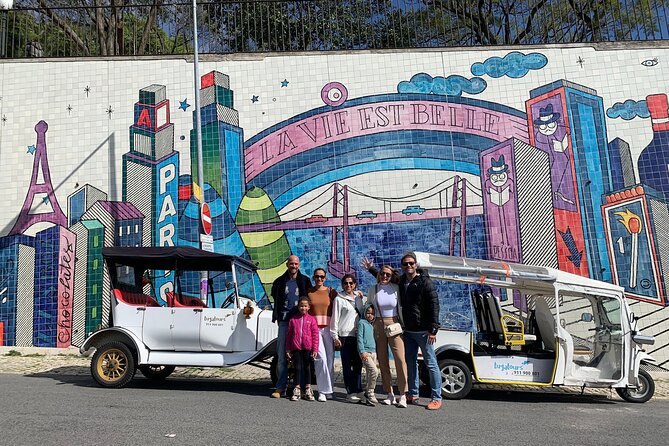
This private tour uses an electric vehicle and keeps you moving through the city’s big sights without the usual parking and traffic stress. I like that the route connects Baixa to Alfama viewpoints so you get the stories behind Lisbon’s layout, earthquakes, and hills in one easy loop.
Two things I really like are the live local guide commentary and the way the stops are chosen for quick “aha” moments. When the guide is Joao, the facts land fast, and you don’t feel like you’re just being pointed at plaques. Second, I love that the ride includes both classic monuments and the “look at this” miradouro moments, so you get history and views in the same time window.
One consideration: even on a tuk tuk tour, churches and viewpoints can mean short uphill bits and a bit of walking. If you’re dealing with mobility limits, you’ll want to plan for that extra movement.
In This Review
- Key highlights worth your attention
- Electric tuk tuk in Lisbon: why this style of tour works
- Where you start, where you end: Rua de Arroios to Praça dos Restauradores
- Baixa Pombalina and Rossio: Lisbon’s rebuilt heart
- Lisbon Cathedral (Sé): Romanesque power and layered repairs
- Miradouro das Portas do Sol: the Tagus and Alfama in one glance
- Graça’s Miradouro da Senhora do Monte: big panorama, calmer feel
- São Vicente de Fora: azulejos, tombs, and a monastery worth slowing down
- Alfama and the National Pantheon: rooftop city views plus major Portuguese figures
- Feira da Ladra and Largo do Carmo: local market energy and earthquake ruins
- São Roque Church in Chiado: ornate interior, simple exterior, strong art
- São Pedro de Alcântara viewpoint and Bairro Alto: a garden with a view
- Príncipe Real, Eduardo VII Park, and Avenida da Liberdade: shifting gears into Lisbon’s modern pulse
- Finishing at Praça dos Restauradores: a strong landing point
- Price and time: is $42.38 worth it for the way you travel?
- Who this tour suits best (and who should think twice)
- Should you book the Lisbon electric tuk tuk highlights?
- FAQ
- How much does the electric tuk tuk tour cost?
- How long is the tour?
- Is hotel pickup included?
- What language is the commentary?
- What’s the meeting point and where does the tour end?
- Does the tour allow children?
- When does Feira da Ladra run?
- What’s included in the price?
Key highlights worth your attention

- Hotel pickup in central Lisbon so you start where you actually are.
- Private tour for your group with English live commentary throughout.
- Electric tuk tuk rides that help you cover steep areas without tiring out early.
- Multiple viewpoints including Portas do Sol, Senhora do Monte, and São Pedro de Alcântara.
- Historic anchors like Lisbon Cathedral (Sé), São Vicente de Fora, and São Roque Church.
- Alfama time built in, plus optional shopping at the flea market when it’s running.
Electric tuk tuk in Lisbon: why this style of tour works

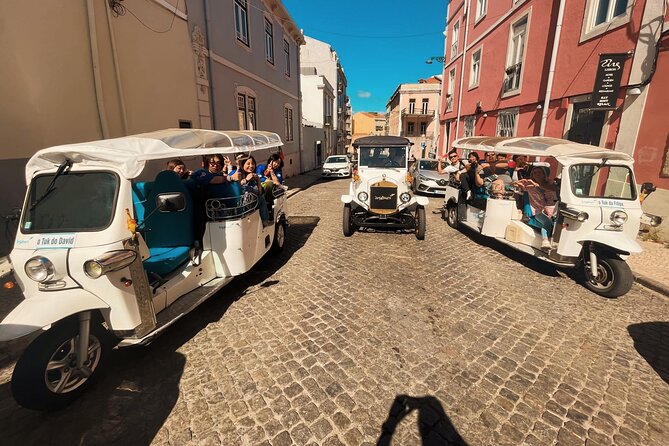
Lisbon is gorgeous, but it’s also hilly. A classic walking-only plan can turn into a stair workout before you even reach the best viewpoints. With an electric tuk tuk, you still get the close-up feel of neighborhoods and streets, but you save your legs for the moments that matter: the lookouts, the church stops, and the short photo breaks.
The tour is also private, so you’re not stuck in the “everyone line up now” shuffle. That matters in Lisbon, where streets can be narrow and people move at different speeds. Your guide can pace the commentary to your group and focus on what you’re seeing right now, not what you’ll see later.
You can also read our reviews of more tours and experiences in Lisbon.



Where you start, where you end: Rua de Arroios to Praça dos Restauradores

The tour starts at Rua de Arroios 120, in central Lisbon, and ends at Praça dos Restauradores. That end point is useful: you’re in a central spot with an easy jump-off for the rest of your day, whether you want to keep exploring on foot or hop on public transport.
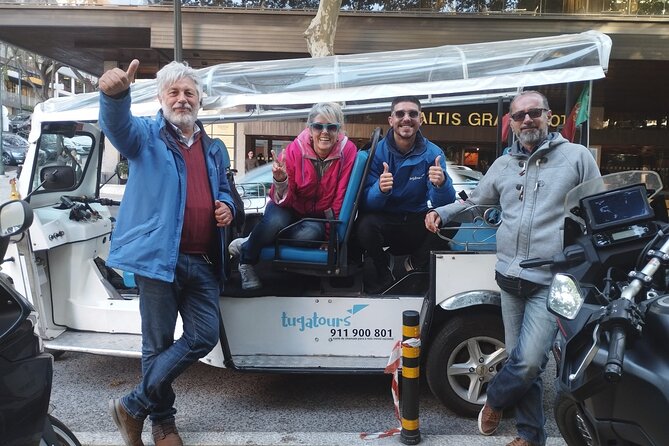
If you requested pickup from a city-center hotel, a driver meets you at the agreed location and takes you to the start point. If you didn’t request pickup, you go to the garage at Rua de Arroios 120-A—look for the Tuga Tours logo and someone holding the tour name sign.
One practical note: arrive at least 10 minutes early at the start. In a city like Lisbon, that buffer helps everything run smoothly.
Baixa Pombalina and Rossio: Lisbon’s rebuilt heart
Your route kicks off in Baixa Pombalina, the city’s central district rebuilt after the 1755 earthquake. The plan is laid out like a grid, with wide, straight streets and the neoclassical façades that make Baixa feel orderly compared to the older quarters above it.
From here you pass by landmarks like Rossio Square and Praça da Figueira, and you reach the big showpiece: Praça do Comércio by the Tagus River. This is the part of Lisbon where you can understand the city’s “reset” moment. It’s not just sightseeing; it’s urban design history you can actually see.
If you like photo ops, Baixa is forgiving—open plazas, clear lines, and lots of café life. If you’re short on time, these straight streets also help you understand where everything is before you start climbing into the older neighborhoods.
Lisbon Cathedral (Sé): Romanesque power and layered repairs
Next up is Lisbon Cathedral, also called Igreja de Santa Maria Maior (Sé)—the oldest cathedral in Lisbon. The key visual is the Romanesque façade with twin fortified towers. It’s a building that feels like it has been bracing itself for centuries.
Inside, the cathedral has been changed and restored through time, with Gothic, Baroque, and Neoclassical touches. It also survived major earthquakes, including 1755, which is why it carries more weight than a typical “pretty church” stop.
One standout detail for people who love layers: the cloister area ties in archaeological discoveries, including Roman and Visigothic remains. You’re not only looking at architecture; you’re seeing proof that this site kept mattering after different eras.
Miradouro das Portas do Sol: the Tagus and Alfama in one glance
Then comes one of Lisbon’s signature viewpoints: Miradouro das Portas do Sol. You get a sweeping panorama over Alfama’s rooftops, the Tagus River, and major landmarks like the National Pantheon and São Vicente de Fora area.
The viewpoint’s name points to the old Moorish city walls and gates. That’s a nice “connect the dots” moment: this isn’t just a pretty terrace; it’s sitting near the city’s older boundary.
Practical tip: this is a great spot for photos, but also for pausing. If your plan is fast-paced, build in a few minutes here and let your brain catch up. The light can shift quickly, and the view is the whole point.






Graça’s Miradouro da Senhora do Monte: big panorama, calmer feel
From there you head to Miradouro da Senhora do Monte in the Graça neighborhood. This is one of the highest viewpoints in the city, with a wide sweep that stretches toward São Jorge Castle, across the Baixa district, and all the way to the Tagus River and the 25 de Abril Bridge.
Compared with some of the most famous viewpoints, this one tends to feel more laid-back. You’ll also spot the chapel of Our Lady of the Hill, which adds a spiritual layer to the scene. If you want a viewpoint break that’s more reflective than crowded, this stop fits well.
Keep your camera handy. The idea here is to get context: once you see where Baixa, Alfama, and the river sit relative to each other, Lisbon starts making sense.
São Vicente de Fora: azulejos, tombs, and a monastery worth slowing down
In Lisbon, monasteries and churches aren’t just places to look in. São Vicente de Fora is both historic and artist-focused. The façade is striking, and inside you’ll find Portuguese marble and azulejo tiles from the 17th and 18th centuries.
This is also a royal history stop. The monastery includes tombs linked to the Braganza dynasty—kings and queens—so you’re stepping into Lisbon’s power stories, not only its religious ones. The cloister’s tile panels illustrate La Fontaine’s fables, which is a fun contrast to the serious tombs.
If you care about art, this church is the kind of stop where it helps to spend a little time just looking at details. The terrace views over Alfama and the Tagus River make it a two-for-one: indoors art and outdoor payoff.
Alfama and the National Pantheon: rooftop city views plus major Portuguese figures

Lisbon’s oldest neighborhood, Alfama, is the mood you want to understand. The streets are narrow, the hills are steep, and the architecture is full of colorful façades, tiles, and balconies. It’s also strongly connected to fado, with small restaurants and taverns where the music is part of daily life.
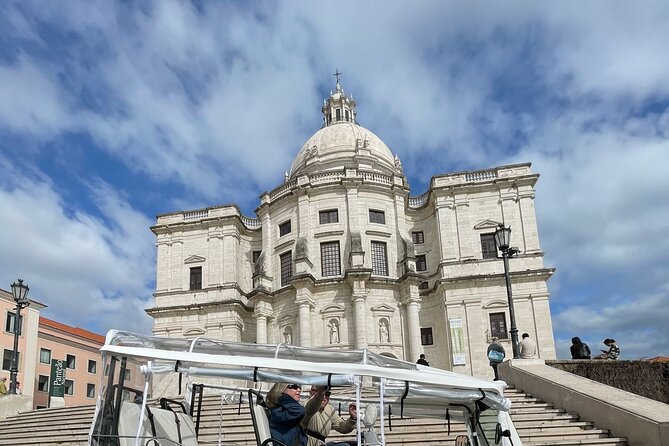
Your tour also includes the National Pantheon (Igreja de Santa Engrácia). The white dome is one of Lisbon’s most visible landmarks, and it can look almost impossible from some angles. Construction started in the 17th century and finished much later in the 20th, which explains why people joke that it’s “something that never ends.”
Inside the pantheon, you’ll find marble decoration and the chance to appreciate views from higher up. It’s also a resting place for famous Portuguese figures, including Amália Rodrigues, Humberto Delgado, and Eusébio. So yes, it’s architectural, but it also feels personal if you connect Lisbon to Portuguese culture beyond tourism.
Feira da Ladra and Largo do Carmo: local market energy and earthquake ruins
If your schedule matches it, you’ll reach Feira da Ladra, Lisbon’s flea market in Alfama. It runs on Tuesdays and Saturdays. Here you can browse antiques, books, vintage clothing, handicrafts, and odd little objects that you can’t buy anywhere else.
Even if you’re not shopping, the point is the atmosphere: vendors and shoppers in a historic setting, where the market has been part of Lisbon for a long time. It’s one of those places where you feel the city living, not just posing.
Another important stop is Largo do Carmo, known for the ruins of Carmo Church destroyed by the 1755 earthquake. The open-air archaeological feeling is unique: it’s an outdoor reminder that Lisbon rebuilds, and it remembers. You can also see nearby access like the Santa Justa Elevator, which links Baixa to Bairro Alto if you want to extend your day after the tour.
São Roque Church in Chiado: ornate interior, simple exterior, strong art
In Chiado, you’ll visit São Roque Church, one of Lisbon’s important churches. The outside is more restrained, but the interior is where the drama happens: azulejos, gilded woodwork, and valuable paintings.
One highlight is the Chapel of St. John the Baptist, known for its cost and the fact that it was brought in pieces from Rome. Even if you’re not an art specialist, you’ll see why people talk about it—because the church turns into a full-on gallery once you’re inside.
It’s also historically resilient. The church withstood earthquakes including 1755. That helps explain why the building feels like more than a scenic stop; it’s an old survivor.
São Pedro de Alcântara viewpoint and Bairro Alto: a garden with a view
Next, you get to relax at São Pedro de Alcântara Viewpoint, in Bairro Alto near the top of the Glória Funicular. This is a garden viewpoint with fountains, benches, and tile panels that point out major landmarks in the view.
From here, you can spot São Jorge Castle, the Cathedral (Sé), the Tagus River, and the color of Baixa Pombalina roofs. At sunset it’s especially lively, and there are kiosks, bars, and cafés nearby if you want a drink with a view.
This stop is a good “reset” for your brain. You’ve done cathedrals and monuments; now you get calm space and open sightlines.
Príncipe Real, Eduardo VII Park, and Avenida da Liberdade: shifting gears into Lisbon’s modern pulse
From Bairro Alto you move toward Príncipe Real, a quieter square known for gardens, old trees, and a tropical greenhouse. It’s the kind of break that makes you slow down and watch people for a moment. There are cafés and nearby shops, and on weekends there can be organic and handicraft markets nearby.
Then you head to Eduardo VII Park, the largest public park in central Lisbon. It opened in 1903 and gives you a green pause with wide paths and tropical plant greenhouses. The park also links back to Lisbon’s rebuilding story with the statue of the Marquis of Pombal.
After that, you’ll pass Marquês de Pombal Square, a major hub where the Marquis of Pombal statue anchors the space. It’s the start of Avenida da Liberdade, Lisbon’s elegant, tree-lined boulevard built in the 19th century. If you like “walkable grandeur,” this is a great section to notice iron lamp posts, stately architecture, and the big-city feel.
Finishing at Praça dos Restauradores: a strong landing point
Your tour ends at Praça dos Restauradores, at the end of Avenida da Liberdade. This square has an obelisk inaugurated in 1886 to commemorate Portugal’s independence restoration in 1640 after 60 years under Spanish rule.
The area mixes historic façades with 20th-century Lisbon touches. It also connects you back toward Baixa and Bairro Alto, with easy access to the Glória Funicular, which lines up nicely if you want to keep exploring the viewpoints after your tuk tuk ride.
Ending here is smart. You’re not dumped on the outskirts. You’re put back in the city’s practical center.
Price and time: is $42.38 worth it for the way you travel?
At about $42.38 per person, this isn’t a “grab and go” deal. But the value comes from the combination: private group, live local commentary in English, an electric vehicle, and a route that hits viewpoints, major churches, and classic squares without requiring you to power up Lisbon’s hills all day.
Duration ranges from 1 to 5 hours, which is key. If you’re only in Lisbon for a short time, a shorter option is enough to get the geographic overview—Baixa layout, Alfama feel, and the view points. If you have the time, longer pacing lets you spend more minutes at stops like São Vicente de Fora and the Pantheon instead of treating them like checkboxes.
Also watch the “private tour” math. If you’re traveling as a small group, the per-person cost often feels more reasonable than a big-group bus experience, especially with pickup included from central hotels.
Who this tour suits best (and who should think twice)
This is a great pick if you want a guided highlights tour that still feels personal. You’ll like it if you care about architecture, Lisbon’s earthquake history, and viewpoints that explain how neighborhoods stack on the hills.
It’s less ideal if you want a fully flexible stop-by-stop itinerary where you wander independently for long periods. The tour is built around a set sequence of sights, so you’ll be following the guide’s pacing.
One more practical detail: it’s not permitted for children under 7. If you’re traveling with younger kids, you’ll need a different option.
Should you book the Lisbon electric tuk tuk highlights?
I think you should book if you want to see a lot of Lisbon without spending your whole day climbing. The strongest reason is the route logic: you learn the rebuilt Baixa plan, then move into older Lisbon layers in Alfama and the churches, with miradouros timed for those big “wow” moments.
If you’re the type who likes photos but also wants real context, this tour does that. You get the view, then you get the why behind it. And with a guide like Joao providing the narration, the stops connect instead of feeling random.
FAQ
How much does the electric tuk tuk tour cost?
The price is listed as $42.38 per person.
How long is the tour?
The duration is approximately 1 to 5 hours, depending on the option you choose.
Is hotel pickup included?
Yes. Pickup is offered at hotels located in the city center. If you do not request pickup, you should go to the garage at Rua de Arroios, 120-A.
What language is the commentary?
The live commentary is offered in English.
What’s the meeting point and where does the tour end?
The tour starts at Rua de Arroios 120, 1150-260 Lisboa, and ends at Praça dos Restauradores, Praça dos Restauradores, 1250-001 Lisboa.
Does the tour allow children?
It is not permitted for children under 7 years old.
When does Feira da Ladra run?
Feira da Ladra takes place on Tuesdays and Saturdays.
What’s included in the price?
It includes pickup (when requested), civil liability and personal injury insurance, live commentary by a local guide, and a private tour in an electric vehicle. Tips are not included.