REVIEW · LISBON
Expert Plus Lisbon Tour with Local Guide in Private Eco Tuk Tuk
Book on Viator →Operated by Eco Tuk Tuk - Portugal · Bookable on Viator
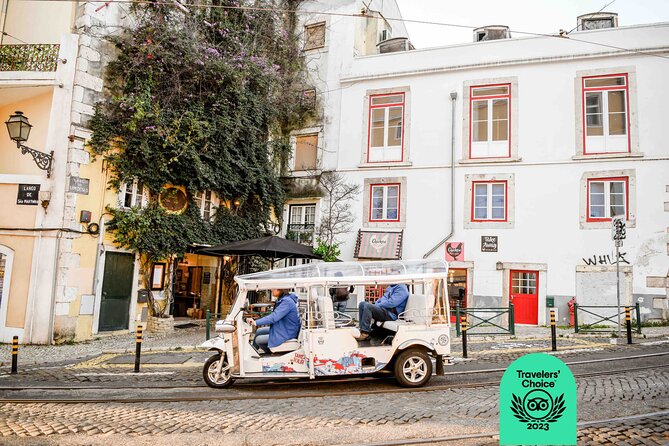
Lisbon glides on an electric tuk tuk. This is a private eco-friendly ride that still lets you hit the big sights fast, with Tagus River views baked into the route. It is designed for people who want the highlights without turning every hour into a hill workout.
I love two things most. First, the Pastéis de Belém skip-the-line stop, so you spend your time eating custard tart, not waiting. Second, the experience feels genuinely personal because it is for your group only, in a vehicle that is built for getting around tight Lisbon streets.
One thing to plan around: your route and photo stops are preset for each time option. You can’t swap them on the fly, and some major interiors (like Jerónimos) may mean extra time and ticket decisions once you arrive.
In This Review
- Key things that make this tour worth your time
- Private Eco Tuk Tuk Lisbon: why this works in real life
- Getting oriented from the Tagus River to the 25th April Bridge
- Pastéis de Belém: the shortest line to the tastiest start
- Jerónimos Monastery: Manueline architecture without the long detour
- Belém Tower area and the Monument to the Discoveries
- MAAT photo stop: modern architecture on the Tagus
- Cais do Sodré: markets, promenade, and the fado-friendly zone
- Chiado and Bairro Alto: cultural center, then a hillside night vibe
- Baixa after the earthquake rebuild: Lisbon’s grid and grand squares
- Sé de Lisboa and the viewpoints: Portas do Sol to Senhora do Monte
- Graça and São Vicente de Fora: traditional streets and a monastery on high ground
- National Pantheon and Chafariz de El-Rei: small stops with real purpose
- Praça do Comércio: the biggest riverside square moment
- Price and value: why $17.24 can work (if it matches your travel style)
- Who should book this eco tuk tuk tour
- Should you book this private eco tuk tuk tour?
- FAQ
- How long is the Lisbon private eco tuk tuk tour?
- Is this tour private or shared?
- What language is the tour offered in?
- Are tickets included for Jerónimos Monastery and Belém Tower?
- Do you skip the line at Pastéis de Belém?
- Where does the tour start and end?
- Do you offer pickup at the cruise port?
- Is the tuk tuk electric, and do you have covers for weather?
- What are the age and weight rules, and can you bring pets?
- Can I cancel for free?
Key things that make this tour worth your time
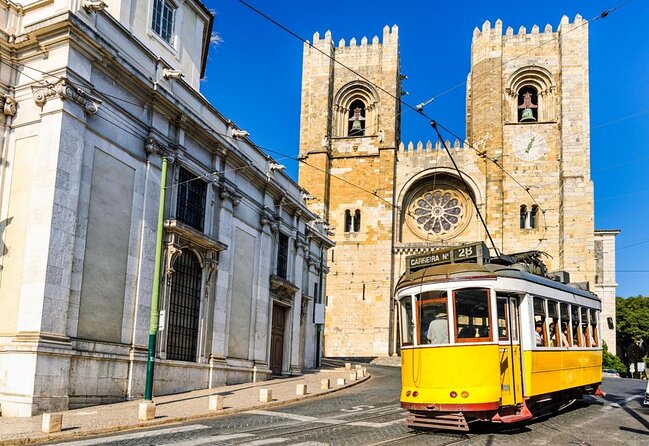
- Electric, 100% sustainable tuk tuk ride that’s built for Lisbon’s hills and narrow lanes
- Skip-the-line at Pastéis de Belém, with an easy stop built right in
- Belém UNESCO core: Jerónimos Monastery, Belém Tower area, and the Discoveries monument
- Plan-your-day stops across Chiado, Baixa, Alfama, and multiple miradouros (viewpoints)
- Warm-weather help: blankets and protective covers for rain and wind
- Private timing with preset photo moments, so you move efficiently without racing
Private Eco Tuk Tuk Lisbon: why this works in real life
Lisbon is gorgeous, but it can be slow going. You’re dealing with hills, tight streets, and the kind of traffic that makes even short routes feel long. This private tuk tuk approach is a smart way to get your bearings fast while keeping your legs mostly on vacation.
The vehicle is 100% electric, which also fits Lisbon’s push toward lower-emission transport. It’s not just a feel-good detail. When you’re bouncing over cobblestones and climbing and descending all day, a smoother, quieter ride can make the difference between a fun afternoon and one you survive.
I also like that your guide is part driver, part explainer. In the guide names I’ve seen shared, people often call out clear English and a friendly style. You might get guides like Lionel, Vitor, Dimiz, or Sylvia, and the pattern is consistent: they connect what you’re seeing to why it matters in Lisbon’s story.
You can also read our reviews of more tours and experiences in Lisbon.



Getting oriented from the Tagus River to the 25th April Bridge
Most Lisbon highlight tours start with a photo. This one starts with a mood: a ride along the Tagus River and a view of the 25th April Bridge. It is a suspension bridge inaugurated in 1966, and it often gets compared to San Francisco’s Golden Gate Bridge because of the similar color and shape.
This stop matters because it anchors everything else. From the waterline, Lisbon’s geography becomes obvious: hills, harbors, and the historic importance of ships. If you like to understand a city, that opening helps your brain connect neighborhoods later.
It also sets you up for better street-level photos. You’ll be able to look at the skyline and say, yes, I know where I am and which side of the river I’m looking at.
Pastéis de Belém: the shortest line to the tastiest start
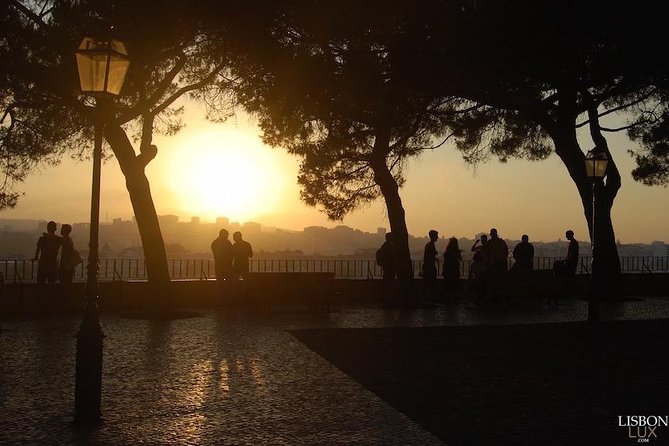
Then comes the stop people remember: Pastéis de Belém. This is the original custard tart linked to the Hieronymites Monastery area, and the pastry shop has been cooking them since 1837. The big win here is that you skip the long line.
The tour time is short on purpose (about 10 minutes), but that’s enough. You’re not on a food tour with long wandering. You’re on a Lisbon overview tour that gives you the one iconic bite you should not skip.
A practical tip: go in hungry. The tart is the point, but the stop also helps you judge what pace feels right for the rest of the day. If you’re fast at snacking and photos, you’ll likely enjoy the rest of the route more.
Jerónimos Monastery: Manueline architecture without the long detour
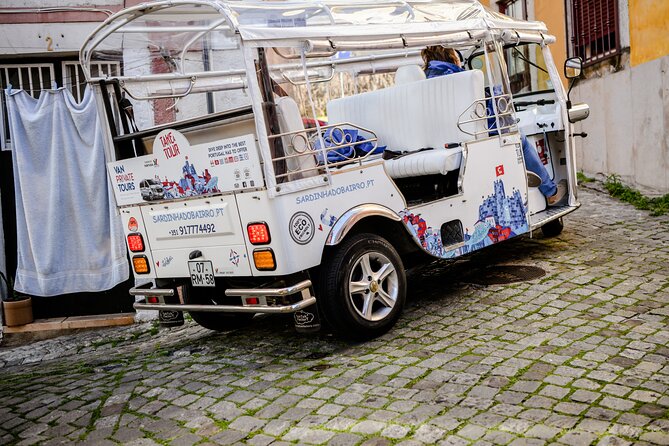
Next up is Mosteiro dos Jeronimos (Jerónimos Monastery). This is the 16th-century church and monastery complex, built in the Manueline style. Construction began in 1501 and took about 100 years to complete, and it was classified as a UNESCO World Heritage Site in 1983.
Expect about 15 minutes at the site. Admission is not included, so you’ll want to decide on the spot whether you want to pay for interior access. Even when the stop is brief, the exterior is worth it. Manueline details can be mind-bending once you start noticing carved stonework patterns.
Here’s the drawback to keep in mind: the line situation can be a real factor at Jerónimos. On days when crowds are high, your time inside may be limited. If you’re the type who mainly wants the big photo and the feeling of the place, you may still come away happy. If you want deep interior time, plan to treat this tour as orientation and then add a second visit later.
Belém Tower area and the Monument to the Discoveries
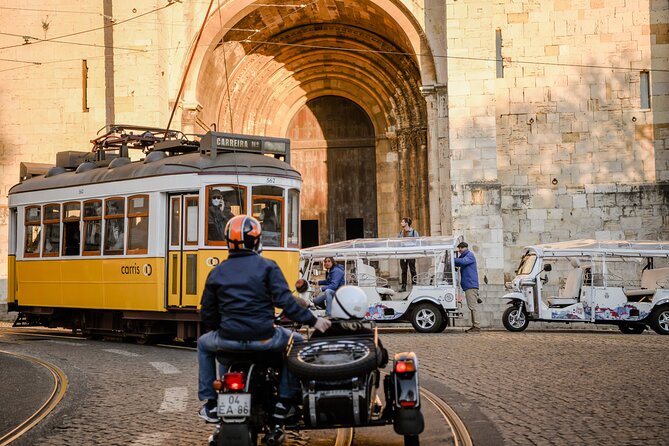
Belém Tower Garden is another UNESCO World Heritage stop. The tower itself is a 16th-century fortification that served as both a fortress and a ceremonial gateway to Lisbon during the era of overseas expansion. You’ll get a short window (around 15 minutes) to take it in.
After that, the tour heads to the Monument to the Discoveries. This one is along the river where ships departed toward India and the Orient. The monument was built between November 1958 and January 1960, celebrating the fifth centennial anniversary of Infante Henry the Navigator’s death.
These two stops are a good pair. Tower = defensive and symbolic coastal presence. Monument = the bigger story of departures, trade, and navigation. If you’re visiting Lisbon for the first time, it’s hard to beat this combo for hitting Portugal’s “Age of Discovery” theme in a single afternoon.






MAAT photo stop: modern architecture on the Tagus
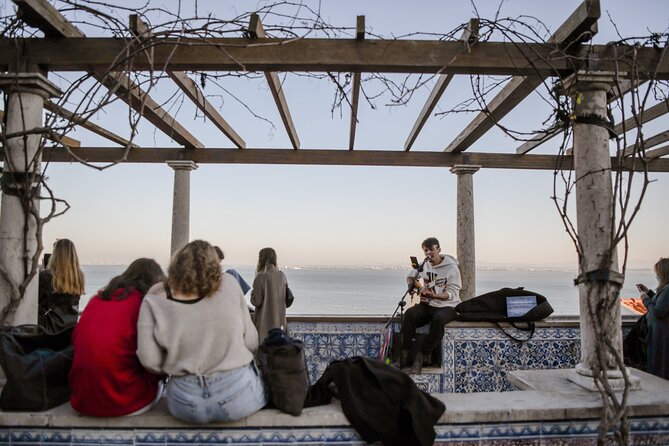
After the classic Belém landmarks, you’ll see a more modern slice of Lisbon at the Museum of Art, Architecture and Technology (MAAT) area. The description you’ll hear points out the museum’s striking, wave-like front building along the Tagus. It opened in 2016, and the thermoelectric power station nearby is part of the setting.
In most cases, this is likely a quick visual stop rather than a full museum visit. That’s fine. The value here is contrast: you go from Manueline stone and maritime monuments to contemporary design, all without losing momentum.
If you’re the type who likes to plan a return, note what you’d want to see deeper later. This tour gives you the “I should come back” list.
Cais do Sodré: markets, promenade, and the fado-friendly zone

From Belém, the tour swings into Cais do Sodré, a riverside district known for nightlife and restaurants. This is where Lisbon feels less like a postcard and more like a working city with evening energy.
You’ll get a stop near Ribeira Market, a 19th-century market with a food-court hub and eclectic stalls. The tour also mentions Pink Street, a lively area for bars and restaurants where you can listen to fado.
And don’t miss the Ribeira das Naus promenade, because it’s one of those stretches that makes you slow down. Even if your tuk tuk keeps you moving, the river walk vibe helps you reset before the central neighborhoods.
If you want a practical game plan: use this time to decide whether you want to eat your next meal around here. The tour’s quick taste can point you toward where you’d actually linger later.
Chiado and Bairro Alto: cultural center, then a hillside night vibe
Next comes Chiado, a historic and fashionable central neighborhood between Baixa and Bairro Alto. It’s known for squares, traditional cafés, art galleries, theaters, and shopping. Specific landmarks mentioned include Café A Brasileira, Livraria Bertrand (described as the world’s oldest operating bookstore), and the São Carlos Theater.
Then you’ll pass through Bairro Alto for about 10 minutes. Bairro Alto is famous for its nightlife and a maze of narrow, cobblestone streets. It’s also tied to fado venues and late-night cafés.
Short stops here are the right choice because both areas are best served by walking once you’re done with the tour’s transport portion. If you only have one day, this tuk tuk route gives you the quick “this is my vibe” filter. If you have more time, it helps you pick where to return for the best atmosphere.
Baixa after the earthquake rebuild: Lisbon’s grid and grand squares
Then you hit Baixa, Lisbon’s downtown commercial and architectural center. This district has neoclassical buildings and a grid-like street layout that was rebuilt after the 1755 earthquake, led by the Marquis of Pombal. It’s the practical heart of Lisbon, and it makes a lot of sense after the more maze-like neighborhoods.
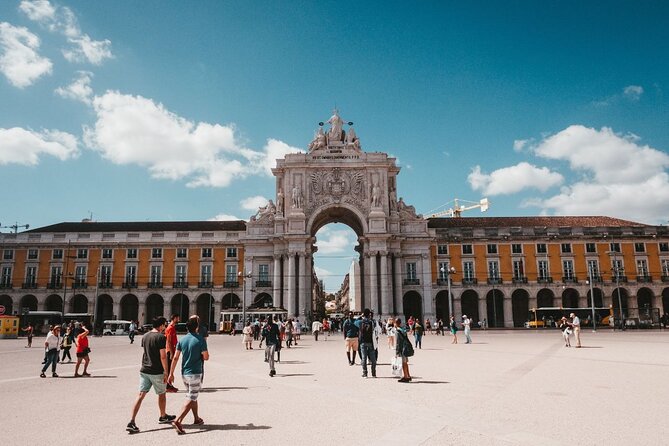
You’ll also see key landmarks connected to Baixa, including Praça do Comércio (the grand riverside square) and Rossio Square. The Arco da Rua Augusta and the Santa Justa Lift are also part of the area’s big visual identity.
If you like understanding city design, this part helps. Lisbon isn’t just “pretty hills.” Baixa shows how the city tried to rebuild and rationalize itself after catastrophe. The result is still visible in the street plan today.
Sé de Lisboa and the viewpoints: Portas do Sol to Senhora do Monte
Two of the most useful “orientation” moments are the church stop and the viewpoint stops.
First is Sé de Lisboa (Basilica of Saint Mary Major of Lisbon). The construction began in 1148, described as one year after Afonso Enriques conquered the city, and it’s considered the oldest church in Lisbon. Even with limited time, it’s a solid marker of Lisbon’s older layers.
Next comes Largo das Portas do Sol in Alfama, a square known for iconic panoramic views that include the Tagus River, Baixa’s Pombaline area, and the Castelo de São Jorge in the background.
After that, you’ll get Miradouro da Senhora do Monte, a major viewpoint in the Graça neighborhood. It’s known for sweeping panoramas of Lisbon and the Tagus River, and it’s a strong payoff stop for short timing. Viewpoints are where your brain finally “clicks” into place after all the neighborhoods.
Graça and São Vicente de Fora: traditional streets and a monastery on high ground
Graça is described as traditional, with narrow cobbled streets, a local-community feel, and panoramic miradouros. Landmarks mentioned include Graça Church and the National Pantheon area.
The tour also brings you to the Monastery of São Vicente de Fora. It’s located on high ground where Graça and Alfama meet, and it’s called “de fora” because it was outside the city walls, and the parish wasn’t under the Lisbon bishop’s jurisdiction at the time.
The value here is how you see Lisbon’s layers stacked. You get modern viewpoints and central squares, then you shift into a neighborhood that feels more lived-in. Even if your time is limited, it’s a clear change of pace.
National Pantheon and Chafariz de El-Rei: small stops with real purpose
Another standout within the tour’s shorter-format approach is the National Pantheon of Portugal, located in the Church of Santa Engrácia. The current building stands on a site where a church was already erected in 1568 by order of Infanta Maria, daughter of King Manuel I.
Then there’s Chafariz de El-Rei, described as the first public ornamental fountain in Lisbon, built in the 13th century during the reigns of Afonso III and Denis I. The fountain took advantage of excellent groundwater in Alfama.
These might be quick photo or sight stops rather than “spend time” moments. But they’re the kind of details that make your tour feel more like the real city, not just a list of famous names.
Praça do Comércio: the biggest riverside square moment
Near the end, you’ll reach Praça do Comércio, still commonly called Terreiro do Paço. This is the enormous riverside square next to the Tagus where Portugal’s kings had a palace site for about two centuries. Today, it’s partly government departments, and it’s one of the largest squares in Europe, described as about 36,000 m² and bordered by 79 arches.
This is a strong finish for two reasons. First, the open space gives your eyes a breather after lots of narrow streets and viewpoints. Second, it’s right by the river, so it echoes that opening ride theme and closes the loop nicely.
Price and value: why $17.24 can work (if it matches your travel style)
The price is listed as $17.24 per person, and the real question is what you’re buying with that number. You’re not just buying transport. You’re buying:
- a local driver/guide experience
- a private vehicle for your group only
- a tour that begins without queues or waiting times
- pre-selected photo stops
- blankets and protective covers for weather
- and a specific skip-the-line advantage at Pastéis de Belém
At the same time, it’s also fair to plan for the parts that cost extra. Jérónimos Monastery and the Belém Tower area have admission tickets not included. So you should treat this as a guided highlights tour, not an all-inclusive ticket bundle.
Where this becomes great value is when you’re short on time and want orientation, not a checklist grind. If you have limited stamina, the tuk tuk does real work for you on Lisbon’s hills and tight street sections.
Who should book this eco tuk tuk tour
I think this tour fits best if you:
- have limited time and want the major Lisbon sights connected into one route
- prefer minimal walking and hate the idea of backtracking up steep streets
- want a guide who explains what you’re seeing in English
- like the idea of using the tour to choose where to return later
It’s less ideal if you:
- want a museum-heavy day with long interior stays
- expect to change the route or photo stops mid-tour
- need hotel pickup, since pickup and drop-off at your hotel isn’t included
Also note the format is set for groups: a legal maximum of 4 passengers per tuk tuk. If you’re more than that, multiple tuk tuks get booked for your group.
Should you book this private eco tuk tuk tour?
Book it if you want a fast, guided Lisbon overview that reduces walking and adds context while keeping you moving. The combination of Belém UNESCO sites, classic custard-tart payoff at Pastéis de Belém, and viewpoint stops is a strong mix for first-timers and cruise-day visitors.
Don’t book it if you’re planning to spend most of your day inside major monuments and you hate fixed stops. In that case, you’ll likely be happier piecing together a more self-directed schedule with flexible ticket time.
If you’re on the fence, here’s the decision rule I’d use: if you’re trying to see Lisbon in a day and you want a guide plus efficient transport, this is a solid choice.
FAQ
How long is the Lisbon private eco tuk tuk tour?
You can choose from tour lengths ranging from 1 to 4 hours. The route uses preset photo and sight stops that depend on which duration you select.
Is this tour private or shared?
This is a private tour/activity. Only your group participates.
What language is the tour offered in?
The tour is offered in English.
Are tickets included for Jerónimos Monastery and Belém Tower?
No. Jerónimos Monastery and Belém Tower Garden have admission tickets listed as not included.
Do you skip the line at Pastéis de Belém?
Yes. The Pastéis de Belém stop includes skipping the long line.
Where does the tour start and end?
It starts at Tv. do Carvalho 25, 1200-058 Lisboa, Portugal, and it ends back at the meeting point.
Do you offer pickup at the cruise port?
For the 3- and 4-hour options, pickup is offered at the Lisbon Cruise Port (Jardim do Tabaco Quay). You’ll be asked to choose a pickup point (Time Out Market or the cruise port) the day before.
Is the tuk tuk electric, and do you have covers for weather?
Yes. The tour uses a 100% electric and sustainable vehicle. Blankets and protective covers are included to help you stay warm in rain or wind.
What are the age and weight rules, and can you bring pets?
The minimum age is two years (no babies allowed), and there is a minimum mandatory weight of 9 kg. Pets or animals are not allowed.
Can I cancel for free?
Yes. Free cancellation is available if you cancel at least 24 hours before the experience starts for a full refund.