REVIEW · LISBON
Essential Tour of Old Lisbon in 2H00 : Private Tuk-Tuk Tour
Book on GetYourGuide →Operated by TukGuide Portugal · Bookable on GetYourGuide
Lisbon looks different when you’re moving. A private electric tuk-tuk tour turns Old Lisbon into a rolling photo walk, with a live guide steering you through the hills and narrow lanes. You’ll also get a practical intro to the neighborhoods people always mention, but with stops timed for views instead of wandering.
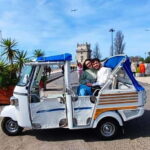
What I like most is the private, flexible pace and the way the guide can shape the route to your interests. I also love the electric tuk-tuk setup: quieter than gas vehicles and built for Lisbon’s tight streets, with transparent, waterproof covers when weather turns.
One consideration: a 2-hour loop packs in a lot of stops, and slow traffic can eat into viewing time. Also, if you’re expecting a food or ginjinha tasting, note that food and drinks aren’t listed as included, even if the tour description hints at opportunities.
In This Review
- Key things to know before you go
- Why an electric tuk-tuk makes Old Lisbon make sense fast
- Pickup, timing, and the 2-hour feeling of a private loop
- Starting with Baixa, Rua Augusta Arch, and Lisbon Cathedral
- Miradouros that do the heavy lifting: Portas do Sol, Santa Luzia, Senhora do Monte
- Convento da Graça and the Graça Historic District: street life and hill views
- Alfama: Fado streets, narrow alleys, and the feel of Old Lisbon
- São Vicente de Fora, Santa Clara, and National Pantheon of Santa Engrácia
- Fado Museum and the meaning behind the music
- Chiado, Largo do Carmo, Praça Luís de Camões, and Elevador da Bica
- Principe Real, Estrela Basilica, and viewpoints that keep the city flowing
- Assembleia da República, plus the ride-back rhythm to finish strong
- Price and value: what $85 buys in a private 2-hour format
- Who this private tuk-tuk tour suits best
- Should you book this private tuk-tuk tour of Old Lisbon?
- FAQ
- FAQ
- How long is the Old Lisbon private tuk-tuk tour?
- Is the tour private?
- What areas of Lisbon will we pass through?
- Do we stop at viewpoints for photos?
- What languages are available for the live guide?
- Where does pickup and drop-off happen?
- Is food, drinks, or monument entry included?
- Is the tuk-tuk wheelchair accessible?
Key things to know before you go
- Private group: your tuk-tuk experience is just for your party.
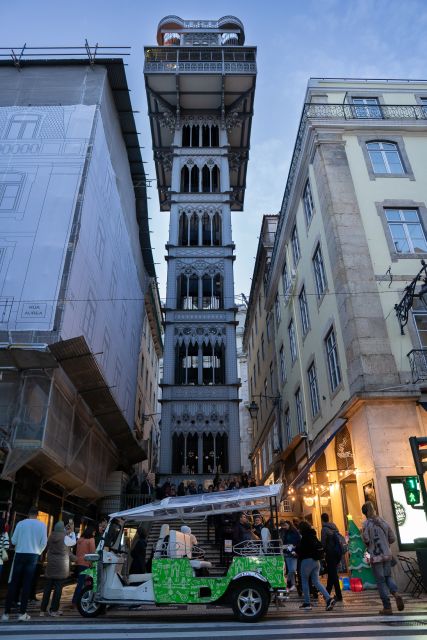
- Electric + covered ride: easier on hills and comfortable in light rain, thanks to transparent waterproof covers.
- Viewpoint strategy: photo stops at miradouros like Portas do Sol and Senhora do Monte.
- Live narration in multiple languages: English, French, Italian, German, Portuguese, Spanish.
- Comfort extras: loudspeaker so you don’t miss the commentary, and blankets for colder days.
- Food isn’t guaranteed: monument entry and food/drinks are not included.
Why an electric tuk-tuk makes Old Lisbon make sense fast
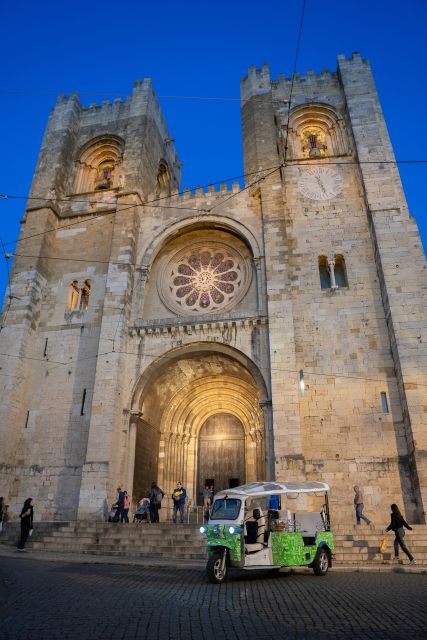
Old Lisbon can feel like two things at once: charming and confusing. You’ll see tiled façades and sweeping views on one block, then hit stairs, dead ends, and steep grades the next. An electric tuk-tuk helps you skip the “how do I get there?” problem and focus on what’s actually worth seeing.
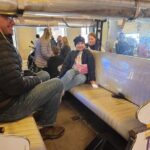
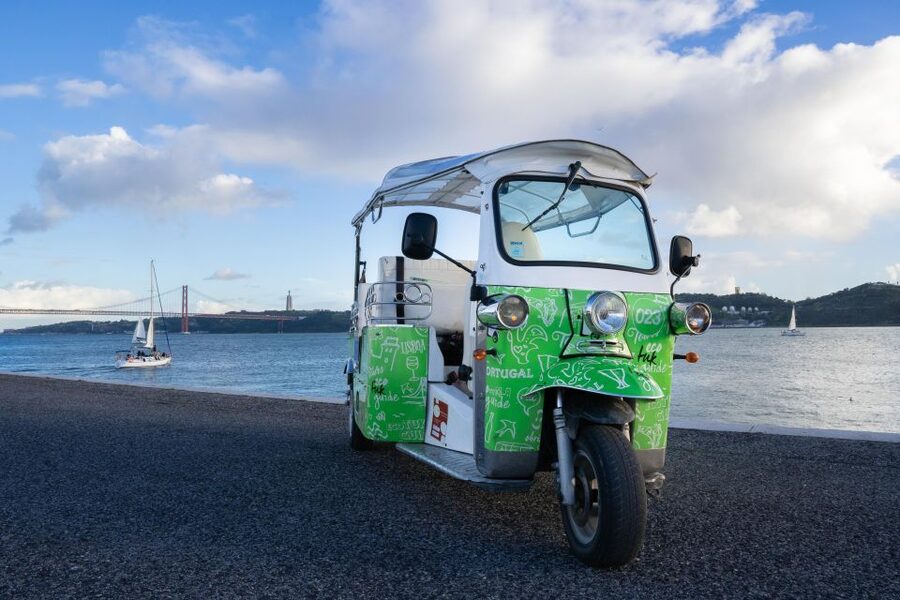
The ride is built for real street conditions. You’ll travel narrow lanes that cars struggle with, and the electric motor keeps things quieter. If you’re visiting in cool or rainy weather, the transparent, waterproof covers are a big deal—meaning you can still look out and photograph without getting soaked.
There’s also a smart bit of design for the guide experience: a loudspeaker helps you hear the commentary clearly while you’re rolling along. On a short tour, that matters, because you don’t want to spend the best moments scanning the road for things you missed.
You can also read our reviews of more tours and experiences in Lisbon.



Pickup, timing, and the 2-hour feeling of a private loop

This is a 2-hour private tour, with pickup included from hotels or Airbnb-style stays in the historic city center. If you’re arriving by cruise ship, pickup and drop-off also work from the cruise ports—so you’re not trying to figure out transit on limited time.
The tour uses two pickup time slots (listed as 1200-225 and 1300). Your confirmation will tell you exactly where and when you meet, but the key point is: your schedule is built around a tight, half-day-friendly window.
Because it’s private, you don’t just sit and wait while a group funnels through. You can ask questions, and the guide can adjust the flow depending on what you care about most—architecture, everyday Lisbon, or viewpoint photos.
Also, a quick reality check: the route includes lots of “stop and look” moments. That’s great for first-timers, but if traffic slows down, you’ll feel it. One guide-driven experience note from recent bookings was that time in traffic can reduce how much time you get at certain points.
Starting with Baixa, Rua Augusta Arch, and Lisbon Cathedral

Your tour begins in the lower, classic area of Lisbon—Baixa de Lisboa—the part of town designed around grand streets and the big-city feel. This is helpful because it gives you orientation fast: you get the “map in your head” before you start climbing into the older neighborhoods.
From there, you’ll pass the Rua Augusta Arch, a landmark that acts like a transition marker. Even if you’ve seen photos, it’s different in person—because you can feel the scale and understand why it became such a symbol of Lisbon’s central axis.
Next comes Lisbon Cathedral, a stop that’s both visual and historical in one place. The cathedral area works well early in the tour because it sets a tone: Lisbon isn’t just scenic—it’s layered, and the city keeps older roots close to major paths.
Even with guided time, keep your expectations realistic. In a 2-hour private loop, you’re not “covering every corner.” You’re building momentum and learning what’s worth a longer visit later.
Miradouros that do the heavy lifting: Portas do Sol, Santa Luzia, Senhora do Monte
Let’s be honest: Lisbon’s best angles often come from standing still on a viewpoint and letting the city spill out below. This tuk-tuk tour plans its photo moments around that reality.
You’ll have a short stop at the Portas do Sol Terrace, plus photo time at Miradouro de Santa Luzia. Both are classic for a reason: the mix of rooftops, the slope of the city, and the sense of direction toward the river makes your photos look like postcards even when the lighting isn’t perfect.
Then comes Miradouro da Senhora do Monte, with the longest viewpoint photo time listed here (about 10 minutes). If you only remember one stop, make it this kind of place—because it gives you the broadest “Lisbon in one glance” effect.
One small tip: bring your camera settings ready before you reach each miradouro. If traffic or timing shifts, you’ll still capture what matters without fiddling while everyone is waiting.
Convento da Graça and the Graça Historic District: street life and hill views
After the central orientation, the tour starts moving into the older soul of the city. Convento da Graça is a meaningful stop because it sits in a neighborhood that feels distinctly local—less polished than the central streets, more grounded in daily life.
From there, you’ll spend guided time in the Graça Historic District. This area is known for street art and a lived-in feel, and it works well in a tuk-tuk format because it lets you move without losing your place.
Graça also connects you to the viewpoint logic: you’re not just collecting buildings, you’re seeing how the neighborhoods relate to the slopes and sightlines. That’s the kind of understanding you’ll carry into your next days of exploring.






Alfama: Fado streets, narrow alleys, and the feel of Old Lisbon
Alfama is the neighborhood most people hope to experience, and this tour includes guided time there. It’s where the city’s old-world maze is at its strongest, and it’s strongly associated with Fado music—the birthplace reference shows up in the tour’s own framing, and it helps explain why the area feels so culturally charged.
Alfama in a tuk-tuk is a smart compromise. Walking can be magical, but it also means stairs, tight lanes, and time loss when you need to backtrack. On this tour, you get the look and the context, then you can decide what to revisit on foot later.
The guide’s role matters here. If you land with Adriana or Beatriz as your guide (names that show up in recent bookings), you’ll likely get a warm, high-information ride. One French-language booking specifically praised Adriana for strategic stops and a very smooth guide style, and German/English groups also noted that Beatriz and Adriana shared Lisbon stories clearly.
São Vicente de Fora, Santa Clara, and National Pantheon of Santa Engrácia
This part of the loop adds religious and cultural texture without turning into a ticket crawl.
You’ll visit Monastery of São Vicente de Fora, then have a Campo de Santa Clara photo stop. These stops give you a break from purely street-level sightseeing and show another side of Lisbon: the city’s long connection to major institutions and historical architecture.
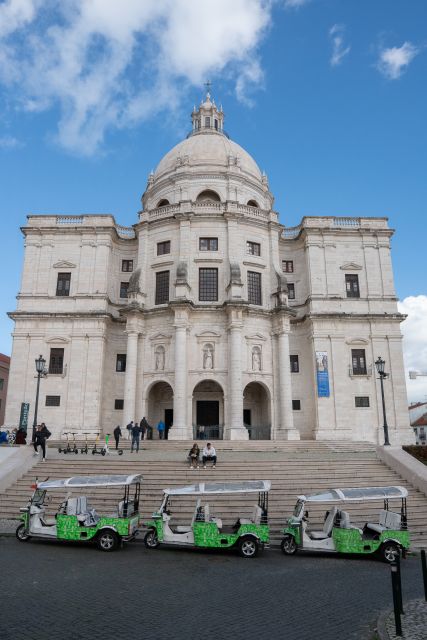
Next up is the National Pantheon of Santa Engrácia. It’s a fitting stop in a tour like this because it bridges the “old neighborhood” feeling with a landmark you can recognize later when you’re planning your independent day.
You won’t be overwhelmed with entry-ticket expectations. Monument entry tickets are not included, so if you want to go inside anywhere, budget extra time and consider tickets separately.
Fado Museum and the meaning behind the music
A short Fado Museum stop is included, and even if you don’t go deep inside (since time is limited), it’s still valuable. You’ll hear the cultural context for why Alfama and Fado sit together in Lisbon’s identity.
In a 2-hour tour, museum time works best as a “set the story straight” moment. You leave knowing what to listen for later—what makes Fado distinct, and why the neighborhood mood fits the music.
Chiado, Largo do Carmo, Praça Luís de Camões, and Elevador da Bica
The tour doesn’t only stay in the oldest streets. You’ll also move into areas tied to Lisbon’s more everyday, bohemian street culture.
Stops include Largo do Carmo Square and Praça Luís de Camões, plus Elevador da Bica. Even if you’ve seen these names on maps, it’s different to experience them during a guided ride because you connect landmarks to the neighborhoods around them.
Chiado is specifically named in the tour’s description as a bohemian hub with cafés, boutiques, and theaters. In practice, you’ll get a taste of that atmosphere rather than a full on-the-ground exploration. The payoff is that you’ll know where to return if you want to linger for longer.
Elevador stops also help you understand the city’s constant vertical movement. Lisbon isn’t flat, and these funicular-style landmarks show how locals cope with slopes without losing the street experience.
Principe Real, Estrela Basilica, and viewpoints that keep the city flowing
As the tour moves toward the upper neighborhoods, you’ll pass through Jardim do Príncipe Real, then continue to Estrela Basilica.
This part of Lisbon tends to feel calmer than the most central traffic zones, and it’s a nice counterbalance after earlier hill views. You also get a better sense of how different “versions” of Lisbon can exist within a short ride.
You’ll also have a photo stop at Miradouro de São Pedro de Alcântara. It’s the kind of viewpoint that feels like a reward for staying alert—because it gives you a straight line toward what you’ve been seeing all day: rooftops, the river area’s direction, and the city’s layered layout.
Assembleia da República, plus the ride-back rhythm to finish strong
Near the end of the loop, you’ll reach Assembleia da República. Including a civic landmark like this helps round out your first-day understanding: Lisbon isn’t only old walls and miradouros. It’s also the present-day heart of political and public life.
The best strategy here is to treat the final stretch as your “collect and connect” moment. You’ll usually be able to connect what you’ve learned about neighborhoods, topography, and history into a simple mental map—then you’re ready for independent wandering.
Then it’s drop-off at your choice of historic city center options or back at a cruise port location.
Price and value: what $85 buys in a private 2-hour format
At $85 per person for 2 hours, you’re paying for three things: time efficiency, private guidance, and transport designed for Lisbon’s shape.
Here’s how I think about the value:
- You’re not spending the tour figuring out how to get between hills.
- You’re using a guide to explain what you’re seeing, instead of guessing.
- You’re getting planned stops at major viewpoints so your photos don’t rely on random luck.
The tour’s inclusions add up: pickup and drop-off in central Lisbon or cruise ports, live commentary, a loudspeaker for clarity, blankets for colder days, and weather-protective transparent covers. Those details matter in real life because Lisbon weather can change fast, and old-town walking adds up quickly.
What you should plan for: monument entry tickets are not included, and food and drinks aren’t included. The description mentions potential opportunities for snacks like ginjinha, Pastel de Nata, or Pastel de Bacalhau, but you shouldn’t assume those costs are covered. If you care about tasting those, I’d line it up as your own add-on near the end of the tour or during your next café break.
Who this private tuk-tuk tour suits best
This is a great choice if:
- You want a first-time orientation without exhausting stairs.
- You’re traveling with a small group and want flexibility rather than a big bus flow.
- You want the miradouro viewpoints with guided context, not just random scenic stops.
- You appreciate the feel of Old Lisbon neighborhoods like Alfama, Graça, and Chiado, but you want help turning it into a coherent story.
It’s also a good “reset day” option if you’ve been on the go and you still want Lisbon’s highlights without committing to a full walking day.
It may not fit if you need wheelchair access (the vehicle is not accessible for wheelchairs/walkers) or if anyone in your party is under 7 years old or pregnant, since the tour states it’s not suitable for those situations.
Should you book this private tuk-tuk tour of Old Lisbon?
If your goal is to get your bearings fast and still see the right viewpoint angles, I think this is a smart booking. The private format, electric ride comfort, loudspeaker clarity, and viewpoint plan make the 2 hours feel purposeful instead of scattered.
Book it if you:
- want a guided overview of the city’s key old-town areas like Alfama and Graça,
- care about photos from miradouros without committing to a long hike,
- value a guide who can tailor the pace to your questions.
Skip or reconsider if:
- you’re very focused on ticketed museum time (entry tickets aren’t included),
- you’re expecting a guaranteed food or ginjinha tasting (food and drinks aren’t included),
- you know you’re sensitive to traffic delays, since the short schedule can be affected when the streets slow down.
FAQ
FAQ
How long is the Old Lisbon private tuk-tuk tour?
It lasts 2 hours.
Is the tour private?
Yes. It’s a private group experience for your party.
What areas of Lisbon will we pass through?
You’ll cover parts of Old Lisbon including Alfama, Graça, and Chiado, with additional stops around central areas like Baixa and landmarks throughout the old districts.
Do we stop at viewpoints for photos?
Yes. The tour includes photo stops at several miradouros, including Portas do Sol, Miradouro de Santa Luzia, Miradouro da Senhora do Monte, and others such as Miradouro de São Pedro de Alcântara.
What languages are available for the live guide?
The live guide is offered in English, French, Italian, German, Portuguese, and Spanish.
Where does pickup and drop-off happen?
Pickup and drop-off are included from hotels or Airbnb stays in the historic city center, and from Lisbon cruise ports.
Is food, drinks, or monument entry included?
No. Monument entry tickets are not included, and food and drinks are not included.
Is the tuk-tuk wheelchair accessible?
No. The tuk-tuk is not accessible for wheelchairs or walkers, and it isn’t listed as suitable for children under 7 or pregnant women.