REVIEW · JAISALMER
Jaisalmer Tuk-Tuk Private Full Day Tour with Pick-up
Book on Viator →Operated by Mystic Camel Safari Day Tour · Bookable on Viator
Golden Jaisalmer rolls by on three wheels. This private tuk-tuk day tour is an easy way to hit the city’s signature stops without fighting traffic, plus you start with a hotel pickup at 8:30 AM.
What I like most is the way the day balances “big landmark” moments with the smaller, carved-details you’d miss on your own—especially when your driver is Musa, who brings the history alive with real local know-how.
A possible catch: entry costs are not included for several sights, so you’ll want a little extra cash saved for tickets while still keeping the overall value very reasonable.
In This Review
- Key things you’ll notice right away
- Why this tuk-tuk day feels efficient (and fun)
- 8:30 AM pickup: how the day gets set up
- Mandir Palace and the “palace power” start
- Tazia Tower: a replica with real meaning
- Nathmal Ji Ki Haveli: when the architecture is the point
- Kothari’s Patwa Haveli: carved pillars and jharokhas
- Salim Singh-ki Haveli: built in 1815, built without mortar
- Jaisalmer Fort and Surya Gate: the main wow factor
- Jain Temples: archaeology meets devotion
- Gadisar Lake for a slower pace
- Desert Culture Centre & Museum: practical, hands-on context
- Vyas Chhatri: the sunset-style fort view
- Shopping time: what to look for and how to spend it
- Optional tuk-tuk ride and the end-of-day fun factor
- Driver Musa and the difference a private guide makes
- Price and value: what $18.02 gets you
- Practical tips so your day stays smooth
- Should you book this Jaisalmer tuk-tuk tour?
- FAQ
- FAQ
- What time is pickup?
- How long is the tour?
- Is this a private tour?
- What’s included in the price?
- Are admission tickets included?
- Which stops are free to enter based on the details provided?
- What shopping can I expect during the afternoon?
- Can I cancel for a full refund?
Key things you’ll notice right away
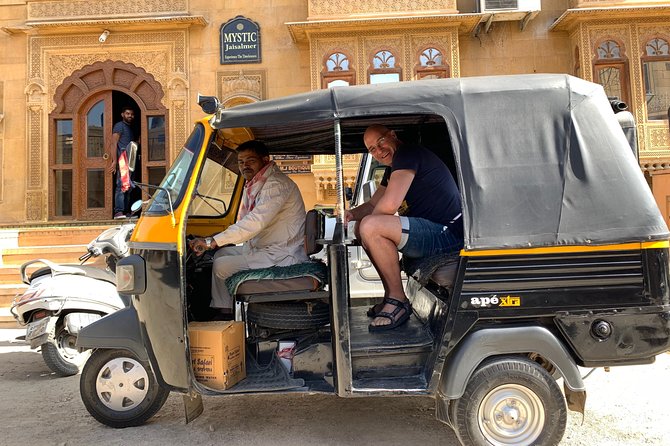
- Hotel pickup at 8:30 AM saves time and lets you start sightseeing while the day is still fresh
- A private vehicle means you can move at your pace, with fewer headaches than hopping between spots
- Haveli-heavy morning focuses on carved architecture, jharokhas, and landmark residences
- Jaisalmer Fort + Surya Gate gives you the main viewpoint and fort-entry experience in one run
- Gadisar Lake and Vyas Chhatri add a calmer pause and an eye-catching sunset outlook
- Afternoon shopping time lets you browse traditional goods like silver jewelry, textiles, mirror work, and leather items
Why this tuk-tuk day feels efficient (and fun)
Jaisalmer is spread out in a way that can be deceptively tiring. You can absolutely do it by yourself, but when your day is 5 to 8 hours and you want to see the fort, multiple havelis, and the lake area, a tuk-tuk setup is a practical shortcut.
This tour works because it’s designed around flow. You begin early with a hotel pickup, then move through a tight cluster of historic sights. The morning leans architectural—palaces, towers, and havelis—before the fort area and Jain temples. Later, you get a break with Gadisar Lake, a museum stop, and a classic viewpoint at Vyas Chhatri. Then the day hands you a block of time for shopping. If you’re the type who likes a plan but still wants breathing room, this schedule is the kind that helps you actually see things rather than just getting “close.”
And yes, a tuk-tuk is part of the appeal here. It keeps the day feeling local: you’re not staring at a windshield in the same way you would in a larger vehicle, and you naturally move slower through the old-town vibes.
8:30 AM pickup: how the day gets set up
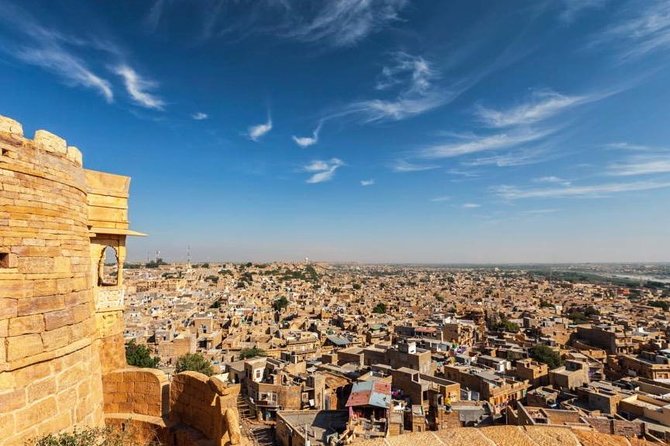
Pickup starts at 8:30 AM from your hotel with your driver. You also get a mobile ticket, which is handy when you’re coordinating multiple stops and don’t want to keep track of paper.
Since the tour is private, only your group participates. That matters more than it sounds. In a city where you’re visiting several interiors and photo stops, having one dedicated driver can reduce the awkward waits that happen when multiple groups are trying to hit the same attractions.
Included along the way is bottled water, which helps a lot in a day that mixes walking with time outdoors. Also, the tour includes private transportation, so you’re not trying to line up local rides between landmarks.
Mandir Palace and the “palace power” start

The day begins with Mandir Palace, a prominent landmark connected to the rulers of Jaisalmer. The big draw is the idea that this wasn’t just a pretty building—it was the residence of the city’s rulers for more than two centuries. Even when you’re only inside for about 30 minutes, you get context fast: Jaisalmer wasn’t built only on trade and forts; it was governed from ornate, high-status spaces.
This stop is admission ticket not included, so budget time and money accordingly. The upside is that the morning pace doesn’t feel rushed. You get a proper first anchor before moving into towers and haveli details.
Tazia Tower: a replica with real meaning
Next up is Tazia Tower, linked with the Badal Palace complex. This five-storey tower is described as a replica of a mausoleum—small detail, huge significance. It’s a reminder that architecture in Jaisalmer doesn’t just show Rajput power; it also reflects different cultural threads that have lived here over time.
It’s another short stop (around 30 minutes). Like Mandir Palace, admission isn’t included, so plan on that added cost. What makes it worth your attention is that it’s not just “another tower.” It’s tied to a specific story and sits inside a complex area, which makes it easy to connect the dots as you go.
Nathmal Ji Ki Haveli: when the architecture is the point
Then you hit Nathmal Ji Ki Haveli (about 20 minutes). This place was commissioned as the residence of Diwan Mohata Nathmal, the prime minister of Jaisalmer at the time. Construction was commissioned by Maharawal Beri Sal.
This is where the tour starts rewarding your patience. Havelis aren’t just buildings—they’re visual statements. You’re seeing how wealth, governance, and craftsmanship show up in stonework and façade design. Even if you’re not an architecture nerd, spending time in these spaces helps you understand what makes Jaisalmer’s golden look so memorable.
Kothari’s Patwa Haveli: carved pillars and jharokhas
After that comes one of the best-described craftsmanship stops: Kothari’s Patwaon-Ki-Haveli. This is highlighted as one of the finest, oldest, and largest havelis in Jaisalmer, and the emphasis is on artistic work in multiple corners—gracefully carved pillars, detailed façades, and balconies called jharokhas.
You’re there for about 30 minutes, and that’s the right amount of time. Too short and you miss the patterning. Too long and you start taking photos of repeating details. This feels like a sweet spot.
Admission isn’t included, so again, you’ll pay as needed. But if you care about the “why” behind the city’s reputation, this is the type of stop that makes the tour feel like more than just sightseeing.
Salim Singh-ki Haveli: built in 1815, built without mortar
Next is Salim Singh-ki Haveli, built in 1815 by Salim Singh, described as the prime minister of the kingdom when Jaisalmer was the capital. One detail that stands out from the description: the stones are connected without cement and mortar.
That’s the kind of fact you’ll remember later, because it changes how you look at the building. Instead of seeing “old stone,” you start noticing how construction choices were part of the design. The stop is about 30 minutes, and with your driver’s context, it becomes a more meaningful pause in the day.
Jaisalmer Fort and Surya Gate: the main wow factor
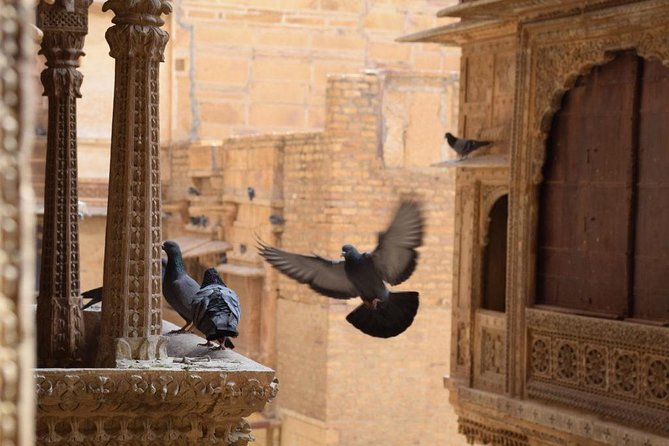
Then the tour shifts into the big one: Jaisalmer Fort. You get about 1 hour 30 minutes here. The fort is known as a living fort, with a portion of the old city’s population still residing within it. That’s important: you’re not visiting a deserted ruin. You’re stepping into a place where everyday life and history overlap.
To enter the fort area, you also pass Surya Gate, described as one of four entry gates to the fort. Surya Gate is free, and you typically spend about 10 minutes there—short and useful for getting oriented before going deeper into the fort.
Not having admission included at the fort means you should expect additional costs. But if you only do one “must-do” in Jaisalmer, it’s usually this fort space, because it gives you scale, setting, and the city’s signature architecture in one place.
Jain Temples: archaeology meets devotion
From the fort zone, you head to Jain Temples (about 30 minutes). These are described as marvelous treasures of the desert city, with both archaeological value and religious sentiment. The temples date back to the 12th and 15th century, which helps you connect the fort era to the wider historical timeline of the city.
Admission isn’t included for this stop, so plan for ticket costs. The time is short, but the temples are the kind of place where concentrated time is better than long wandering. With a private driver, you can also move out cleanly when you want to keep momentum for the lake and museum.
Gadisar Lake for a slower pace
After a strong concentration of architecture and temples, you get a breather: Gadisar Lake. This is a man-made water reservoir, once described as the only source of water in Jaisalmer, constructed by the first ruler. It’s surrounded by temples and ghats, so it’s not just a body of water—it’s a scenic structure tied to the city’s rhythm.
This stop is about 1 hour, and it’s free of admission. That makes it an easy win in the afternoon plan, especially if your morning was full of interiors and short ticketed stops. The lake also helps reset your eyes before the museum and the viewpoint.
Desert Culture Centre & Museum: practical, hands-on context
Next is the Desert Culture Centre & Museum (about 1 hour). This is one of those stops that can feel optional until you realize it helps connect the dots between the region’s past and what you’re seeing in shops.
The museum description includes local musical instruments, ancient coins and currency, traditional jewelry worn by women, and hunting gear. If you’re the type who likes to buy souvenirs with context, this is the place that helps your purchases make sense. Tickets aren’t included here, but the time feels fair for a single-day experience.
Vyas Chhatri: the sunset-style fort view
To round out the sightseeing portion, you go to Vyas Chhatri. This is described as an atmospheric assemblage of golden sandstone chhatris (cenotaphs) on an old Brahmin memorial ground, located on a rise at the northwestern edge of town. It’s a popular sunset point where you can view the fort.
This stop is about 1 hour, and no admission is included according to the data you were given. Even if you’re not arriving for the exact golden hour, it’s a good place to slow down and take in the fort’s presence from a different angle than the earlier fort entry experience.
Shopping time: what to look for and how to spend it
After you’ve handled the sightseeing anchors, you get afternoon shopping time. The description calls out a range of items, including precious stones, silver jewelry, bangles, clothes, leather work, mirror work, and textiles.
Here’s how to make this shopping block work for you:
- Decide what you want before you step in. Silver jewelry and textiles are easiest to compare when you have a goal.
- Keep an eye on craftsmanship. Places will often try to sell by style first; the Haveli morning helps you recognize real workmanship when you see it.
- Don’t rush your last 30 minutes. If you’re buying textiles or stones, you’ll want to step back and compare options.
The tour doesn’t state shopping is mandatory or included as a purchase deal—just a dedicated block of time—so treat it like browsing with a guide nearby.
Optional tuk-tuk ride and the end-of-day fun factor
There’s also an interesting add-on idea at the end of the day: if you want to learn how to ride a tuk-tuk and do a test drive, the driver can arrange it.
That’s not something you should count on without confirming, since it’s described as something that can be arranged. But if you like quirky experiences and you don’t want your day to end with photos only, it’s a nice possibility.
Driver Musa and the difference a private guide makes
One review highlight you should take seriously: Musa. The praise is specific—he’s described as brilliant, friendly, polite, and welcoming, with great knowledge of history. He also took the group to a fantastic local restaurant called Milan’s Restaurant.
That kind of personal touch matters because a full-day tour can become “checklist travel” if the driver is only moving you between stops. When the driver knows the stories and also understands where to eat locally, the day feels more like Jaisalmer than just a schedule.
Private touring also helps you ask questions mid-stop. That’s the real value in a dedicated driver: you don’t have to wait until the end for context.
Price and value: what $18.02 gets you
At $18.02 per person, the best value part is that you’re paying for private transportation for a full day. Many day tours at this price are either group tours or they quietly add costs in ways that make them feel pricier later. Here, the included items are straightforward: private ride and bottled water.
The part you should plan for is that admission tickets are not included for multiple stops, including several haveli sites and the Jain Temples and museum. Some stops are free—like Surya Gate and Gadisar Lake—so the extra fees aren’t guaranteed to be enormous, but they are still part of the math.
Bottom line: if you want a private way to see the fort area, multiple havelis, Gadisar Lake, and a museum in one day without negotiating rides between points, this price is hard to beat.
Practical tips so your day stays smooth
A few practical notes to help you get the most out of a 5 to 8 hour tour:
- Plan for extra time at ticketed sights. Several stops list admission tickets as not included.
- Bring small change or a simple payment method for entries. You’ll likely pay on-site depending on the stop.
- Wear comfortable walking shoes. Fort and temple areas can mean uneven stone and short bursts of walking.
- If you’re shopping, keep space in your day bag. Textiles and metalwork can add weight quickly.
And remember: the tour is short enough that you’ll still want to enjoy the time you have. Don’t try to turn every stop into an all-day photography session.
Should you book this Jaisalmer tuk-tuk tour?
If you want a straightforward way to see Jaisalmer’s highlights in one day, I’d say this tour fits well. It’s especially worth it when:
- you like architecture and historic details (havelis, palace-linked sites, fort area)
- you prefer a private setup with one driver instead of hopping around
- you want a mix of sightseeing plus a block for shopping
- you’d enjoy a history-focused driver like Musa
Skip it only if you strongly prefer fully included attractions and hate the idea of paying admission at multiple stops. Also, if you don’t enjoy guided context and would rather wander freely without any schedule at all, you might feel constrained.
FAQ
FAQ
What time is pickup?
Pickup starts at 8:30 am from your hotel.
How long is the tour?
The tour is listed as about 5 to 8 hours.
Is this a private tour?
Yes. It’s a private tour/activity with only your group participating.
What’s included in the price?
The tour includes private transportation and bottled water, and you receive a mobile ticket.
Are admission tickets included?
Admission tickets are not included for several stops. Some places listed are free, but many are marked as admission ticket not included.
Which stops are free to enter based on the details provided?
Surya Gate and Gadisar Lake are listed as free.
What shopping can I expect during the afternoon?
The tour includes shopping time where you can find items like precious stones, silver jewelry, bangles, clothes, leather work, mirror works, and textiles.
Can I cancel for a full refund?
Yes. Free cancellation is available up to 24 hours in advance for a full refund. If you cancel less than 24 hours before the start time, the amount paid is not refunded.